

The Best Earth, Wind & Fire Songs That Aren't September
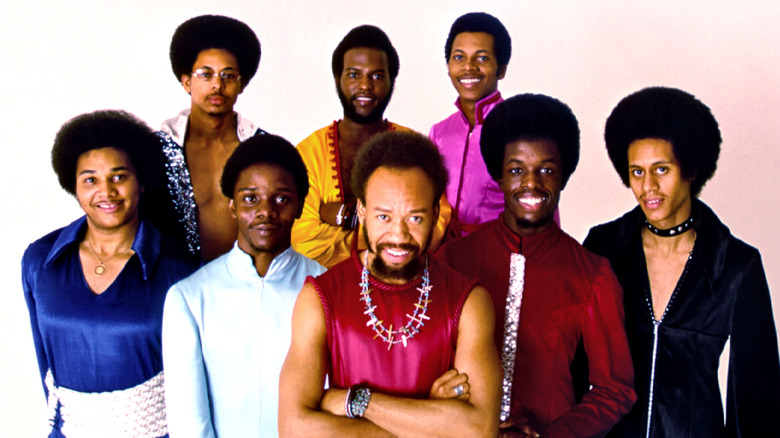
There's so much more to the Earth, Wind, & Fire catalog than just the perennial favorite, "September." While that brassy, hopeful tune captures the world's attention every autumn, this essential '70s band offers moods and modes aplenty. Everything from funky R&B and soaring gospel tones to silky soul and percolating jazz, all melded into a sound that made this incredibly talented band a singular unit. No matter which genre the flexible ensemble dipped its collective toes into, the members were always able to come up with a panoply of uplifting, sugar-sweet sounds that could feel hushed and romantic or bold and triumphant.
Considering this groovy crew was spinning out chart-making tunes from the early '70s through the mid-'90s, we had a heck of time zeroing in on five songs that show the range and reliability of Earth, Wind & Fire's considerable talents. Rather than snagging just the highest-charting hits, we went for some of the better-known songs that may have been forgotten in the lead-up to the 21st century. The seminal late-'70s ballad "After the Love Has Gone" gives us a heartbreakingly romantic soundtrack to slow dance to, while aspirational pieces like "That's the Way of the World" help us reach higher and think bigger. And of course, the ultra-funky "Let's Groove" gets us hopping and bopping on the dance floor.
After the Love Has Gone
With "After the Love Has Gone," Earth, Wind & Fire brought the danceable wavelength way down to a slow-jam tingle that set aside the starry-eyed romance in favor of a more relatable break-up ballad. It sent the band spiraling squarely into the realm of adult contemporary music and tapped into something remorseful and real in listeners. The tune went to No. 2 on the Billboard Hot 100 in September 1979, helping prove the band's maturity and ability to handle a more subdued version of its trademark formula.
A major element of this different sound was the songwriting and production team involved. Future Chicago member Bill Champlin was involved, as was guitarist Jay Graydon and soon-to-be producer extraordinaire David Foster, who was responsible for some of the biggest power ballads of the '80s. When Earth, Wind & Fire leader and vocalist Maurice White got wind of the tune while working on the band's ninth album, "I Am," it became part of the project. It was a fortuitous turn, leading to a chart blazer and a Grammy win for best R&B performance by a duo or group with vocals. Ultimately, "After the Love is Gone" added an air of cosmopolitan sophistication to the Earth, Wind & Fire sound. It's still debated by fans of yacht rock as a potentially foundational work for the genre, and the emotion it stirs is as fresh and raw as it was back in the day.
Shining Star
If anyone needs a little pick-me-up affirmation of self-actualization, "Shining Star" should be at the top of the feel-good playlist. The chorus reminds everyone who hears it, "You're a shining star / No matter who you are / Shining bright to see / What you could truly be." It's almost nursery rhyme-simple in its composition, but set to a super catchy melody with exceptional players weaving a sonic tapestry behind it, it becomes much more. The message transcends simplicity, becoming a divine confirmation and an internalized reminder that you shine. Who couldn't use that more than a few times throughout their day?
Cosmic references are part and parcel of the band's mythic presence. The group even used astrology to adapt the name Earth, Wind & Fire and incorporated galactic and mythic themes into both its music and overall aesthetic. According to Maurice White, "Shining Star" was inspired by a stroll through a Colorado forest with a star-studded display in the skies above. He and fellow singer Philip Bailey collaborated with guitarist Larry Dunn, whose funky riff gave the team a springboard that launched them to the stars, figuratively at least. The audio alchemy was magical enough to give Earth, Wind & Fire its only No. 1 song in May 1975. Even today, the uplifting messaging and energetic jazz-funk melodics land an invigorating hit to the central nervous system.
Fantasy
One of the more dramatic and ambitious works in the early Earth, Wind & Fire canon, "Fantasy" gives cinematic vibes, employing a bit of actual fantasy imagery to espouse the idea that your wildest dreams can come true. It reads like psychedelic sci-fi poetry, imploring listeners to "Take a ride in the sky / On our ship, fantasize / All your dreams will come true miles away." For a band tapped into cosmic Egyptian mythology and Afrofuturism, it's a perfect fusion of intergalactic utopian feel-goodness and gritty encouragement to keep your dreams in play no matter what.
It was the band's ability to portray optimism that helped make Earth, Wind & Fire symbols of Black emancipation in the '70s. The fantastic voyage themes encoded a true message of possibility for the Black community. The group led by example, embodying the potential for success with a forward-thinking spirit that celebrated progress and unity. In "Fantasty," lines like "Every man has a place / In his heart, there's a space / And the world can't erase his fantasies" encouraged dreamers to hold onto their ideals regardless of real-world pressures.
That kind of onward-and-upward thinking worked like gangbusters for the band. The members weren't just giving lip service — they've manifested ongoing success for decades, still touring throughout the year more than 50 years after they first formed the group. "Fantasy" offered a chance to slow the pace and share their philosophy while showing off a different set of musical skills, pairing classical-feeling motifs with a decidedly funk-centered spine.
Let's Groove
Similar to the band's earlier top 10 blaster, 1979's "Boogie Wonderland," "Let's Groove" is a high-energy tune that was designed to create a frenzy in the dance clubs of the '80s. Disco had died a swift and unpleasant death, leaving R&B and funk as the arbiters of pre-electronic dance music. Earth, Wind & Fire heard the call, grabbed a vocoder to get that sqwonky robot voice intro, and sent out a transmission that reminded everyone in the room that dancing is essential and a transcendent activity for one and all.
The song asserted its post-disco dance spirit with snazzy horn work in one of the most infectious beats ever laid down on vinyl (or magnetic tape). Its lyrical directive helpfully advises listeners, "Just move yourself and glide like a 747 / And lose yourself in the sky / Among the clouds in the heavens, gods." It makes getting into the groove sound like an otherworldly ascension, which is perfectly on-brand for this spiritual crew.
Even at the band's most dance-ready, it added strokes of its trademark cosmic encouragement and joyful can-do attitude. A No. 3 hit in the winter of 1981, "Let's Groove" joined the catalog of classic R&B tunes that can get the most stoic movers sliding and gliding on the dance floor. There's no wedding, anniversary party, or bar mitzvah where it doesn't get the crowd moving, even more than 40 years later.
That's the Way of the World
If you grew up watching '90s TV, you may remember this one as the theme from the John Ritter and Markie Post sitcom "Hearts Afire" — and you may have even thought that was the title. But "That's the Way of the World" was actually a hit for Earth, Wind & Fire almost 20 years before the show adopted it as a signature song, peaking at No. 12 in autumn 1975 as the band's final charting song of the year.
This tune turned the tempo down and gave the players more expansive textures to explore. The breezy jazz-based construction and soothing falsetto vocals define this smooth-as-silk mid-tempo jam. Naturally, the melody is woven around another positive message, this time about the importance of keeping your passion alive at every age.
The dispatch is pretty clear here: "Ahh, don't hesitate / 'Cause the world seems cold / Stay young at heart / Ahh, 'cause you're never / Never old at heart." It's like a musical birthday card that doesn't need a special day to deliver its joyful missive. Whether you grooved to this one when it originally showed up on the radio or you discovered it as a primetime television tune, it likely had you testing out your falsetto as you aimed for the highest of high notes — literally and figuratively. With Earth, Wind & Fire's ongoing credo of keeping hope alive, that's an apt pinnacle to strive for.