

5 Flop Power Ballads That Have Earned Respect From Younger Generations
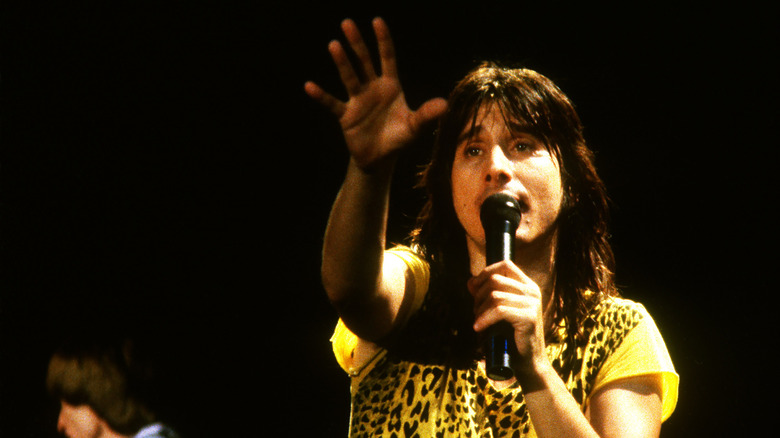
Oh, the humble power ballad. A seamless synthesis of macho rock and heartfelt vulnerability, the power ballad really came into its own in the late '70s and early '80s. Fueled by operatic vocals, romantic lyrics, and ornate guitar solos, these soaring compositions became instant-classic anthems, many of which found themselves at the top position of the Billboard Hot 100. But for every "Don't Stop Believin'," there were dozens that flopped — and flopped hard — when they first came out. Some didn't even get released as a single. Sadly, no amount of Aqua Net hairspray or shirtless volleyball montages or high school prom slow dances would make them climb the Billboard charts.
At least, not at the time. But, like that nerd who takes off the glasses to suddenly become totally bodacious, many of these flops have become well-respected hits. All they had to do was wait a few decades. Yes, like many of the flop love songs from the '70s that earned admiration from younger fans, a handful of power ballads have received a reappraisal from new listeners. This respect has varied, from a shift in collective agreement on the merits of such power ballad auteurs as Jim Steinman to going No. 1 on social media. Yet success is success, and these tunes deserve one more chance to win over your heart.
Forever Young — Alphaville
"Forever Young" wasn't always forever a hit. Alphaville, having formed in Münster, Germany, at the start of the 1980s, first tasted success stateside with their minor hit, "Big in Japan" (it topped the Dance Club chart in '84 and eventually reached No. 66 on the Billboard Hot 100 in '85). However, the group is better known for "Forever Young," a sweeping, synth-fueled power ballad that has become the theme for growing up.
Though the song was first written in the shadow of nuclear annihilation at the height of the Cold War (a much darker meaning to "forever young"), it's rife with emotion, as vocalist Marian Gold is wistful for fleeting youth. "So many adventures couldn't happen today / So many songs we forgot to play," he sings. "So many dreams swinging out of the blue / We'll let them come true / Forever young, I want to be forever young."
"Forever Young" peaked at No. 93 during its initial three-week run on the Billboard Hot 100 in 1985. After Alphaville rereleased it at the end of the decade, it hit No. 65, but that was it until 2024. That year, thanks to TikTok users repurposing the song to soundtrack their own life milestones, the tune went to No. 1 on the TikTok Billboard Top 50, giving it love, respect, and over 1.2 billion streams on Spotify alone.
Goodbye to Romance — Ozzy Osbourne
Ozzy Osbourne's "Goodbye to Romance" is a flop of a power ballad in the sense that it was never released as a single, so it never had a chance to run up the charts. And honestly, that move was kind of for the best: At the time, Ozzy was trying to get back on his feet, having left Black Sabbath (actually, he was fired) in 1979. "Blizzard of Ozz," released in the U.K. in late '80 and in the U.S. in '81, was his big coming out as a solo artist. The LP's two major singles, "Crazy Train" and "Mr. Crowley," would rechristen him as metal's "Prince of Darkness," but they weren't hits ("Crazy Train" peaked at No. 49 in the U.K. but didn't make the U.S. Hot 100 during its initial release).
Had Ozzy released "Goodbye to Romance," it might have cracked the Top 20 right out of the gate and given him his first major Top 40 hit. But, on the flipside, it might have alienated fans who thought Ozzy had gone soft. "Goodbye to Romance" is a slightly maudlin reflection on love lost. "Goodbye to friends, I tell ya / Goodbye to all the past," he sings on the chorus. "I guess that we'll meet, we'll meet in the end." Later on, he adds, "Now broken wings can't hold me down, I'm free again."
"Goodbye to Romance" may have been a soft rock No. 1, or it could have bombed. Regardless, it has surged in popularity in the decades since, amassing over 23 million streams on Spotify alone. And Ozzy did end up scoring a Top 10 power ballad in 1989 when he appeared on Lita Ford's "Close My Eyes Forever."
Tonight Is What It Means to Be Young — Fire Inc.
Fire Inc.'s "Tonight Is What It Means to Be Young" is what you'd call a rare double-flop. The song was written for 1984's "Streets of Fire," an action flick starring Michael Paré, Diane Lane, and a surprisingly hot late-20s Willem Dafoe. The film itself was a bomb, released during the same summer as "Indiana Jones and the Temple of Doom" and "Star Trek III." In 2016, the film's screenwriter, Larry Gross, recounted to Slash Film the moment that he and producer Joel Silver first heard the initial box office numbers. "There's the song in the movie called 'Tonight Is What It Means to Be Young,'" Gross explained. "And I remember, in the park, Joel saying, 'Today Is What It Means to be Dead.'"
"Tonight Is What It Means to Be Young" closes out the film. It's a pure '80s power ballad, full of bombast and surging emotions — a perfect playlist addition, in between Bonnie Tyler's "Holding Out for a Hero" and Pat Benatar's "Invincible (Theme from "The Legend of Billie Jean)." And there's a reason for that: It was written by power ballad virtuoso Jim Steinman, the songwriter behind Bonnie Tyler's "Total Eclipse of the Heart" and much of Meat Loaf's music, including "I'd Do Anything for Love (But I Won't Do That)." Steinman whipped up the song in two days when the producers couldn't secure the rights to Bruce Springsteen's "Streets of Fire" as an ending theme.
Sadly, "Tonight Is What It Means To Be Young" didn't fare much better than the film, peaking at No. 80 on the Billboard Hot 100 on June 16, 1984. Fire Inc. never recovered from this flop because — surprise! — they weren't a real band but a collection of musicians in Steinman's stable. Laurie Sargent sings the song, and her vocals dub over Diane Lane whenever she sings. But while "Tonight Is What It Means To Be Young" wasn't a hit, the track has earned a respectable following, racking up over 14 million plays on Spotify.
I'm Gonna Love Her for Both of Us — Meat Loaf
By the time that Michael Lee Aday, the artist better known as Meat Loaf, released "I'm Gonna Love Her For Both of Us" in 1981, he had a handful of hits under his belt, courtesy of his breakthrough album, "Bat Out of Hell." "Two out of Three Ain't Bad" had come close to breaking into the Billboard Top 10, and both "You Took the Words Right out of My Mouth" and "Paradise by the Dashboard Light" had worked their way into the Top 40. He was set! So, when Meat Loaf reunited with collaborator Jim Steinman to work on the follow-up, "Dead Ringer," they probably expected to keep the momentum going.
Instead, they hit a brick wall. "I'm Gonna Love Her for Both of Us" had the swelling emotion synonymous with both Meat Loaf and Jim Steinman. But it didn't resonate with fans at the time. Perhaps it was the long runtime (4:29 for radio, cut down from 7:09) or that it was too close to "Paradise by the Dashboard Light." Or maybe fans weren't ready for another helping of Meat Loaf. It peaked at No. 84 on the Billboard Hot 100, and Meat Loaf wouldn't have a song on the Hot 100 for another 12 years (when "I'd Do Anything For Love" went to No. 1).
The failure of "I'm Gonna Love Her for Both of Us" might explain why "Dead Ringer for Love" wasn't released as a single in the U.S., despite featuring Cher. Overseas, it went to No. 5 in the U.K. And with both Steinman and Meat Loaf dying in 2021 and 2022, respectively, fans have reevaluated the song's place in power ballad history.
Why Can't This Night Go On Forever — Journey
It seems that, outside of Steely Dan and Queen, no classic rock act has resonated as much with millennials and Gen Z as Journey. Fans born decades after "Don't Stop Believin'" was first released know every one of the song's words by heart, and the band racks up 20-plus million monthly listeners. But how many of them will say that "Why Can't This Night Go On Forever" should have been bigger when it was released as a single in '87?
Written by keyboardist Jonathan Cain and vocalist Steve Perry, "Why Can't This Night Go On Forever" follows the power ballad formula of putting up everything in the title. It's a song about not wanting a good moment to end, whether it's with the love of your life or performing in front of a sold-out arena. "What's in our hearts, there's never time, to say," sings Perry. "Need you tonight, lover don't fade away / Like a photograph / That time won't erase / Why can't this night ... go on forever."
"Why Can't This Night Go On Forever" peaked at No. 60 on the Billboard Hot 100 in 1987. As of this writing, it has over 9.7 million streams on Spotify. The song also has a bit of unintentional irony to it: It was the last single Journey released before going on a 10-year hiatus. Perry was already eying the door, having released his first solo album (1984's "Street Talk") before working with the band on 1986's "Raised on Radio." After touring in support of the album, the Journey members went their separate ways before reuniting for 1996's "Trial By Fire," the last album to feature Perry on vocals. Steve Augeri took over in '98 before Arnel Pineda replaced him in 2007. Ah, why can't this gig go on forever?