

Fictional Bands That Scored Real Billboard Hits
Not every song that makes it big on the Billboard charts belongs to a real-life musical act. Through the decades, there have been many entirely fictitious bands that have become a sensation on the strength of the song credited to them. We've all seen groups in movies and TV shows that land a track on the charts, even if the ensemble onscreen isn't the one behind the music. It's part of the fun of having a fictional world that spills into the real world, especially when the songs become smash hits that stand up all on their own.
While there are real musicians and singers behind these acts, the message here is that even a band that doesn't exist in the real world can pull off the magic of making a hit song loved by the world. Many arise from cinema releases that tell stories about bands trying to make it big. Plenty come from TV shows where music is a central theme. And maybe the most unexpected of all are animated works, where the bands are an extra step removed from being actual people. There's even a hit from a band called Steam that never existed as a band at all, adding an extra layer of intrigue to their chart success.
Steam
If you're a sports fan, you've likely sung along to "Na Na Hey Hey Kiss Him Goodbye" during one sporting event or another, even if you were only watching from home. You may have even known that the name of the band that performed this stomper of a diss track is Steam, a cheeky nod at the heat produced by a group with such a scorching kiss-off tune. But what you may not have known until now is that there never was an actual band called Steam, despite the song's Billboard hit status and lingering impression it left on listeners for decades.
Musicians Gary DeCarlo, Paul Leka, and Dale Frashuer, who had played together in a doo-wop group called the Chateaus, were the songwriters who created the song while working on material for DeCarlo's solo career. The team reached for an early version of "Na Na Hey Hey Kiss Him Goodbye" and fleshed it out as a B-side selection, but Bob Reno, the leader of the label, Mercury, where Leka had office space, thought it should be the actual release instead. Rather than confuse the issue by crediting it to DeCarlo, the song was released under the name Steam. An actual band was assembled to provide live performances, though none of the players had worked on the recording. The weird circumstances paid off big time: "Na Na Hey Hey Kiss Him Goodbye" went to No. 1 on the Billboard Hot 100 in December 1969, proving that Steam had ... well, steam, even if it was all just a clever illusion.
The Archies
A cartoon band achieving the sort of success real bands strive for seems a little insulting to everyone who's ever tried to reach for the stars. In autumn of 1969, the Archies skunked authentic musical acts and notched a No. 1 hit with their now-iconic single, "Sugar, Sugar." The cutesy lyrics and childish melody made for a combination sweet enough to entice listeners into sending the tune to the top. But rather than being included in an animated episode, "Sugar, Sugar" originally appeared as part of "The Archie Comedy Hour." The release of the single helped promote the show, which in turn helped make the single a bubblegum-pop music smash.
The song was co-written by Jeff Barry and Andy Kim, a singer who'd end up having a chart-topper of his own in the '70s called "Rock Me Gently." Singers Ron Dante and Toni Wine provided the voices of the male and female members of the Archies, turning make-believe members Archie, Jughead, Reggie, Betty, and Veronica into very real hitmakers ... in a sense, at least. The silly charm of the song has made it one of the more memorable tunes of the era, as well as holding the No. 1 on the spot longer than any act in 1969 at four sugar-coated weeks on the Hot 100.
The Partridge Family
The sitcom "The Partridge Family" gave "The Brady Bunch" a run for its money back in the early '70s. Both shows made use of family musical acts, though the truth about the Brady family is that the kids only dipped their toes into the business in later seasons. Meanwhile, the Partridges were a full-time working band trying to balance music careers with their regular suburban lives. The cast had the benefit of real-life mother-and-son singers in Shirley Jones and David Cassidy, which made the powerful success of the No. 1 song "I Think I Love You" slightly less surprising. The backing band on the single was a group named the Wrecking Crew, though the track was credited to the TV-only family band.
Tying the song into the series it came from by pretending it was actually performed by the band made marketing sense, however. Fans of the show were already familiar with "I Think I Love You," so there was no leap to be made into the real world. David Cassidy eventually went bankrupt, but back then, he was a teen heartthrob in his own right, so why not maximize all the crossover exposure to make the tune as successful as possible? The whole multi-faceted magic trick hoisted the song all the way to the top spot of the Billboard Hot 100 in 1970, turning a bogus musical group's music into a real hit single.
Eddie and the Cruisers
Michael Paré starred as the titular Eddie in 1983's "Eddie and the Cruisers," the pseudo-biography of a faux '60s rock band, but he did none of the singing in the movie. The song "On The Dark Side" served as the band's signature piece, and it was written and performed in real life by the New Jersey unit John Cafferty and the Beaver Brown Band. Cafferty's vocal and musical resemblance to fellow Garden State rocker Bruce Springsteen lent authenticity and helped ground the film's music with a gritty realism. Springsteen had actually performed with the Beaver Brown Band, prompting comparisons through the years — for better or worse.
"On the Dark Side" rocked up the Hot 100 charts and became a No. 7 firecracker, and John Cafferty and the Beaver Brown Band became a band known for their tough-rocking sound. There were even two music videos released: One used scenes from the movie, and the other used images of Cafferty and the crew performing. Together, they clued viewers in on the dual personalities who shared the success of a single song.
Fire Inc. / Ellen Aim and the Attackers — Tonight is What it Means to be Young
Hitmaker Jim Steinman was in the midst of his '80s heyday when he contributed a song to the soundtrack of the dystopian rock opera "Streets of Fire." The tune was called "Tonight Is What It Means to Be Young," and it carried all the melodrama and sonic fireworks of Steinman's earlier hits like "Total Eclipse of the Heart" and "Holding Out for a Hero" for Bonnie Tyler and "Paradise by the Dashboard Light" for Meat Loaf. He knew how to deliver an anthemic tune, even if the band performing it only existed on the silver screen.
In the film, the song was performed by the band Ellen Aim and the Attackers, an edgy ensemble led by actress Diane Lane. The actress was lip-syncing to the vocals of singer Holly Sherwood, who lent her voice to a studio group who took on the project-specific name Fire Inc. There was also a male voice in the mix, credited to singer Rory Dodd. It made for a multi-layered façade that was bound to confuse anyone who tried to figure it out.
The through line here: "Tonight Is What It Means to be Young" was fiery enough to hit No. 80 on the Billboard Hot 100, even though the film went down in a blaze of cinematic humiliation. Sometimes a movie exists simply to support its rocking soundtrack.
The Barbusters
You may know how Joan Jett got her start in music, but you may not remember that she tested her talent for acting in a movie that placed her at the front of a fictional rock band. "Light of Day" let Jett strum her stuff with her real Blackhearts players backing her as a unit called the Barbusters, and Michael J. Fox lent his '80s star power as her guitar-playing brother. Fox even plays the guitar in the movie, showing off real talent he faked in those iconic sock hop scenes in "Back to the Future."
Despite all the actual musicianship in the movie, the song the band became known for, also called "Light of Day," was written by Bruce Springsteen. The tune infused the soundtrack with authenticity that translated into a real-life hit for this film-only musical act. It's classic Springsteen, depicting working-class struggles and the optimism of success being just out of reach, as it is for the group in the movie.
The song didn't exactly soar to the heights of musical success, but it did reach No. 33 on the Billboard Hot 100 — not a bad showing for a celluloid ensemble. Both Jett and Springsteen have been known to include "Light of Day" in their live acts, keeping the spirit of the artificial band alive with a very real banger of a barroom rock tune. That's good news for audiences of both performers: This is one of those lesser-known Bruce Springsteen songs that sounds cooler today.
The Heights
At the advent of the teen- and YA-heavy network TV crush of the early '90s, a show called "The Heights" — featuring a young band trying to make it big — appeared on Fox. The Aaron Spelling production brought together an ensemble of beautiful people and turned them into a fictional aspiring rock band, facing the trials and tribulations of young adulthood while striving for fame. The theme song, "How Do You Talk to an Angel?", became a bigger success than the show, crushing the competition to become a No. 1 song for two weeks in late 1992.
One of the stars of the show, Jamie Walters, provided vocals for the song, while his co-stars provided supporting vocals. Meanwhile, studio musicians fleshed out the backing tracks. And just as the song reached the peak of success, the cast found out that the show had been cancelled, but not before the theme was nominated for an Emmy. Even in the world of imitation rock bands, success is still possible.
The Oneders (Wonders)
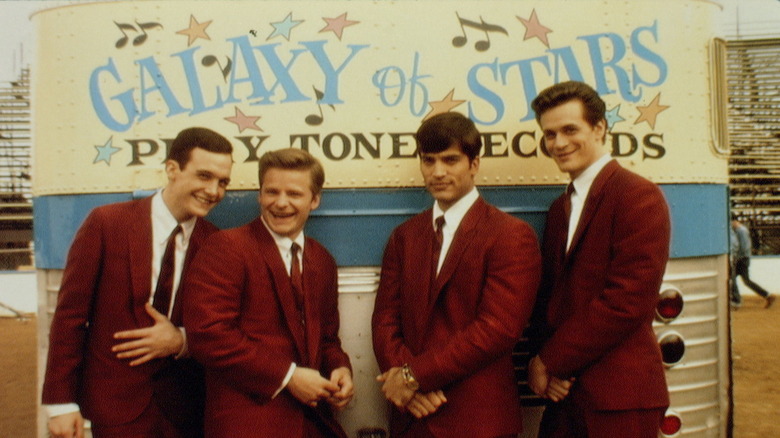
Who knew that a groovy movie about a fictitious '60s one-hit wonder band would produce such a convincing theme song? "That Thing You Do" was a larky romp that followed the rise and fall of a middle American ensemble called the Oneders (later renamed the Wonders to make the pronunciation clearer). It was a reimagining of how rock music made unexpected pop stars in its early days, and it needed a song that could fool audiences into believing it was hit-worthy. And the title song used to sell the illusion felt like it was lifted straight out of a '60s after-school dance show — as if Corny Collins from "Hairspray" lent director Tom Hanks his '45 collection and said, "Take your pick!"
Adam Schlesinger of alt-roc band Fountains of Wayne was tapped as the songwriter, an inspired choice considering the loving detail he gave the song. It's a peppy, bebopping jam that has all the hallmarks of a real '60s-style hit: jangling guitars, sugar-sweet harmonies, a wall-of-sound arrangement, and a bouncy spirit celebrating unrequited love. If you didn't know it was from a band that didn't exist in the real world, you could almost swear it was a Phil Spector creation, the kind that helped make bands like the Ronettes and the Crystals — true pop music wonders of the '60s. It stopped just short of breaking into the Top 40 of the Hot 100, peaking at No. 41 in November 1996. Not too shabby for a fake band.
Guy and Girl
The cinema verité musical film "Once" showed the attempts of an acoustic songwriting duo known simply as Girl and Guy to become a working musical act. Played by actual musicians and singers Glen Hansard and Marketa Irglova, the pair created and performed the songs used in the film. One in particular, the delicate ballad "Falling Slowly," caught fire in the real world and helped launch larger musical careers for both Hansard and Irglova.
The two performed in real life as the Swell Season, releasing music from the soundtrack as a tangential project. The names were different, but the songs they played were the ones heard in the film, adding an extra layer of realism to the project. "Falling Slowly" rose to No. 61 on the Billboard Hot 100, quite an achievement for a relatively quiet song from a small movie. It also wowed the film-making industry, resulting in an Academy Award win for best original song in a film.
Lemonade Mouth
The Disney organization doesn't skimp when it comes to adding first-rate music to its film and TV productions, a standard upheld to the fullest with the 2011 Disney Channel movie "Lemonade Mouth." The fictitious band in the film comes together during a detention session, similar to the John Hughes teen classic "The Breakfast Club," only this diverse crew bonds over their love of music. All of the actors who played the imaginary band were actual singers and musicians, which made pulling off the illusion of becoming a real act much easier.
Three songs from the soundtrack landed in the Billboard Hot 100: "Determinate" at No. 51, "Breakthrough" at No. 88, and "Somebody" at No. 89. The entire soundtrack did much better, hitting No. 3 on the album charts and becoming one of the most successful TV soundtracks in the Billboard world. The movie and made-up band it showcased are still celebrated for their music, proving that sometimes fake bands and their real hits have lasting impact, even if they don't really exist.
Daisy Jones & the Six
With Fleetwood Mac and the feud between Stevie Nicks and Lindsey Buckingham as inspiration, it was a foregone conclusion that the Amazon Prime series "Daisy Jones & the Six" would generate heat when it launched in 2023. What came as a sweet surprise was how warmly received the soundtrack was, becoming a sensation in its own right and making audiences wonder how a fake band could pull off such an authentic sound. The group's vocalists were played by Riley Keough (also known as the granddaughter of Elvis Presley) and Sam Claflin, both of whom trained to sing the songs from the film as well as playing their instruments. For all intents and purposes, Daisy Jones & the Six became a real (fictional) band, if only for the film and soundtrack, and they were the first from a scripted movie or series to top Billboard's new Emerging Artists chart. The album, "Aurora," also topped the Soundtrack chart.
It was a double whammy few real-world bands get to experience. The translation of turning actors into real musicians to become a phony '70s Laurel Canyon-style band that racked up actual hits threw in a twist that gave the series an added layer of authenticity. Viewers could experience the music beyond their binge-watching, leading to all sorts of streaming activity, as well as creating a No. 1 hit on the soundtrack chart and launching the first fictional band to the top of the iTunes chart.
HUNTR/X
One of the most successful fake bands to ever hit the music scene has been HUNTR/X, a female K-pop trio that originated as animated characters in the Netflix CGI smash film "KPop Demon Hunters." The story centers around a group that uses music to slay evil forces while slaying onstage, with the anthemic and highly melodic bop "Golden" serving as their anthem. The lyrics serve up a message of self-belief and overcoming doubt, wrapped in a candy-coated synth-heavy shell.
"Golden" hit No. 1 on the Billboard Hot 100 for a whopping eight weeks, became the first No. 1 K-pop song on the Billboard Radio Songs chart, and spent 20 weeks atop the Billboard Global 200 chart. The tune was also the second-longest chart-topping run for an all-female act with three or more members, besting former record-holders — and actual humans — TLC and behind only Destiny's Child. And the "KPop Demon Hunters" album launched four songs into the Top 10 of the Hot 100 simultaneously — a record for a soundtrack. That's some pretty solid success for a band that only exists as pixels on a screen.
In the real world, EJAE, Audrey Nuna, and REI AMI, the three singers who performed the film roles and the vocals on "Golden," sang their groundbreaking song live. The most notable performance at the 2026 Grammy Awards, where the song was nominated for best song written for visual media. The nomination was credited to HUNTR/X.