

5 Hits From The Beatles That Take Boomers Back To Their First Crush
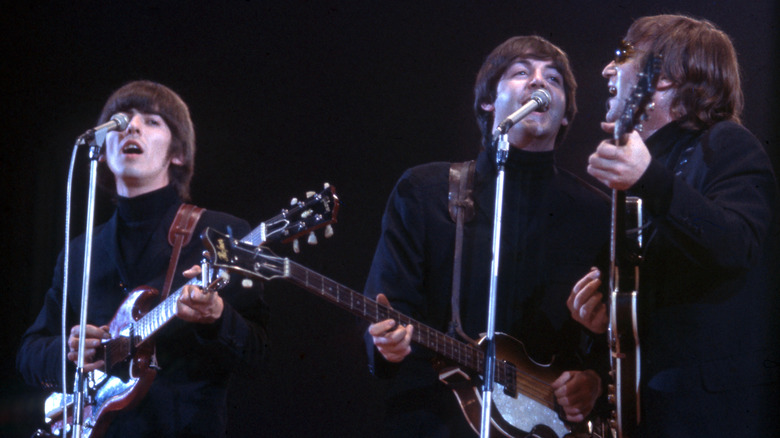
Whether it's their first day behind the wheel or an endless array of instant party flashbacks, the baby boomer generation has a lot to look back on, and first crushes are no exception. More importantly, they have decades of amazing classic rock for the soundtrack — with the Beatles at the forefront. Throughout the 1960s, the Beatles topped the Billboard Hot 100 with one single after another, celebrating love in all its highs and lows.
First crushes are a fact of life and a transformative one at that. We can all remember that first time our hearts beat faster or the world seemed to rotate around the object of our affections. The Beatles knew that rush all too well, and so made young love a staple of their early teeny bopper pop hits as well as more thoughtful perspectives on the topic in their later years. To that end, we wanted to take a look at five Beatles songs that will spark that first-crush nostalgia.
I Saw Her Standing There
Prior to the release of psychedelic anthems like "Lucy in the Sky with Diamonds," a song once banned from the radio, the Beatles were purveyors of innocent young love songs and a bring-them-home-to-mom heartthrob image. To that end, their 1963 debut "Please Please Me" is filled with rollicking Merseybeat grooves and cheerful appeals to the teenage heart (even the break-up tunes like "Misery" sound like they were sung with a smile.)
The lyrics of "I Saw Her Standing There," the album's opening track, read like a checklist of symptoms for that first onset of limerence: the transformative connection of eye contact, the mounting heart palpitations, and the threshold-crossing moment of first holding hands. But dancing emerges as the underlying theme. With proms, homecomings, and Sadie Hopkins dances defining the lives of young boomers (and really, every generation since), it's not hard to see why this song would hold fond memories.
From a musical standpoint, "I Saw Her Standing There" reflects the Beatles' early influences, including American R&B and blues, as well as the undeniable benefits of a relentless performance schedule throughout the Hamburg club scene. Still, even in this early incarnation, John Lennon and Paul McCartney's tight vocal harmonies and the sophisticated lead guitar work from George Harrison point towards the musical sophistication that loomed on the group's horizon.
She Loves You
The teary eyes (and occasional conniption fits) of the girls in the audience when the Beatles gave their iconic performance on the Ed Sullivan show are enough to underscore the point that many boomer girls' first crushes were likely the Fab Four themselves. That performance opens with "She Loves You," a track that had already kicked off Beatlemania in the U.K. and would bring the same frenzy stateside.
Lennon, Harrison, and McCartney's euphoric belting of the "she loves you yeah, yeah, yeah" choral hook puts the song in the same realm of young love innocence as "I Saw Her Standing There." The verse lyrics point at something deeper than the usual love song fare. Rather than focus on the usual binary of joyous romantic excitement or wallowing heartbreak, the Beatles explore a subtler theme of reconciliation relayed through a mutual friend. That ability to dig deeper into the nature of love and relationships than their teen idol peers would become a hallmark of the quartet's later work.
Yesterday
One of the sobering realities of looking back on first crushes is remembering how many ended badly. "Yesterday" captures those moments of melancholic reflection with musings on how simple and carefree life seems when in the blissful throes of a happy relationship. The song was carved into the collective subconscious of American boomers as the single shot to No. 1 on the Billboard Hot 100 in September 1965 and stayed there for four weeks.
The wistful melody came to Paul McCartney in his sleep and he was, at first, convinced he'd unintentionally plagiarized an existing song. After showing the melody to colleagues — including John Lennon — he determined that it was fit for the group and the song became the first Beatles recording to feature only one member of the band as a performer. The song's popularity endures into the modern day with over 2,200 cover versions emerging across the decades.
Norwegian Wood (This Bird Has Flown)
"Norwegian Wood (This Bird Has Flown,)" shows the Beatles entering a new identity. By 1965, the oldest baby boomers were of college age and the Beatles were maturing right along with them. The band, worn out from the rigors of pop stardom, were growing out of the jingle-jangle teeny bopper music that had made them household names and were moving in a more adult and cerebral direction. 1965's "Rubber Soul" was the outgrowth of that developmental process. Their lyrical content still centered around love and relationships, but it came from a subtler, more introspective vantage point.
A first crush is a malleable concept. For some, it's an innocent infatuation with a junior high classmate. For others it's a life changing experience that comes tangled with a burgeoning awareness that the world is a more complicated place than previously believed. The lyrics of "Norwegian Wood" reflect this matured awareness of blossoming romance with a vignette about a man and woman who come back to the latter's apartment and chat over drinks before drifting off to sleep in separate rooms.
The song's cultural legacy was further cemented when Japanese novelist Haruki Murakami (himself a boomer) used it as the title of his 1987 coming-of-age classic. The novel "Norwegian Wood" tells of a 37-year-old businessman who hears the song and is transported back to his college years, the unrest of the era, and his complicated romantic life. Later adapted into a film in 2010 by director Tran Anh Hung, it stands as an enduring testament to the song's nostalgic impact.
And I Love Her
There's a general understanding that minor keys lend themselves to more thoughtful, contemplative music. That's certainly the case with the Beatles' 1964 hit "And I Love Her," a gently thoughtful, up-tempo ballad from the album "A Hard Day's Night" that climbed to No. 12 on the Billboard Hot 100.
From a lyrical standpoint, "And I Love Her" tells the story of making the transition from simple affection to a deeper bond, as the lyrics follow the upward movement of the narrator's relationship. It's the kind of revelation that comes late at night when one is alone with their thoughts and the lyrics reflect that: "bright are the stars that shine, dark is the sky. I know this love of mine will never die and I love her."