

The No. 1 Song On June 24, 1979 Sounds So Much Cooler Today
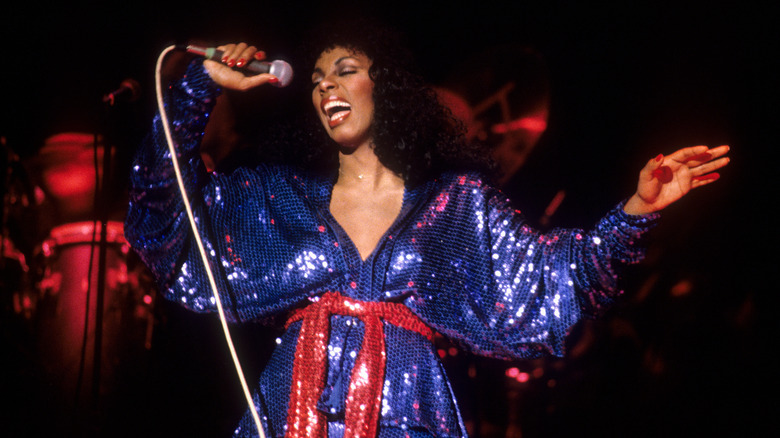
Welcome to the second edition of The No. 1 Song on This Day, a biweekly column where we discuss the No. 1 songs from decades ago that are way cooler today.
Donna Summer's "Hot Stuff" has become the unofficial anthem for whenever someone gets changed and dances while looking at themselves in the mirror. Over 45 years later, the beat still pumps through the body and gets everybody flexing like they're a Greek god on parade. Summer had already produced several songs that defined '70s disco, so it was unsurprising that "Hot Stuff" sat at the No. 1 position on the Billboard Hot 100 during the week of June 24, 1979. It had already been in the top spot the week before that and hung on to that position for most of June.
"Hot Stuff" doesn't feel like a typical disco-era song, though. While it certainly has a bassy groove that turns those floor anchors into happy feet, the electric riff gives it more of a snapping bite than usual. You hear the song, and you feel the atmosphere fire up to scorching-hot temperatures. Would you consider this disco or rock? Also, who really is the "hot stuff" in the song: Is it you, or the mysterious stranger you want to grind up against as you thrust those hips to the chorus?
While many of its contemporaries have been lost to the sands of time, "Hot Stuff" continues to endure as a genre-transcending banger. So let's take a look back at what makes it such a knockout song.
The lyrics of Hot Stuff focus on the primal and familiar
There must be some kind of record for how many times "hot stuff" is said in Donna Summer's "Hot Stuff." The weird part is it actually works, since it becomes such a singalong-able part of the track. Even if you have no idea what comes next, it volleys you up to shout "hot stuff" in unison with everybody else. It never gets old.
Of course, it isn't too difficult to determine what the song is about here, especially with lines like "Sittin' here eatin' my heart out waitin' / Waitin' for some lover to call." At the same time, it also makes you wonder if the "hot stuff" could be you or your sultry partner for the night. Unquestionably, it's an anthem about giving into primal instincts and focusing only on the horizontal tango. Would this be love or lust? That's up to you to decide, but it's a human urge that's relevant even to this day.
While the lyrics of "Hot Stuff" aren't original in the slightest, the catchy composition acts as a precursor to the template for many rock bands of the '80s and '90s, who sang about similar seductive subject matter. Heck, the entire glam subgenre built a career out of singing strictly about making love and one-night stands. Most of it is nothing more than a derivative of "Hot Stuff."
The music of Hot Stuff was a sign of things to come
By the late '70s, disco's power waned. People had grown tired of the glitter balls and funky bass beats. Change was in the air, the rocking '80s were imminent, and Donna Summer knew it too. Part of the solution was not a straight-up revolution but integrating subtle rock influences into the core of "Hot Stuff" — and this came courtesy of the six-string-slinging of Steely Dan's Jeff "Skunk" Baxter and Paul Jackson Jr. Baxter understood the assignment and appreciated how Italian producer Giorgio Moroder allowed for experimentation here. "Let's find a little spot that we can get people's attention and do something sideways," Baxter told Vertex Effects.
The guitar makes all the difference, since the song is able to cater to both disco and rock fans. The groovy structure and synthesizer lines remain intact, but there's also more steel to the song than its contemporaries. This blurring of genres would become a precursor of what's to come in the music industry, as performers stepped outside of the boundaries to create new, unexpected mash-ups. Think of genre-bending artists, such as the Prodigy and Pendulum, who would likely not exist today if it weren't for the experimentative nature of "Hot Stuff."
From a foundational perspective, "Hot Stuff" isn't technical wizardry. But like all good music, it bucked trends to find the magic in simplicity. By doing so, it allowed the real star of the song -— Summer's timeless voice — to shine like an everlasting sun.