

The 5 Best Guitar Riffs From '70s Artists
The perfect guitar riff is unique, recognizable, iconic — in other words, a snippet of scratchy guitar work that instantly identifies the song it comes from. It's a blend of technical skill and songwriting know-how, plus a little creative luck, that leads guitar players to conjure unforgettable hallmark sounds that transcend the song itself to become musical memes, in a sense. And the songs of the '70s have some of the best guitar licks ever captured on recorded media, turning the era into a never-ending riff fest featuring a who's who of the biggest guitarists in the business.
It was no picnic trying to hone in on the five best guitar riffs of the '70s; so many classic rock tunes caught lightning in a bottle that decade. We pored over the possibilities and landed on a quintet that represents a range of sounds and styles without straying too far from the quick-and-crunchy riff work that makes the best riffs ... well, work. Glossy pop-rock banger "Ebony Eyes" and velvety soft rock classic "Rhiannon" contain guitar riffs you can identify at 50 paces. In the more bluesy rock arena, riffs from "Whole Lotta Love" and "Smoke on the Water" are solid standards for both listeners and guitar players. And the searing thunder of "Barracuda" is an ominous moan-and-wail combo that can get heads banging from the jump.
Barracuda — Heart
You may not find a more thrilling guitar riff in the rock world than Heart's opening chug-a-chug grinding from "Barracuda." Not only does it drill into the instrument's lowest register and shred the first three notes with crackling feedback, it also leaps to the eardrum-piercing heights of the upper range with shrill ringing that fries your nerves just a split second later. It's a string-scaling seesaw designed to unnerve and warn all comers that what follows is going to be heavy duty. It also reappears as a motif through the song in case anyone listening forgets what they've gotten themselves into.
With the dangerous aquatic beast as a title and this urgent pulse of a riff weaving through the song, it feels like the hard rock equivalent of the "Jaws" theme, a minimalist musical structure that warns all comers that danger lurks nearby. But credit for the cranking hook goes to another rock unit from the '70s: Nazareth, who adopted a nearly-identical riff for their version of a Joni Mitchell tune called "This Flight Tonight." That riff sticks with the low-note gallop that opens "Barracuda", which Heart's co-lead guitarist Roger Fisher interpolated into a power-packed jumpstart for the song, adding the shrill notes as a counterpoint.
This riff is so propulsive and hooky, it became the heartbeat of a vintage empowerment rocker that put a greasy music industry rep on notice. It also told the rock world that the Wilson sisters won't be played, pun intended.
Whole Lotta Love — Led Zeppelin
Three notes were all it took for Jimmy Page to invent a blues-rock riff for the history books. The cranking opening of "Whole Lotta Love" is a distillation of generations of musical evolution, a deceptively simple figure that transports the ancestry of rock 'n' roll into the future (at the time) without betraying the heritage that made the sound possible. And once this aural freight train starts barreling down the tracks, it doesn't let up until Robert Plant's bridge of ecstatic shrieks at the song's halfway point.
The urgency of this grinding riff shows off the sensual nature of the tune, lending a grinding framework for Robert Plant's ultra-suggestive lyrics, which leave little to the imagination, if anything at all. But the simple power behind a sinewy three-tone guitar phrase is a perfect match for what the band is portraying here. The energy is under strict control, contrasting Page's restraint against Plant's unfettered howl. It's an infections counterplay that shows just how sophisticated rock music could become in the hands of true creative masters of the format.
Though the song debuted in November 1969, it reached an apex at No. 4 (and an all-time chart high for the band) on Billboard's Hot 100 by the end of January 1970, sneaking into the decade by a hair — or in this instance, by a riff, one that's become an indelible piece of rock history. That's pretty solid for a band that hated releasing singles.
Smoke on the Water — Deep Purple
Deep Purple did more than craft a power chord-centered guitar riff for "Smoke on the Water" — the band created a call to arms that set a million aspiring guitarists off on a quest to recreate it for anyone who would listen. This is another ominous four-note lick that would be at home in a grindhouse zombie movie. Crackly feedback and a bit of warbly chorus gives the riff an expansive feel that carries it through until the bass comes bubbling up from underneath. And when the bluesy vocals kick in describing the band's fateful trip, the song feels a bit looser ... until the riff returns post-chorus to remind listeners that this is serious rock 'n' roll.
The song itself is a doozy, recounting the band attending a Frank Zappa concert at Switzerland's Montreux Casino when a fired-off flare from the audience literally set the house on fire. Once you know the story behind the song, the riff takes on the character of an emergency alarm signal, cleverly disguised as a simple guitar hook. Guitarist Ritchie Blackmore reached for the opening passage of Beethoven's Fifth Symphony, flipped it around, and conjured an all-timer of a guitar riff that never fails to bring the heat, no matter how many burgeoning rock stars crank it out on their Fender Strats. It's not a bad example to follow from an act that set a record as the loudest rock band in the world.
Rhiannon — Fleetwood Mac
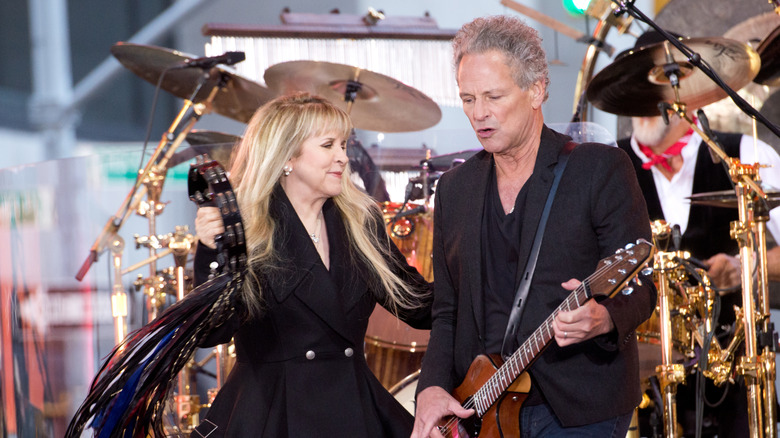
One of the most undeniably iconic guitar riffs of the decade — and arguably most of rock history — is Lindsey Buckingham's subdued plucking at the opening of Fleetwood Mac's classic "Rhiannon." Though the song is a Stevie Nicks composition (and one of her most familiar and cherished among stalwart fans), credit for the riffs that give the song its swampy, otherworldly spookiness goes fully to Buckingham and his deft fretwork. He doesn't try to reinvent the wheel here; he simply takes Nicks' existing melody and applies it to the fretboard, transforming a simple stepwise pattern into an all-time classic that defines the song and gives it the spotlight before Nicks summons up her smoky vocal hypnosis.
Equally important in the "Rhiannon" riff world is the high-stepping follow-through that comes in after the post-chorus, closing the loop and starting the pattern all over again. The brilliant bookending that repurposes similar notes in a different form keeps the rolling tones from feeling monotonous and provide border between halves of the song. It helps the song feel like a highlight among the wild creation of the "Rumors" album.
Though "Rhiannon" became a staple of the Fleetwood Mac songbook and a signature tune for Nicks' solo career, the song originated as a tune from Buckingham Nicks, the duo's pre-Mac band. Live performances show the tune to be crunchier, with more searing guitar textures, but the unforgettable riff work is identical. When something works this well, there's no reason to change it.
Ebony Eyes — Bob Welch
With "Ebony Eyes," Bob Welch put a period on his tenure with Fleetwood Mac and bolstered his solo career with an unforgettable opening guitar riff. The chugging loop of minor-key notes made a tidy melodic circle that belied the joyful major-key uplift of the chorus. It also made the song instantly identifiable, a perfect device to hook listeners in without a bunch of instrumentation — just an electric guitar cranking out a rock groove that gave 1977 a scorcher of a riff.
The fun of the opening musical curlicue bobbing yet surly personality is how it sets up the verses for a seriously smitten Welch, with lyrics that describe the perils of coming too close to the woman who's caught his attention. Then it does a switcheroo and leads listeners into a rollicking refrain that celebrates the romantic possibilities that await, all thanks to the woman's titular ebony eyes.
Interestingly, after Welch high-fived Stevie Nicks on his way out of Fleetwood Mac as she and Lindsey Buckingham became his replacements, Nicks ended up providing live backing vocals for "Ebony Eyes" on more than one occasion. It seems the catchy tune with the memorable riff has all kinds of ties back to the Mac.