

5 Defining Duets Of Stevie Nicks That Prove She's The Queen Of Dreamy Collabs
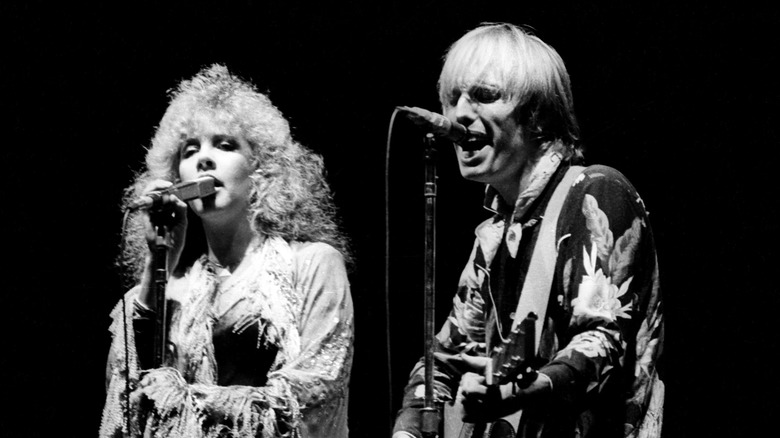
The myriad musical roles Stevie Nicks has played in her career may be highlighted by her being the Fleetwood Mac member who gave the band its only No. 1 single before launching a solo career that turned her into a mega-star. But the whirling diva of the rock world has been nothing if not a generous partner to her musical cohorts, a status that's led to some of the most incredible rock and pop duets ever recorded. It's a natural fit for the harmony-loving singer, whose famous personal and professional partnership with Lindsey Buckingham was where her rock 'n' roll adventures began. But Nicks also has a knack for choosing musical partners who let her add her distinctive spirit to their works, transforming straightforward songs into works of dreamy audio magic.
The duets in Nicks' catalog run the gamut from the smoky, moody "Gold," performed with '70s folk-rocker John Stewart, to the soulful and spirited "Whenever I Call You Friend," her pairing with '80s pop phenom Kenny Loggins, and "Leather and Lace," her smash musical hook-up with former paramour Don Henley. Falling squarely in the space between those sounds are a pair of simmering duets with Tom Petty and the Heartbreakers, the languid yet stirring "I Will Run to You," and the bombshell hit "Stop Draggin' My Heart Around." The whole set is a masterclass in choosing the perfect partners for making smoldering harmony and melodic bliss.
Whenever I Call You Friend
Before leaping into her own solo project, Stevie Nicks stepped outside the bounds of Fleetwood Mac in 1978 to create "Whenever I Call You Friend" with soon-to-be pop superstar Kenny Loggins. Fresh from his previous partnership as part of Loggins & Messina, Loggins was embarking on his own solo endeavor and had shown a bit of promise with his debut album, "Celebrate Me Home." But it was this harmony-heavy slice of radio nectar that blended his golden tones with Nicks' warm whiskey vocals that gave him his first hit, a No. 5 single that became a '70s staple and a lasting favorite for fans of both singers.
There's a joy in this duet that doesn't surface in the songs Nicks had recorded with Fleetwood Mac, maybe because she didn't write this one about her famous feud with Lindsey Buckingham. Loggins wrote the tune with singer-songwriter Melissa Manchester, creating an entirely different vibe for Nicks to wrap her pipes around. The Loggins-Nicks connection was made when Loggins opened for Fleetwood Mac on their "Rumors" tour. Nicks made the proposal that she was available if Loggins was in the market for a female voice, and he took her up on the offer not long afterward.
This one never appeared on a Nicks album, only on Loggins' 1978 L.P., "Nightwatch." The limited availability made it even more of a special release, drawing Nicks fans in Loggins' direction — a move Loggins credits to Nicks' presence helping drive his solo success.
Gold
One of Stevie Nicks' earliest duet projects was a percolating piece of dark adult contemporary rock from John Stewart called "Gold." Stewart was the songwriter behind "Daydream Believer," the sunny pop song that became a No. 1 for the Monkees in the '60s and a top 20 tune for Anne Murray in the '80s. His style became more nuanced as his career progressed, culminating in this pairing with Stevie Nicks for a high-charting tune that broods and simmers in the shadowy underbelly of Southern California in the '70s.
Though the lyrics take a jaded view of the LA music business of the time, it feels like Stewart is tipping his hat to Nicks' growing legacy here. The arrangement is very Fleetwood Mac-forward, thanks to guitar work and production from Lindsey Buckingham. The chorus "Driving over Kanan, singing to my soul / There's people out there turning music into gold" even feels like a loose callback to "Gold Dust Woman," which had already left an impression on Fleetwood Mac fans on the "Rumors" album two years earlier. Nicks' growling harmonies add urgency to the track, fading in and out like a ghost.
There's no question that having Nicks apply her haunting vocal work to the tune helped drive it all the way to No. 5, giving Stewart the highest charting single of his career. It's one of the greatest cameos of '70s rock that's easy to overlook until it pops up on a nostalgia playlist.
Stop Draggin' My Heart Around
When Stevie Nicks was planning her first solo album, the now-beloved "Bella Donna," she was eager to work with Tom Petty and the Heartbreakers, whom she admitted to her then-boyfriend and producer Jimmy Iovine that she'd love to emulate. Petty originally came up with the song "Insider" for them to collaborate on, but he kept that one for his own album and gave the now-classic "Stop Draggin' My Heart Around" to Nicks instead, which became her first single separate from Fleetwood Mac.
Petty and the Heartbreakers had already recorded the song, but some of his vocal verses were removed so Nicks could sing them instead. Then, she sang along with his recorded refrain, giving the illusion of Nicks and Petty crooning to one another and helping to create the original Nicks solo sound, an earthy brew that gave way to synths and drum machines as she expanded her repertoire. It also demonstrated Petty's flexibility, allowing an unofficial Heartbreaker into the club to add new tones and textures to the band's signature formula.
"Stop Draggin' My Heart Around" became Nick's top-performing tune as a solo artist, sticking around the Billboard Hot 100 for a stunning 21 weeks — almost six months — and taking her and the band to the No. 3 spot in September 1981. The video became an early MTV staple. It was also a pinnacle release for Petty and his Heartbreakers, proving the synergy between these two power acts even in their earlier days. Nicks credits the song for giving "Bella Donna" a jumpstart, proving her worth as a stand-alone artist and becoming one of the pre-eminent duets in rock history.
Leather and Lace
Another "Bella Donna" track that paired Stevie Nicks with rock royalty, "Leather and Lace," gave a nod to the singer's country music roots while letting her trade lines with Eagles' drummer and vocalist Don Henley. The romantic past shared by Nicks and Henley helped sell the romance in this chiming country ballad, though the flames had fizzled by the time the song became successful. That didn't diminish the sincerity or authenticity of these iconic voices sharing their deepest feelings. "Give to me your leather," Nicks sings, "Take from me my lace" — a sweet sentiment that could easily become musical wedding vows.
At the time the song was released, the Eagles were one of the biggest acts in the world, and Nicks was coming into her own as an artist separate from her Fleetwood Mac compatriots. She'd originally written the song as a duet for real-life country music couple Waylon Jennings and Jessi Colter, with Henley lending his prodigious songwriting power to the project. When Jennings and Colter hit rocky times, Jennings intended to record the song solo, but Nicks opted to keep it for herself and Henley instead.
Fans loved the twang-and-jingle delivery and lifted "Leather and Lace" to the No. 6 spot in January 1982. Those who knew about the real-life Nicks-Henley connection understood that the song was a grace note for the pair, an elegant way of the singers telling each other that it may not have worked out, but at least they gave it a shot.
I Will Run to You
For "The Wild Heart," Stevie Nicks' second solo record, she partnered with Tom Petty and the Heartbreakers again for a song with similar smolder but a different message, a cranking mid-tempo tune called "I Will Run to You." It took the same formula of bluesy guitarwork and earthy organ-and-percussion textures, but the lyrics read differently, almost like a sequel to "Stop Draggin' My Heart Around." The two singers are at the point of admitting their affection for one another, vowing, "I will run to you, down whatever road you choose / I will follow you down, I will run to you." Rather than accusing one another of playing coy, they're promising to stick together no matter what. It's quite a shift for the two-year gap between the songs, but it also illustrates how perfectly Nicks and Petty complement one another.
Heartbreaker guitarist and songwriter Mike Campbell would go on to assist Nicks with future writing and performing projects, keeping the thrilling sound alive as a silent partner rather than a duetting counterpart. The pairing presents a softer tone that feels more like a Nicks' composition with a guest appearance by Petty rather than the other way around. Whatever balance was struck with this moody tune, it took the song to No. 35 on the Billboard Mainstream Rock chart in 1983 — not a bad showing for a follow-up to a Top-10 hit.