

The Greatest Music Cameos Of '70s Rock Nobody Talks About
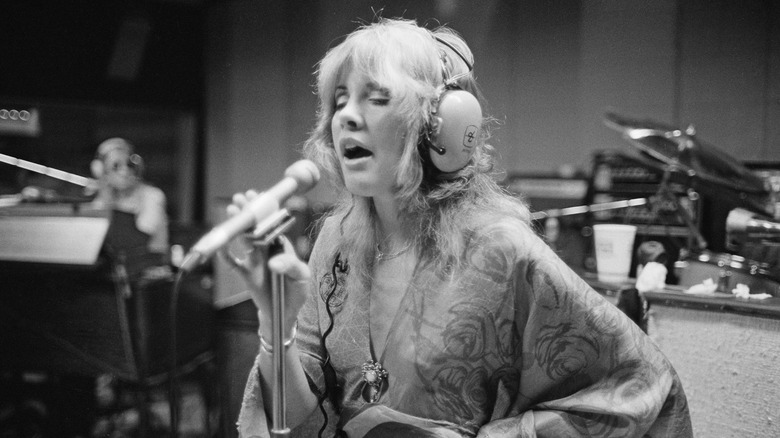
Many of the best-known and beloved rock singles of the 1970s feature unheralded or secret performances from some of the decade's most vital rock stars — because so few people know that they even happened. While it wasn't uncommon for '70s rock stars to refuse to work together, the classic rock world of that era ultimately consisted of several tight-knit scenes operating in just a few major hubs, and so the decade was pretty much a big tent where creative cooperation proved fruitful. Rock stars from Jerry Garcia to Mick Jagger and Stevie Nicks relied on each other to make their songs better or to give them an extra edge, almost guaranteeing that those tunes would become hits or part of the calcified classic rock canon.
But still, many of those singers and bands didn't want to make a big deal about their guest spots on crucial records. Such appearances were barely, if at all, advertised, marketed, announced, or touted, and sometimes not even listed in the liner notes. But over the years, artists revealed and confirmed the rumors: that their beloved hits featured one-off, guest, and cameo work from other hugely famous '70s rock stars.
Mick Jagger for Carly Simon
The identity of the inspiration for "You're So Vain," one of pop music's greatest inflated-ego takedowns, is among the biggest unsolved mysteries of classic rock. Singer-songwriter Carly Simon only made it to No. 1 once in her career, and she did with "You're So Vain" in 1973, because it's just that tantalizing. Simon has since confessed that part of the song is about a former lover, actor Warren Beatty, while the other verses' targets remain shrouded in secrecy. Simon won't confirm or deny if her time with another flame, Mick Jagger, led to some passages in "You're So Vain," but even if that's not the case, Jagger, in all his swagger, still factors into the song's creation and history.
While she was in the studio recording "You're So Vain," which at the time had the working title of "Ballad of a Vain Man," Simon received an unexpected phone call from Jagger, who wanted to hang out. So she asked him to come sing some backing vocals along with Harry Nilsson, who'd been working with Simon for some time already. While neither rock star was credited, Nilsson's softer vocals are buried in the mix, but Jagger's braying contributions are unmistakable — particularly on the choruses of "You're So Vain."
Elton John for John Lennon
John Lennon actually hated songwriting, which might be why he wasn't as prolific of a hitmaker in the 1970s as his former bandmates in the Beatles, particularly Paul McCartney. Between 1970 and 1973, Lennon only reached the Top 5 of the pop chart twice; by 1974, he was despondent and distracted from creative endeavors by personal problems, including a trial split from his wife, Yoko Ono, and serious issues with his U.S. immigration status. It was in that year that Lennon managed to complete the "Walls and Bridges" LP with a little help from his friends, including Elton John, one of the biggest pop superstars of the era.
On the Lennon-written, frantic and energetic "Whatever Gets You Thru the Night," John contributed backing vocals, organ, and piano, and he thought it was such a great song that, during production, he predicted that it could very well be a No. 1 hit single. Lennon politely disagreed, prompting John to make a bet: If "Whatever Gets You Thru the Night" topped the Billboard Hot 100, Lennon would have to take the stage at a future Elton John concert.
In November 1974, John's prophecy came to fruition: "Whatever Gets You Thru the Night" made it to No. 1. And that's why Lennon surprised the audience at John's Thanksgiving concert at New York's Madison Square Garden: to make good on the wager. The two stars worked their way through "Whatever Gets You Thru the Night" and a couple of Beatles tunes.
David Bowie for Lou Reed
Either as a founding member of the spooky and envelope-pushing Velvet Underground or as a solo artist who recorded some seminal '70s albums, Lou Reed is a rock legend with zero No. 1 hits. Only occasionally did Reed make any concessions to the musical mainstream, including his 1972 LP "Transformer." That record included Reed's only Top 40 hit, "Walk on the Wild Side," and sold so consistently that it stayed on the album chart for eight months. "Transformer" is also as much a Bowie album as it is a Reed one, since the British artistic legend helped produce, mix, and arrange the whole project.
David Bowie was the party who could translate Reed's unique style for the tastes of a wider audience. And while Bowie was one of the most recognizable voices in rock history, he only put a little of that to use on "Transformer." The enigmatic ballad "Satellite of Love" was a B-side to the single "Vicious," but it became one of Reed's best-known and most accessible tracks. There's a quiet Bowie vocal assist there, with background vocals and a moment where he reaches some very high notes toward the end of the tune.
George Harrison, Billy Preston, and Carole King for Cheech and Chong
One false thing people might believe about Cheech and Chong is that the marijuana-obsessed comedy duo of the 1970s only plied their trade in movies and sketch comedy albums punctuated with novelty songs. But Richard "Cheech" Marin and Tommy Chong were so popular that they floated onto the Top 40 three times, including in 1973 with the No. 15 hit "Basketball Jones Featuring Tyrone Shoelaces," a rambling, half-spoken, half-falsetto-delivered soul spoof about a man's obsession with basketball. It's a slight novelty very much of its time (it's even got an accompanying trippy cartoon), and yet "Basketball Jones Featuring Tyrone Shoelaces" low-key featured some of the best and most important musicians of the '60s and '70s.
George Harrison played guitar on the track, alongside Billy Preston on keyboard and Carole King on piano. King also contributed backing vocals, along with R&B greats Darlene Love and Ronnie Spector, and Mamas and the Papas member Michelle Phillips. Rolling Stones collaborator Nicky Hopkins helped round out the temporary Cheech and Chong band.
Lindsey Buckingham and Stevie Nicks for Walter Egan
With his hypnotic and gently hard-rocking 1978 single "Magnet and Steel," Walter Egan slipped into the Top 10 for the first and, as it would turn out, only time, making him a quintessential '70s one-hit wonder. That song's success was a career peak for Egan, who'd toiled on the fringes of the music industry for more than a decade, associated with big-name acts like Jackson Browne and Gram Parsons. When it came time to record his album "Not Shy," Egan cashed in on all that rock star capital, enlisting some famous and connected friends to bolster the LP. For example, Egan's friend, Fleetwood Mac guitarist Lindsey Buckingham, co-produced the album, and he also subtly shows up on "Magnet and Steel." The chorus of that hit features a three-part harmony of differently ranged singers, with Buckingham providing the lowest voice.
Buckingham's lines seamlessly blend with the higher notes reached by someone with whom Buckingham had collaborated a lot: fellow Fleetwood Mac bandmate and former romantic partner Stevie Nicks, who was also the inspiration for "Magnet and Steel." It's a somewhat frustrated song about an unshakeable and bubbly fixation, and Egan has confirmed that he wrote the piece about Nicks.
Peter Cetera and Donnie Daucus of Chicago for Billy Joel
Billy Joel tied what was at the time his pop chart peak of No. 3 with the 1978-released single "My Life." The track from the "52nd Street" LP is Joel's snarling but sweetly sung declaration of independence, a musical message to his judgmental haters to back off. And yet, in this song where Joel proclaims that his life is his and doesn't require any interference from outside parties, he utilized some talented musicians who were much more famous than he was in 1978: Chicago's Peter Cetera and Donnie Daucus.
As Billy Joel showed that the piano was a viable rock 'n' roll instrument, Chicago proved that horns and jazz influences had a place in modern music in the 1960s and 1970s. Chicago also boasted some formidable vocal talents via the high-registered and nearly electronically precise Peter Cetera. He added the harmony parts and backing vocals that can be heard in various strengths throughout "My Life," as can the support singing of Chicago guitarist Donnie Dacus.
The Beach Boys for Chicago
By the mid-1970s, the Beach Boys were widely considered passé, a relic of the mid-1960s that struggled to interest large audiences in its post-surf-era recordings. But then the band enjoyed a massive comeback in 1974, thanks to the release of a greatest hits collection and three of its members helping out on a smash single by an immensely popular soft rock band. "Endless Summer" went to No. 1 and eventually sold 3 million copies, the first time the Beach Boys had reached the album Top 10 since 1966. Around the same time, Chicago unveiled the single "Wishing You Were Here." At that point in its history, multiple members of Chicago took turns on lead singer duties, including Terry Kath and Peter Cetera, who both got the gig on "Wishing You Were Here," a song the latter wrote for the 1974 album "Chicago VII."
But some singers besides Kath and Cetera steal the song out from under Chicago, helping it to a peak of No. 11. Beach Boys touring bassist James Guercio simultaneously managed Chicago and owned a recording studio, and he arranged for Al Jardine, Carl Wilson, and Dennis Wilson to add backing vocals and obvious Beach Boys-style harmony singing to a "Wishing You Were Here" session.
Jerry Garcia for Crosby, Stills, Nash & Young
Inducted into the Rock & Rock Hall of Fame as Crosby, Stills & Nash, the band of folk balladeers scored some of its biggest hits and best-known songs when Neil Young was in the lineup. "Teach Your Children," a sentimental reflection upon and appreciation for parenthood, while also patronizing and self-congratulatory, lilted its way into the Top 20 in 1970. While four named celebrity musicians in the credits may be more than enough, "Teach Your Children" also included the stellar pedal steel guitar work of another iconic boomer-generation musician: the Grateful Dead's Jerry Garcia.
The group landed Garcia by simply asking him. The Grateful Dead was recording an LP in an adjoining studio, and Graham Nash, thinking "Teach Your Children" sounded thin, suggested Stephen Stills add a solo. He declined the chance, but David Crosby had a suggestion: Get Garcia to play the steel guitar, even though he'd taken up the instrument just a few weeks earlier.
Rick Wakeman for Cat Stevens
Little about the process that resulted in the No. 6 hit "Morning Has Broken" was the way Cat Stevens usually did things. By the early 1970s, the singer-songwriter had settled into a voice-and-acoustic guitar-based format to perform the songs he'd usually composed himself. But while putting together the 1971 album "Teaser and the Firecat," Stevens was fresh out of concepts and sought inspiration from a book of hymns, where he found "Morning Has Broken," written in 1931 by poet Eleanor Farjeon to the tune of the 1880s Gaelic melody "Bunessan." "I just did my own arrangement," Stevens told Billboard. However, that statement isn't entirely true, because Stevens enjoyed an assist on the track from Rick Wakeman, progressive rock keyboardist and pianist with a classical sensibility best known for his work with Yes.
Wakeman was working on music in the same studios where Stevens was trying to figure out "Morning Has Broken," and he asked if the piano player would expand the song, because it was clocking in at around 40 seconds. Wakeman not only played on "Morning Has Broken," but also arranged it, coming up with the ideas to double the first verse and turn his piano introduction into a motif.
Linda Ronstadt and James Taylor for Neil Young
Neil Young is a well-established solo act, but he has also liked being a musician in a band on occasion. Apart from frequently fronting Crazy Horse, he's also the "Young" in the off-and-on folk-rock supergroup Crosby, Stills, Nash & Young. Even when he's making records whose sleeves will bear only his name in a large font, Young is drawn to top-notch musicians, even giving stars with household-name status supporting roles on his works. Young put together the band he wanted for the Nashville-based recording sessions for the 1972 album "Harvest." He'd headed to the music hotbed to play on "The Johnny Cash Show," and while there, he convinced two other performers to join him in the studio: Linda Ronstadt and James Taylor.
Young had them sing backup on the haunting and dreadful "Old Man," later a major hit. "We wound up on our knees around this microphone. I was just shrieking this high harmony," Ronstadt recalled in "Shakey: Neil Young's Biography." Taylor, whose primary instrument is the guitar, additionally played the banjo on "Old Man." "I don't think I played on one before or since," Taylor quipped.
John Lennon for David Bowie
In September 1975, "Fame" spent two weeks at No. 1, representing David Bowie's first stint at the top of the pop chart. "Fame" is a funk and soul song, styles that were not previously in Bowie's creative wheelhouse, but then he was always very adept at changing genres on a whim and jumping on chances to work with collaborators whom he admired. And that's how "Fame" came to exist in the first place: John Lennon and Bowie, along with guitarist Carlos Alomar, wrote the song together, not too long after those marquee rockers first met and became fast friends.
"He was terrified of meeting John Lennon," frequent Bowie producer Tony Visconti told BBC Radio 4 (via The Guardian) in 2021. After hours of the two rock stars silently hanging out in a room together, while Bowie nervously made charcoal drawings, Lennon demanded to do a Bowie portrait. That relieved the tension so much that within a week, Bowie had asked Lennon to help out on his version of the Beatles' "Across the Universe." After that was done, they started messing around on some instruments and built "Fame." The spacey, falsetto backup vocals toward the song's conclusion are all Lennon.
Joe Walsh for Jay Ferguson
Jay Ferguson is probably a star who can't stand Led Zeppelin, as his psychedelic band Spirit once unsuccessfully sued that hard rock juggernaut for lifting its instrumental "Taurus" for "Stairway to Heaven." Nevertheless, Ferguson moved on from psychedelia and progressive rock into a more accessible, pop-friendly sound as the 1970s progressed. Ferguson scored his first and sole Top 20 hit when "Thunder Island" peaked at No. 12 on the pop chart in 1978, a song that embraced the lighter, country-twinged, heavily produced "California" sound that was the style at the time, as pioneered by bands like the Eagles. In fact, it was an Eagle — Joe Walsh — who gave the track a serious assist.
A nostalgic recounting of a terrific and seriously romantic day playing around on the beach with a lady friend, "Thunder Island" is memorable for Ferguson's bittersweet and reaching vocals, and, coming out of nowhere to punctuate this otherwise soft piece of radio rock, is a guitar solo that absolutely shreds. Ferguson brought in a guest musician to handle that element, and as he clearly wanted to sound like the Eagles with "Thunder Island," he employed an actual Eagle to play guitar. That's Walsh ripping through the explosive bits of electrified hard rock found in "Thunder Island."