

The 5 Best Rolling Stones Songs That Aren't Gimme Shelter Or Paint It, Black
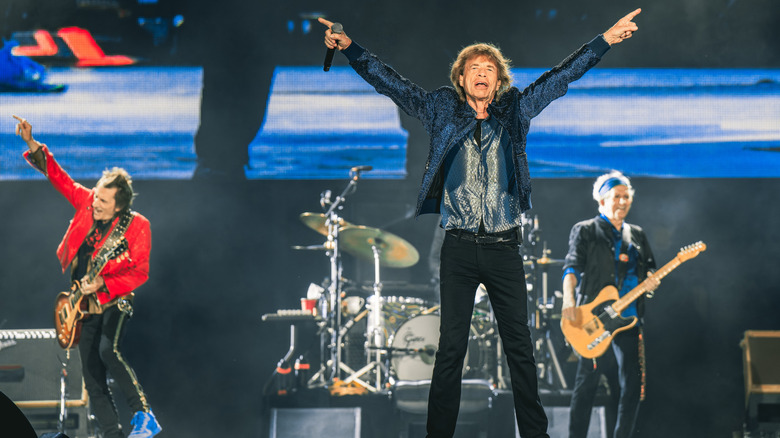
There are certain songs by the Rolling Stones that just feel like they're impossible to avoid. Generation after generation has heard "Paint It, Black" and "Gimme Shelter," the classic tracks that taught us Mick Jagger has a curious desire to paint red doors black or that he might fade away if he can't find shelter. There are countless examples of the songs' cultural ubiquity: From U2 to W.A.S.P., it seems like major artists can't get enough of covering "Paint It, Black," and "Gimme Shelter" is a recurring soundtrack piece in the films of Martin Scorsese.
So while we can't deny that "Paint It, Black" sounds so much cooler today, it doesn't give a proper picture of the Rolling Stones' diverse array of musical explorations. With that in mind, we wanted to delve into the Rolling Stones' back catalog and unearth some of the under-appreciated gems. Some of these songs were major hits, and others are fascinating deep cuts. But what each one demonstrates is that the Rolling Stones are a band with more to offer than a tiny handful of their most legendary tracks.
Anybody Seen My Baby?
By the 1990's, Mick Jagger and company were walking a precarious musical tightrope. The group was exploring modern production techniques and of-the-moment stylistic fads while still working to maintain their legacy reputation as the bad boys of British blues rock. As such, 1997's "Bridges to Babylon" features an array of experimentation, from the gospel-tinged "Saint of Me" to "Might as Well Get Juiced," a slow burning foray into techno. On the other hand, straight-ahead rockers like "Flip the Switch" maintain the classic Stones sound.
Landing in the middle of the album's ongoing battle between experimentation and rugged traditionalism is "Anybody Seen My Baby?" With its slow, snaky bassline and wailing, ethereal guitar work, it reflects the band's extraordinary maturation process since they started out singing "I can't get no satisfaction" with punkish abandon. It's that elder statesman quality that makes "Bridges to Babylon" so enjoyable, and "Anybody Seen My Baby?" is a supreme example.
The song was well received, climbing to No. 2 on Billboard's Adult Alternative Airplay chart as well as No. 3 on its Mainstream Rock chart and No. 1 on the Heritage Rock chart, while the album peaked at No. 3 on Billboard's Top 200. Adding to the song's mystique is the music video which follows an enigmatic Angelina Jolie through a metropolitan underbelly.
Mixed Emotions
The truth of Mick Jagger and Keith Richards' turbulent relationship is legendary. As such, "Mixed Emotions" arrived at a rocky time for the Rolling Stones. Tensions were running high between Mick Jagger and guitarist Keith Richards by the time the band convened to record "Steel Wheels." Both had released solo albums to varying degrees of success and come to realize that, irrespective of what the thought of one another, they were stronger together than apart. With that background in mind, the hook "you're not the only one with mixed emotions" feels like a meta commentary on the state of relations within the band.
From a musical standpoint, "Mixed Emotions" captures a reinvigorated Stones returning with a refined and confident take on the British Invasion sound that made them a hit in the first place. It's hard-driving blues rock on the faster side of mid-tempo with a chorus that hits like a relaxing shower after a long day. Underneath that inviting sound, however, is a deeper insight into the nature of strained relationships: reconciliation begins with an acknowledgement of mutual confusion and ambivalence.
For Mick and Keith, that musical couples therapy more than paid off: "Mixed Emotions" reached No. 5 on the Billboard Hot 100, and "Steel Wheels" was certified 2x platinum in the United States and 3x platinum in Canada.
Start Me Up
"Start Me Up," the first track on 1981's "Tattoo You," opens with a Keith Richards guitar riff in open G tuning and is soon joined by a straight-ahead Charlie Watts drum groove. It's a bold, confident statement kicking off one of the Rolling Stones' most enduring hits. While the song isn't anything deep or groundbreaking, it does serve to demonstrate that the Rolling Stones' signature sound was timeless and capable of sitting comfortably alongside the rapidly shifting musical tides of the 1980s.
A massive smash hit, "Start Me Up" shot to No. 2 on Billboard's Hot 100 while the album jumped to No. 1 on the Top 200. The song remains popular to this day with a wide range of cover versions, including a vintage Nintendo Entertainment System-inspired reimagining from the 8-Bit Misfits and an orchestral/rock band crossover arrangement by the British Rock Symphony as part of their "Celebration Suite."
She's a Rainbow
The album "Their Satanic Majesties Request" was widely derided as a poor man's attempt to capture the innovative surrealism of the Beatles' 1967 groundbreaking "Sgt. Pepper's Lonely Hearts Club Band." The comparisons aren't unwarranted: Both bands had shared a friendly rivalry since their inception, and the Stones' album plays liberally with the kind of psychedelic experimentation that made "Sgt. Pepper" such a landmark. But where the experiments on "Sgt. Pepper" yielded an internally cohesive and undeniably sincere result, "Satanic Majesties" feels disjointed and random with overtly needy appeals to the Summer of Love crowd.
Nevertheless, the album does offer its share of effective moment, with "She's a Rainbow" outstanding among them. The Stones' actual contribution is fairly simple: a woman, apparently variegated in some abstract manner, is cheerfully extolled in a simple, anthemic chorus. There are a couple of bridge-like interludes thrown in for good measure, but beyond that, it's really just an endlessly repeating hook intercut with studio session player overdubs. The song might be a wild derivation from the everyman angst of "(I Can't Get No) Satisfaction," but it does serve as enjoyable psychedelia.
The song reached a respectable No. 25 on the Billboard Hot 100 and the album made it to No. 2 on Billboard's 200. It's a strong showing for a largely perplexing album and the track later made a thematically appropriate appearance on an episode of Ted Lasso.
You Can't Always Get What You Want
The epic 7 minute, 30 second closer to "Let it Bleed" (the album which opens with "Gimme Shelter"), "You Can't Always Get What You Want" captures the Stones at their regal best. The lyrics reflect moments of personal aspiration and compromise — in relationships, life goals and politics — tied together with the gentle affirmation that despite life's ongoing setback, there's always hope for a better tomorrow if we just keep trying.
The LP as a whole reflects the Stones stepping out of the simplistic pop rock of their earlier recordings while avoiding the experimental excesses heard on "Their Satanic Majesties Request." Where that album saw the larger string, horn and piano overdubs being interjected at chaotic and seemingly random moments, "Let it Bleed" integrates them smoothly and coherently. Nowhere is that more apparent than on "You Can't Always Get What You Want" with its opening choral arrangement that manages to capture gospel and Anglican stylings in equal measure while horns and organ swell tastefully throughout the piece.
The song only made a modest impression upon its release — peaking at No. 42 on Billboard's Hot 100 — but the song went on to factor prominently throughout popular culture with appearances in films like "The Big Chill" and television shows such as "House M.D."