

5 Love Songs That Take Boomers Back To Their First High School Dance
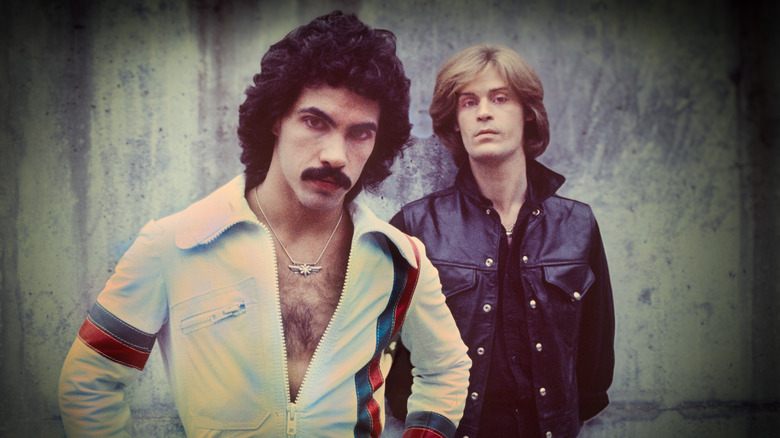
The baby boomers bore witness to an unprecedented boom (no pun intended) in the world of popular music. And in this explosion rose pop's most time-tested staple: the love song. Coming into high school age between roughly 1960 and 1980, boomers had more romantic tunes than ever before to fill their glory days with the music of young love. In that time, when homecoming, prom, and every other sort of dance seem like the most important nights in your young life, dancing to the right song with the right person can be transformative and create a lifelong memory.
We've compiled here five exemplary love songs that would have played in — and been the highlight of — high school dances from across the boomer era, starting with Etta James in '60 and going all the way to Hall & Oates in '80. Each tune is spaced apart by a few years to make sure the whole generation is represented, and most importantly, each is both a true love song and a swell number to dance to, whether slow or fast. Here, then, are five tracks that take boomers right back to the high school dance floor.
At Last — Etta James
By necessity, any compilation of outstanding love songs from the boomer era must either include Etta James or make an excuse as to why it avoided her. The praises of the Matriarch of the Blues can hardly be sung enough, and the same is true of her signature tune, the 1960 uber-ballad "At Last." The track has a perfectly pleasant string arrangement and chords that combine the darling innocence of the '50s sounds with jazz complexity. That said, it is James' voice and all the history and emotion so evident within it that elevates the song to its now-legendary status.
With its slowly bouncing pace and gentle strings, "At Last" is perfect for a slow dance. It's also a perfect love song, at least at the surface level. But beneath the obvious saccharine sentiment of lines like "The skies above are blue / My heart was wrapped up in clover / The night I looked at you" lies James' real pain and relief, emotions she subtly conveys better than most. The "At Last" for James is more than a love finally coming along. It's also James venting a portion of her pretty tragic life leading up to that point — the release of her debut album. The story of how James overcame regular abandonment and abuse throughout her childhood and early adulthood is a harrowing one, but luckily for us, she used it as fuel for her music, giving us peerless, powerful tracks like "At Last."
I Want to Hold Your Hand — The Beatles
In a very real way, the Beatles defined a generation. For a period in the mid-'60s, the Beatles set the standard for pop singles, at one point evidenced by their unbelievable milestone of holding all five of the Top 5 spots on the BillBoard Hot 100 at once. One of those five chart-toppers was the 1963 single "I Want to Hold Your Hand," a love song with lyrics about as pure as driven snow. Its steady uptempo rhythm is perfect for twisting and, although perhaps not shouting, at least some polite and chaperone-approved cheering.
One of the reasons "I Want to Hold Your Hand" stands out as a perfect high school dance song is that it was the band's first song to hit No. 1 in America. As you'd expect, it became a smash sensation with teens (and based on sales numbers, a good chunk of every demographic) countrywide. The song, like the band itself, was an almost immediate and universal sensation, making it a must-play at any dance in '64 and certainly beyond.
Unlike later Beatles work, "I Want to Hold Your Hand" is simple and obvious — it seems to take a first-thought approach to songwriting. But when you're the Beatles, the first thought is often genius, and the same is true here. By leaving their yearning in terms as simple as "And when I touch you, I feel happy inside," the Fab Four created an endearing and yet entirely inoffensive song that's perfect for evading those pesky school censors.
Ain't No Mountain High Enough — Marvin Gaye & Tammi Terrell
Duets naturally lend themselves to love songs for obvious reasons. Yet few have found as instantly magical and iconic a pairing as Marvin Gaye & Tammi Terrell, whose 1967 version of "Ain't No Mountain High Enough" seemingly can't be praised enough. The song, originally written by Ashford & Simpson, has garnered a host of accolades through the years and topped a number of best-of lists. Tellingly, it has never gone long without achieving new relevance through a new cover version or inclusion in some movie or TV segment.
Maybe the greatest feat of Gaye & Terell's recording is establishing itself as the song's definitive version despite an exceptionally dynamic and playful cover (especially in the extended album cut) by Diana Ross only three years later. The reasons why Gaye & Terrell edged out Ross aren't quantifiable, exemplified by the fact that Ross's version charted far better. Instead, they come down to sheer lightning-in-a-bottle chemistry and talent.
Interestingly, Terrell was originally going to sing "Ain't No Mountain High Enough" solo, but as arranger Paul Riser told The Wall Street Journal, a last-minute production idea led to the song's magical duet. "Months earlier, Marvin had a hit with Kim Weston on 'It Takes Two,'" Riser recalled. "So Marvin was added to Tammi's record to help its odds on the charts." He added that "[Marvin] overdubbed his vocal so it wrapped around [Terrell's], as if the two of them were in love, singing to each other in the studio," a sentiment that sums up the pair's undeniable chemistry well.
Let's Stay Together — Al Green
Before anything else, the first thing that needs to be said about Al Green's soul ballad "Let's Stay Together" is that there might not be another song on earth that can match its smoothness. Green's tender, breathy vocals and effortless riffing through scales elevate the song to rarified air for a love song: Absolute, unchecked sentiment without ever overdoing it and drifting into schmaltz territory. For further proof of Green's suaveness, compare his energizing cover of the aforementioned "I Want to Hold Your Hand" to the Beatles' original. With no disrespect to the Fab Four, Green only minimally reinterprets their song and brings it to a whole new level of cool.
"Let's Stay Together" was a smash hit in 1971, and with good reason. Green himself wrote the song, and that proves its apparent earnestness true. Perhaps surprisingly for such a beloved soul masterpiece, the song was written by Green in a matter of minutes and was not a track he even felt confident in releasing until producer Willie Mitchell convinced him otherwise. As the pair have both stated over the years, despite the usual clashes between musicians with two different takes, Mitchell was able to get the best out of Green, and possibly the best the singer ever laid down was "Let's Stay Together."
You Make My Dreams — Hall & Oates
There aren't many love songs written that are as instantly fun to dance to as Hall & Oates' 1980 hit "You Make My Dreams." And we do mean instantly. Within the song's first second, two bouncing piano notes set the jaunty tone for what will eventually become three minutes of pure, joyful celebration. For the final cadre of boomers that came of age as the '80s began, it was the perfect bubbly dance track to let loose to. And on top of all the infectious chipperness (or arguably hidden beneath it), "You Make My Dreams" is also a pretty deftly penned love song.
In the first verse, Daryl Hall flexes a bit of the pair's poetic muscle, singing, "What I've got / Full stock of thoughts and dreams that scatter / And you pull them all together / And, how? I can't explain." The assonance shared by "stock" and "thoughts" makes the line flow expertly, and the subtle imperfect rhyme of "scatter" and "together" is the kind of lyricism you'd expect of an actual poet, not a squeaky-clean and at times saccharine pop duo. But artistry like that is one of the many reasons why Hall & Oates were so beloved in their time and have managed to remain so to this day. Though John Oates has attributed the song's continued success to its memorable inclusion in the bittersweet rom-com "500 Days of Summer," the real reason is its unquestionable charm, as a whole generation of boomers can attest.