

Paul McCartney Co-Wrote This 1973 Theme Song —18 Years Later, A Hard Rock Cover Won A New Generation
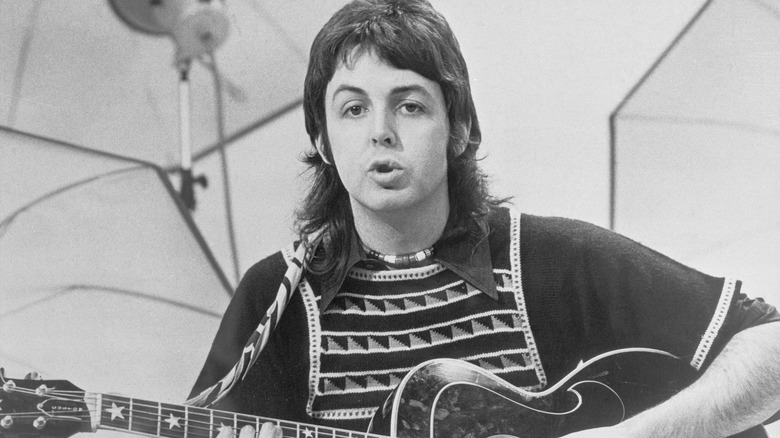
Few of Paul McCartney's critics in the early 1970s could have imagined that, nearly two decades later, one of his post-Beatles hits would be successfully covered by one of the heaviest hard rock outfits of the late 1980s and early 1990s. But "Live and Let Die," one of McCartney's biggest songs with his band Wings, found a second life in the setlists of Los Angeles rock legends Guns N' Roses, proving McCartney's songs often had more bite than naysayers might imagine.
McCartney sometimes attracted the nickname of "the cute Beatle" – a moniker he hated — and his music is often characterized as being in the same mode. Indeed, when his working relationship with his songwriting partner John Lennon was becoming more difficult, Lennon famously dismissed some of McCartney's songwriting as "granny music."
But the characterization is far from accurate; just listen to "Helter Skelter," the 1968 McCartney composition from the Beatles' "White Album," to hear how he pioneered heavy metal before the term even existed. "Live and Let Die," meanwhile, is a track that demonstrates just how multifaceted McCartney's songwriting can be.
Paul McCartney's Bond movie banger
"Live and Let Die" was recorded during the sessions for the 1973 Wings album "Red Rose Speedway," but it was actually commissioned for the James Bond movie of the same name. Composed by Paul McCartney and his wife, Linda, who was also a founding member of Wings, it was requested by the movie's producers, Harry Saltzman and Albert R. Broccoli. The McCartneys used Ian Fleming's 1954 novel as inspiration.
The song begins as a ballad — one seemingly as sweet as any McCartney had produced up to that point — before exploding after the opening bars into a grand, theatrical hard rock epic capable of soundtracking a mass market blockbuster. As well as heavy hard rock passages that see the whole band thrashing in unison, the song is marked by the reunion of McCartney and former Beatles producer George Martin, who provides orchestral sections that add cinematic flourishes to the song.
"Live and Let Die" veers between slower tempos and more frenetic passages, providing all the mixed textures and unpredictability you would hope for from the movie it soundtracks. It proved to be a huge hit as a single for Wings, peaking at No. 2 on the Billboard Hot 100, earning gold certification, and hitting No. 9 on the British singles chart. It has remained a high-octane staple of McCartney's live shows ever since.
GNR's Live and Let Die
Guns N' Roses obviously appreciated the show-stopping grandeur and live potential of Wings' "Live and Let Die." The band began incorporating their own version of the song into setlists for live shows in 1991, playing it more than 50 times that year alone. While the balladic parts of the song, such as the intro, are played relatively straight — but with Axl Rose's natural sneer adding some viciousness to the title lyric — the orchestral passages are given a greater hard rock treatment, with distorted guitar and bright keys largely replacing the strings of the Wings original.
The track was a staple of Guns N' Roses' live shows for years, with the band performing it more than 800 times. In 1991, they cut a studio version of the track for the platinum-selling "Use Your Illusion I" album; it was released as a single, hitting No. 33 on the Billboard Hot 100 and No. 5 on the British singles chart, and earning a Grammy nomination for best hard rock performance. McCartney has praised GNR's reimagining of his classic track, telling an anecdote that in the early 1990s his children would brag in school that their dad had written the song, only to be told they were lying.