

The 5 Best Village People Songs That Aren't YMCA
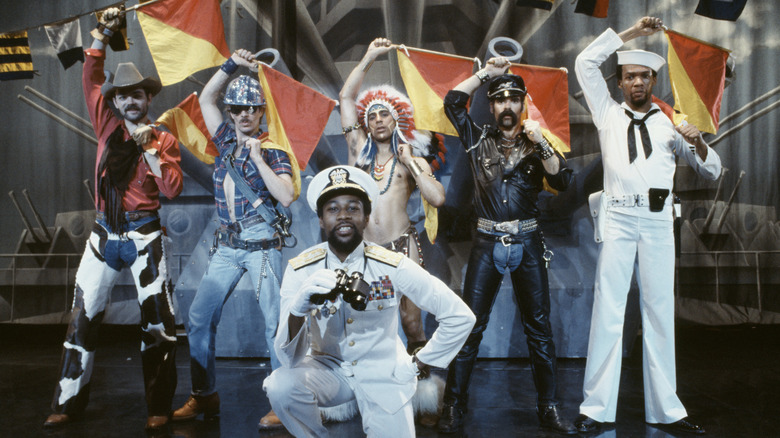
Who would've expected a team of costumed disco singers like the Village People to become a lasting force in the music world? "Y.M.C.A.," the high school hit with supremely singable lyrics and a spell-along line dance, is a sure-fire crowd-pleaser, but these talented performers have more than just that inescapable tune in their collective jukebox.
Revisit the best-known tunes from their musical heyday, and you'll find showy performances and upbeat songs that set the stage for partying positivity. The crew's flashy character costumes that jibed with hyper-masculine archetypes and coordinated dance routines may have overpowered the sounds they created, but their musicianship was a vibrant moment in pop music history. In the process, they became a pop culture sensation and groundbreaking icons for the gay community.
There's undeniable overlap in the songs Village People became famous for, namely the high-energy disco rhythms and representative arrangements that gave dance music of the '70s its instantly recognizable personality. Not to be deterred, we've gathered the most iconic of the group's hits, from radio staples such as "In the Navy" to optimistic and adventuresome marches like "Go West." And we couldn't ignore the anthemic "Can't Stop the Music," which gave the team a fiery title tune from their very own musical film — a pinnacle that may have seemed like simple cheeseball entertainment, but we think also declared the popularity of this one-of-a-kind act.
Macho Man
The gruff, almost barking chorus of "Macho Man" made the Village People sound like a pub filled with rowdy sots raising their mugs in an almost sea shanty chant. This was the group's first appearance in the Billboard Top 40, a No. 25 hit that fired up the club scene when the disco movement was in full swing. The accompanying music video wasn't shy about showing off the band's toned flesh, as well as interspersed clips of faceless gym bros flexing and getting their reps in. It was spirited and good-humored, and more than a little exploitative; the lyrics depended heavily on repeated variations of the line "Wanna feel my body?," so the sensuality here was anything but hidden.
On the surface, there's a longing to fit in with the pretty people: "Every man wants to be a macho, macho man / To have the kind of body always in demand." Underneath, the message reinforced the characters played by the members of the group — stereotypical "macho men" who turned the archetypes into onstage role-play for the world to see.
It was this soft sell of gay culture that made the Village People a massive crossover success and paved the way for future acts to push the envelope further. Even a mega-hit like "Physical" by Olivia-Newton John, where playful innuendo is disguised as fitness culture, owes a debt to what the '70s disco-defining song "Macho Man" made possible.
In the Navy
If the YMCA wasn't adventurous enough for you, the Village People had another endorsement in mind. "In the Navy" listed off the virtues of signing up for a stint on the high seas: "Where can you find pleasure, search the world for treasure / Learn science technology? / Where can you begin to make your dreams all come true / On the land, or on the sea?" They made it sound like an ocean-bound junior college adventure.
The music video was shot on a live warship, the USS Reasoner, with the intention of the U.S. Navy using the song as its recruitment theme. The chant "They want you, they want you / They want you as a new recruit" was a radio-ready slogan. But when news outlets blasted headlines about government money funding a promotion with a sexually ambiguous act, the project was nixed, though the official word from the Navy to Village People creator Henri Belolo was that the budget couldn't support the promo.
Nonetheless, the suggestive sentiments sprinkled throughout the lyrics in "In the Navy" alerted savvy listeners that the Village People knew what they were doing. For an act in the '70s, even hinting at its LGBTQ+ reality was risky business. But this crew delivered the in-jokes with enough commercial pizzazz to create layers all listeners could appreciate, helping make the song a No. 3 hit.
Go West
"Go West" cleverly interpolates the melody from Pachelbel's Canon, reinvented with horns and strings to become the foundation for a disco classic. It has the same bright, anthemic energy the group became known for, this time pushing positivity about the West Coast. With lines like, "(Together) We will fly so high / (Together) Tell our friends goodbye / (Together) We will start life new / (Together) This is what we'll do," it also has that thread of starting a whole new existence somewhere else.
Beyond the ideas of hitching your showbiz wagon to a star, the dream-like qualities of California for East Coasters like the group's members were just as romantic. "(Go west) Sun in winter time," as the chorus goes, "(Go west) We will do just fine / (Go west) Where the skies are blue." Whether listeners tuned in to the prospect of a different experience for members of the gay community in California or for just starting a new life in a better climate, the Village People sang of the possibilities of something great for anyone brave enough to make their move.
In Hollywood (Everybody is a Star)
The idea of becoming something more than you already are crops up in several of the Village People's tunes, most notably in the R&B-heavy "In Hollywood (Everybody is a Star)." There's no mistaking the intention here: If you want to make a name for yourself, heading to Tinseltown is a sure-fire way to get started. But the lyrics make it clear that the sacrifices are deep and self-reinvention is part of the devil's bargain: "Take a bus, a train or a plane to Hollywood / Go there and then change your name / You dye your hair out there, it's part of the game / You're gonna be a star, a big star." In the influencer-free pre-internet world, that was the plan for many starry-eyed youths who pictured themselves in the world of fortune and fame.
Of course, the group was celebrating the go-get-'em spirit required to abandon your ground-level life in hopes of scaling the silvery heights. Even if Hollywood failure stories were a dime a dozen, nobody in this song plummets. "Everybody is a star in Hollywood," the Village People sing, as if they know something we don't about longing for something and going after it. Maybe the message isn't about becoming famous at all; perhaps it's a form of permission for taking a chance in a new place, becoming who you are, and feeling like a superstar no matter where you land. Encouragement like that is always welcome on the playlist.
Can't Stop the Music
Village People were big enough in 1980 to become the subject and stars of their own musical feature, "Can't Stop the Music." This was no small production; major stars of the day Valerie Perrine and Steve Guttenberg starred as a pair struggling to get a record deal, drafting the Village People members as singers from Greenwich Village to help beef up their demo. The script was written by Allan Carr, still basking in the success of 1978's blockbuster "Grease," and the story was a hat tip to the assembly of the real Village People — all of whom played themselves in the movie.
None of this was a recipe for success, however. The Village People movie was a colossal bomb, but the theme song is one of the most memorable tunes arising at the tail end of disco mania. It's another uplifting anthem of positivity, declaring, "You can't stop the music, nobody can stop the music / Take the spark from love, make the rain fall up / 'Cause that's easier to do." The song may have referenced the characters striving to find fame as musicians, but you can replace "music" with just about any goal and pump yourself up with the tune. And if you simply enjoy the idea that music is a force that can't be extinguished? The song works perfectly well for that, too.