

5 Jimi Hendrix Songs That Prove 1967 Was The Best Year Of His Career
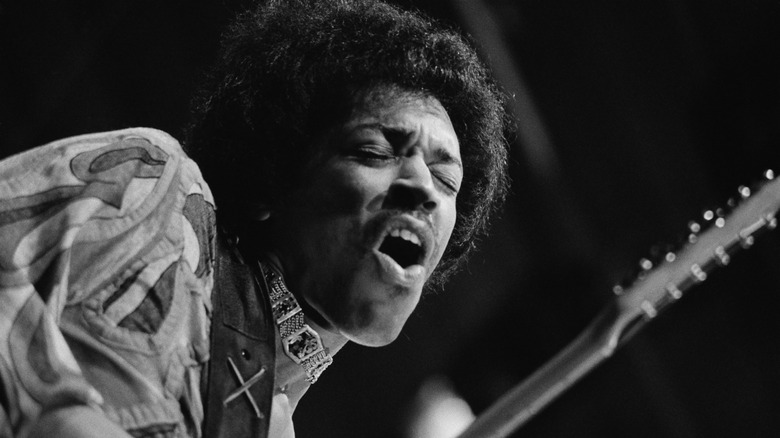
Jimi Hendrix only released three studio albums before his tragic death in 1970 at just 27 years old. Yet more than five decades later, he's still in the conversation when it comes to the greatest or most influential guitarists in rock. In 1967, his star rose quickly with the release of his first two albums, "Are You Experienced" and "Axis: Bold as Love." Thanks to the chart success he had that year, coupled with his breakout performance at the Monterey Pop Festival, we argue that 1967 was the best of his career.
Obviously, Hendrix fans will have opinions, and his 1968 album "Electric Ladyland" has plenty of stand-out songs as he delved deeper into his craft, including his biggest U.S. hit, "All Along the Watchtower." In 1969, he electrified Woodstock with his iconic rendition of "The Star-Spangled Banner." Still, 1967 was when Hendrix was going pretty gangbusters in the U.K., where he went to kick off his career and where he ultimately spent his last days. Ironically, he never charted as well in the U.S. as he did in the U.K., but pop charts are not always the best measure of songs that stand the test of time, and Hendrix is certainly a legend for more than a few hits.
As one of the architects of psychedelic rock, he took listeners on sonic journeys. He did this not only with his guitar prowess but also because he was an effects-pedals geek, pioneering new sounds in real time as they were being invented, imbuing his songs with aural color. In 1967, Hendrix introduced rock fans to something brand new. Here's a look at the songs that made that year the best of his career.
Hey Joe
Jimi Hendrix's sultry prowess on guitar in "Hey Joe" should always be the gold-standard jukebox pick in dive bars. But even if that's not your bag, listening to the song will take you there because that's what Hendrix did — he took us on a sonic journey. This was the song that put him on the map in 1967, though it had been around for a few years, played by various artists but not doing much commercially. Hendrix actually recorded it in 1966 and released it as a single in December ahead of making it the third song on the U.S. version of Jimi Hendrix Experience's debut album, "Are You Experienced."
"Hey Joe" went to No. 6 in the U.K. charts in February of 1967, which was also the Summer of Love not only in California but also in London. By today's standard, it may seem antithetical that a song about shooting your "old lady" for "messing around" with another guy would be a great starting point for an artist's first release when everyone was supposed to be all peace and love. In Hendrix's hands, though, with his singular tone and his loose delivery feeling something like controlled chaos, the track just worked. As one YouTube user said, "Back in 1967 this sounded like it must have come from a parallel universe. 50 years later and it's still the coolest thing to ever hit the airwaves."
Purple Haze
Since we're talking about Jimi Hendrix's career success, we can't write this list without including "Purple Haze." This one was penned by Hendrix and became his highest-charting song in the U.K. at No. 3 in May of 1967. It only made it to No. 65 in the U.S., but again, though Hendrix was an American, it was in the U.K. that he initially flourished as a professional musician. According to Classic Rock, Hendrix once spoke of "Hey Joe," saying, "That record isn't us. The next one's gonna be different." And it was.
"Purple Haze," like "Hey Joe," was released as a single but also included on "Are You Experienced." The song comes in hot with driving guitar and urgent lyrics from Hendrix. Powerful and innovative, it was the first song to incorporate the Octavia pedal, creating a sound people hadn't heard before. To this day, that opening riff lets people know exactly where they're going. It's a thrashing, hard-hitting moment of psychedelia that melted faces at the Monterey Pop Festival in 1967 as the second-to-last song Hendrix and the Experience played before closing out his set with "Wild Thing" and setting his guitar on fire. In the book "The Heart of Rock & Soul: The 1001 Greatest Singles Ever Made," Dave Marsh said, "'Purple Haze' could be characterized as the debut single of the Album Rock Era, the first whose purpose was serving notice that the artist was up to something that could not be contained within this three-minute segment."
The Wind Cries Mary
Jimi Hendrix was on fire in early 1967 when he had three songs from his debut album land in the top 10 of the U.K. charts. His third hit, "The Wind Cries Mary," was introduced as a single just a week before the full album, "Are You Experienced," came out on May 12 in the U.K. (It came out in August in the U.S.). The first week of June, the song peaked at No. 6. By then, the other aforementioned hit singles had already created a buzz, as had his captivating live performances.
"The Wind Cries Mary" showed a softer side of the guitarist. The song is certainly the most personal of Hendrix's tracks on this list, and its tenderness was inspired by a fight with his girlfriend at the time. The track is lilting and gentle with thoughtful lyrics like, "A broom is drearily sweeping / Up the broken pieces of yesterday's life / Somewhere a queen is weeping / Somewhere a king has no wife / And the wind it cries, 'Mary'". But make no mistake, Hendrix still gets some impressive, if subdued, guitarwork in. "The Wind Cries Mary" may not be the go-to for hardcore Hendrix fans who want to hear him shred, but unlike some of his songs, it lent itself well to radio play and helped keep him propelled in the mainstream in 1967.
Bold as Love
The Jimi Hendrix Experience put out their sophomore album, "Axis: Bold as Love," at the end of 1967, but that record didn't spawn hits like "Are You Experienced" did. While there are exemplary tracks on "Axis," like the melodic "Castles Made of Sand" and the cool-grooving "One Rainy Wish," it's the slow-burning "Bold as Love" — the final track on the album — that showcases so much of why Hendrix is such a legend. At four minutes and 11 seconds, the song is long by 1967 standards, but that's why it's great. It lets Hendrix stretch out a bit, and if ever a guitarist deserved space to stretch, it's James Marshall Hendrix. He got to do a little more of that on his 1968 album, "Electric Ladyland," but in 1967, when he was still a newbie, songs were usually around three minutes long because that's what fit on a 45 RPM disk, aka a single.
"Bold as Love" brings that aural color into the lyrics, with metaphorical lines like, "My red is so confident, he flashes trophies of war / And ribbons of euphoria / Orange is young, full of daring / But very unsteady for the first go 'round / My yellow in this case is not so mellow / In fact, I'm tryin' to say it's frightened like me / And all of these emotions of mine keeps holdin' me from / Givin' my life to a rainbow like you." People credit the Pixies with the loud-quiet-loud song dynamic, which Nirvana also used, but you can hear that style being pioneered in "Bold as Love" way back in 1967.
Little Wing
Jimi Hendrix didn't know it at the time, but his song "Little Wing," included on "Axis: Bold as Love," would go on to be one of the most beloved songs of his career. It's also something of an outlier. Almost like a lullaby, Hendrix weaves a gentle melodic tapestry in a brief two-and-a-half minutes that speaks of a free-spirited woman who comforts him. The lyrics are a blend of far-out hippie themes, introspection, and fantasy, but "Little Wing" probably didn't go on to be one of Hendrix's most streamed songs on Spotify just for the lyrics. As we saw with Stevie Ray Vaughan's version, the music is so beguiling that it's enough just to listen to it as an instrumental that showcases the guitar.
Like so many "flop" songs from the '60s that have earned respect from younger generations, "Little Wing" is Hendrix's most covered song today, according to Second Hand Songs. While it didn't make it onto any charts when Hendrix was alive, over the decades, tons of bands from a variety of genres have covered it, including Pearl Jam, Tedeschi Trucks Band, Santana with Joe Cocker, Skid Row, Derek and the Dominoes, the Corrs, Sting, Egovertigo, and Valerie June. Hendrix's output in 1967 brought him career success that was not only instant but has also stood the test of time.