

The 5 Most-Covered Songs Kenny Rogers Ever Recorded
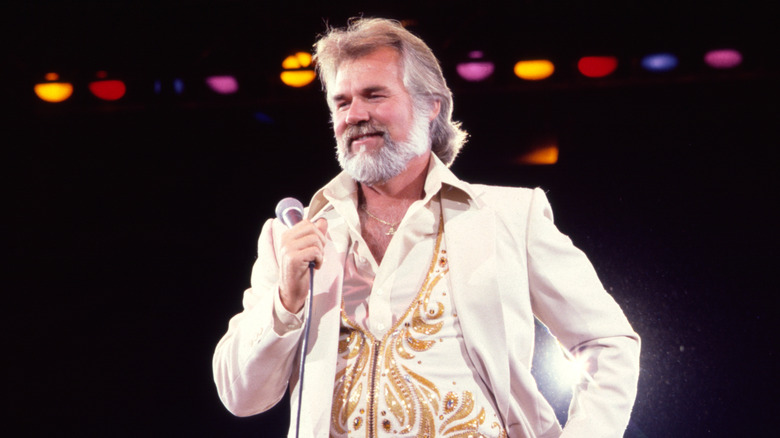
With a warm, velvety baritone, Kenny Rogers was a peerless interpreter of songs, and he made each his own, regardless of whether he wrote it or not. So, it's little wonder that some of his most-cherished hits are also the most covered by other artists. Across genres, decades, and language barriers, various renditions of his songs crop up, breathing new life into them and adding to their legacy.
Artists you'd expect, such as Johnny Cash, and some you never would, like Leonard Nimoy, have all taken a swing. "Sweet Music Man," a modest '70s hit for Rogers, has become a set list staple for generations of guitar pickers and crooners. Covers of classics like "The Gambler" and "Ruby, Don't Come to Town" come in many styles and languages, finding second lives in genres beyond country, including pop, alternative, punk, and indie rock. Coming in as many flavors as there are musicians interpreting them, each version reminds us of what makes Rogers' music so timeless. Indeed, his songs from the '60s and '70s sound even cooler today, in part, because there are so many renditions.
Since emerging in the late 1950s until he passed away in 2020, Rogers slid between genres, while always sounding like himself. That's why bands and musicians of all stripes have dipped into his extensive catalog and pulled up brilliant results. If 24 No. 1 charting hits or 12 No. 1 records on the Billboard Hot 200 aren't proof that Rogers was a force of nature, we don't know what is, and covers of his songs continue to delight.
The Gambler
The song that gives you a primer in poker table strategy, the title track of Kenny Rogers' LP "The Gambler" spent three weeks on top of the Billboard Hot Country charts in 1978 and reached No. 16 on the Hot 100 the next year. A breakout hit for legendary Nashville songwriter Don Schlitz — with Bobby Bare recording a version before Rogers — it's a catchy sing-along staple. Johnny Cash also recorded the tune around the same time, though his sessions were affected by substance misuse issues, making that version a bit flat.
But once Rogers' version laid down the tracks, a trainload of covers came chugging through. "The Gambler" crossed the pond, polishing itself up and gracing English acapella group the King's Singers' 1980 album "New Day." It sits between songs called "Du gör som du vill" and "Eva, din mjuka Eva" on Swedish dance-pop band Jigs' 1982 album "Shirley." If you prefer the melody to the words, there's German composer and arranger Kai Warner's instrumental version from his "It's Country Time" album.
Well into the 21st century, covers of "The Gambler" have continued to dispense card-playing advice to audiences. California band Slightly Stoopid, which came up in the '90s blending rock, funk, punk, reggae, and metal influences, released a surprisingly mournful version in 2020. And at the 61st Academy of Country Music Awards in May of 2026, country superstar Blake Shelton closed the show with a riveting version, which whipped the crowd at the MGM Grand in Las Vegas into a frenzy.
Islands in the Stream
Teaming up with country music icon Dolly Parton always seemed to pay off for Kenny Rogers, and that's certainly the case with their 1983 duet and Billboard Hot 100 No. 1, "Islands in the Stream." Originally written as an R&B song by Robin, Barry, and Maurice Gibb of the Bee Gees, the pop country crossover became the perfect vehicle for the two artists to collaborate. The way they hit their harmonies in the chorus — "And we rely on each other, ah ah / From one lover to another, ah ah" — will always give us chills. And because it is so catchy and poppy, "Islands in the Stream" has been covered by a wide range of artists over the years.
Barry Manilow and Reba McEntire's version on Manilow's "The Greatest Songs of the Eighties" album from 2008 enhances the groove by giving it a disco-like makeover. On the other end of the spectrum is the minimal, hypnotic cover by indie rockers the Constantines and singer-songwriter Feist. And a Danish language version by Anne Grete and Peter Thorup, "Skibe uden sejl," proves that love duets can play anywhere.
Joining this extensive list is the Bee Gees' own live rendition on 1998's "One Night Only" album. Yet another vehicle for the Gibbs brothers' tight harmonies and on-stage chemistry, the song sounds right at home.
She Believes in Me
Another entry off "The Gambler" LP, "She Believes in Me" is pure Kenny Rogers pop gold: an emotional song that declares unabashed love. With a lush arrangement that features strings, piano, and a choir, it adopts the voice of a struggling musician, singing about his partner, who supports and loves him despite his choice of career. "She Believes in Me" climbed into the Top 10 of the Billboard Hot 100 and topped the Hot Country and Adult Contemporary charts in 1979. The subject matter is near and dear to any musician, which, along with the song's success and timeless emotional range, is undoubtedly why it continues to be covered.
One of the most striking renditions of "She Believes In Me" comes from Johnny Mathis on his 1979 album "Mathis Magic." The arrangement is nearly perfect '70s pop, and the singer's velvety tenor adds extra weight to lines like "But she has faith in me, and so I go on trying faithfully." The song also traveled the world and blasted into multiple genres. Dutch crooner Lee Towers' version appears on his "Sincerelee" album from 1980, and the R&B group All-4-One released a gorgeous rendition in 2015. And then there's Me First and the Gimme Gimmes' pop-punk cover, which strips the tune of pop adornments, adds buzzing amps, and channels raw emotion.
Sweet Music Man
Sometimes, inspiration sits down next to you on an airplane. Kenny Rogers was moved to write "Sweet Music Man" after talking to Jessi Colter about her marriage to country star Waylon Jennings on a flight to Nashville, Tennessee. The lyrics tell you things weren't going great, and lines like "And nobody else can make me feel / That things are right when you know they're wrong" are devastating. Of course, that was just the kernel, and by giving voice to the heartbreak of someone who made the mistake of falling for a musician, "Sweet Music Man" resonated widely and has become a country-crooner staple.
In 1977 alone, it closed out Dolly Parton's "Here You Come Again" album and appeared on Tammy Wynette's "One of a Kind." And decades later, Reba McEntire recorded a version for her 2001 "Greatest Hits Volume III: I'm a Survivor" album. And then there's the song's subject, Jennings himself, rendition from the 1980 album "Music Man." Waylon Jennings' rich singing voice, soaring above a haunting, spare arrangement, infuses even more longing and regret into the material. There's a case to be made that his cover is even better than the original.
Ruby, Don't Take Your Love to Town
Before pop country superstardom, Kenny Rogers fronted the folky, psychedelic rock band the First Edition (later Kenny Rogers and the First Edition) in the '60s. Released in 1969, "Ruby, Don't Take Your Love to Town" was the band's second Top 10 charting single, and you can hear why it was a hit. Penned by Nashville singer-songwriter Mel Tillis, it gives voice to a disabled World War II veteran begging his partner not to go out and seek love elsewhere. No doubt, lines like "It wasn't me that started that old crazy Asian war" also resonated with audiences as the Vietnam War still raged.
While Rogers' version no doubt defines "Ruby, Don't Take Your Love to Town," a multitude of artists covered this classic, and several versions actually precede the First Edition's, including Tillis'. But beyond country music and for the decades since, the song has taken flight. It swings in French with Eddy Mitchell's "Tu Reviens au Pays," and Gerhard Wendland's German version, "Ruby, schau einmal über'n Zaun," is just as heartrending. Eclectic funky alt rockers Cake's version, released on the "B-Sides and Rarities" album in 2007, is surprisingly true to the original.
But a cover that will always live long and prosper for us comes from Spock. "Star Trek" actor Leonard Nimoy's version from the 1970 album "The New World of Leonard Nimoy" is stunningly raw and emotional. It'd be illogical not to love it.