

The 5 Most Unexpected Rock Collabs Of The '70s & '80s
Rock music may not be as old as some art forms, but so far, it's served up a healthy dose of eyebrow-raising moments. We know the music industry of the trippy '60s had a dark side, but the decades that followed were also a breeding ground for strange yet true rock stories. The 1970s and '80s saw some remarkable collaborations between artists who, under normal circumstances, we would never have imagined in the same room, never mind producing music together. Looking back, though, should we expect anything less from the era that gave us both disco and hair metal?
As we're about to reveal, the results of these unlikely collaborations are more intriguing than we might at first have imagined. One of our selections bridged the generation gap, while another was the result of good timing and maybe even a romantic connection. One collaborator was literally an international fugitive, while another unexpected team-up put a fading act back in the limelight. So, sit down and strap in for our selection of unexpected rock collabs from the '70s and '80s.
The Sex Pistols and Ronnie Biggs
Whatever your opinion about the Sex Pistols, there's no denying their massive impact on music in the United Kingdom and beyond. The quartet split in January 1978, though the reasons the Sex Pistols broke up had nothing to do with the baffled public or horrified government officials who greeted them on their first and only U.S. tour. Undeterred by the departures of both John Lydon and Sid Vicious, manager Malcolm McLaren decided he could still sell the Pistols as a marketable commodity with a new frontman, and he chose the most unlikely of figures to fill Lydon's boots: convicted robber and prison escapee Ronnie Biggs.
Biggs was part of the notorious gang behind England's 1963 Great Train Robbery. He escaped from prison in 1965 and fled to Brazil, where he was living when McLaren called him and asked if the band could visit. Biggs agreed, and, according to him, the idea of jamming with the Pistols was just a bit of fun. The resulting ditty, "No One Is Innocent, a Punk Prayer by Ronnie Biggs," featured in the soundtrack to the 1980 Sex Pistols biopic "The Great Rock 'n' Roll Swindle," though it was banned by the BBC, and U.K. radio stations refused to play it.
Biggs' lack of musical talent wasn't an issue, but his lyrics definitely were. "No One Is Innocent" referenced German Nazi official Martin Bormann as well as convicted murderers Myra Hindley and Ian Brady. Biggs told the Record Mirror in 1978 (via sexpistols.net) that if God was going to save the queen, then "he has to save everybody or nobody. Because, no one, absolutely no one, is innocent."
David Bowie and Bing Crosby
David Bowie partnered with so many artists during his career that it makes for an eye-popping A to Z list. But in the "B" section lies one of his most memorable collabs: a 1977 duet with legendary crooner Bing Crosby. It's an iconic moment in which two diametrically opposed artists showed each other and their audience just how good they were. It didn't get off to the best of starts, though; Bowie agreed to appear in Crosby's "A Merrie Olde Christmas" TV special for some much-needed positive publicity, but he loathed the chosen song, "Little Drummer Boy." A workaround was created that allowed Bowie to sing "Peace on Earth" instead, giving him his own particular spin on the duet.
Although that issue was quickly resolved, the weird vibe between the two men lingered. Bowie later spoke about Bing, telling Q Magazine (per Rock's Back Pages), "He looked like a little old orange sitting on a stool," and "there was just nobody home at all, you know? It was the most bizarre experience."
Bowie wasn't the only one to have reservations about the collab. Nathaniel Crosby, Bing's son, remembered seeing the "Space Oddity" singer as he arrived on set wearing a full-length mink coat, makeup, and bright-red hair. "It almost didn't happen. I think the producers told him to take the lipstick off and take the earring out," he told Billboard. Bing, who died just a few weeks after taping the duet, said Bowie was "a clean-cut kid and a real fine asset to the show. He sings well, has a great voice, and reads lines well" (via Rebeat).
Carly Simon and Mick Jagger
The number of column inches that have been devoted to precisely who Carly Simon is singing about in her anthemic diss track "You're So Vain" could probably encircle Earth by now. While Simon confirmed in 2015 that the second verse was about Warren Beatty, the far more interesting story concerns who she worked with to record the 1972 song that topped the Billboard Hot 100 the following year. Although he's uncredited, Rolling Stone frontman Mick Jagger, long rumored to be one of the song's subjects, provided backing vocals for "You're So Vain."
In a 1995 interview for CBS' "This Morning," Simon recalled that she was in a London recording studio when Jagger "happened to call ... while I was doing the background vocals with Harry Nilsson." She said the singer asked what she was up to, and Simon invited him to "come down and sing with us." Shortly after, the trio were hard at work in the studio singing the vocals to "You're So Vain."
Now, fans of the record might be a little confused because we don't hear three voices, but Simon explained why: "Harry was such a gentleman, he knew that the chemistry was between me and Mick, in terms of the singing, and so he sort of bowed out." Whether that frisson was because Jagger really was who she was singing about in one of those two other verses as rumors have claimed, we'll probably never know.
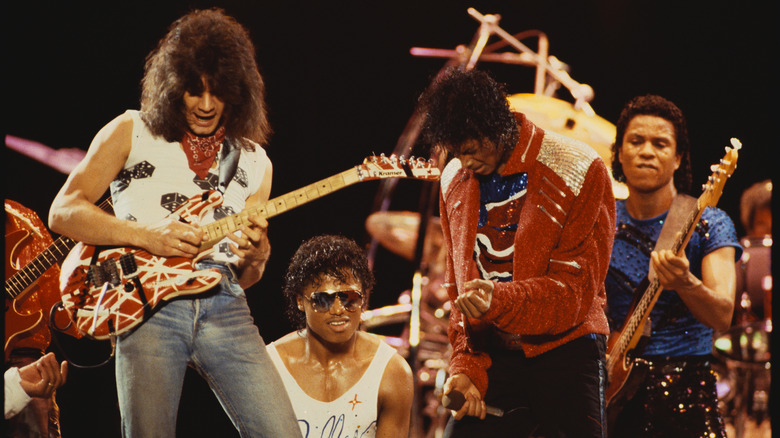
Eddie Van Halen and Michael Jackson
So, you're in a band with an agreement not to work on anyone else's music. But when a legend like Michael Jackson asks for help with the 1983 song "Beat It" and your bandmates aren't around to tell you no, what do you do? Or, as Eddie Van Halen told CNN in 2012, "Who is going to know that I played on this kid's record?"
Van Halen explained the unlikely collaboration came about as a favor to Quincy Jones, and — once he determined it really was him — who's going to say no to a producer of his stature? The guitarist dropped into the studio and listened to the song while Jackson popped out to work on another project. Van Halen didn't like what he heard and asked if he could change a few things, telling Piers Morgan in 2013 that there were "no chord changes underneath it." When Jackson came back, he gave Van Halen's version the thumbs up.
"It took about 20 minutes of my life," the guitarist said. But what was supposed to be a secret had no hope of staying under wraps. He told CNN how a couple of kids listening to "Beat It" in a record store mocked the soloist's efforts to mimic Van Halen, prompting him to admit it was him on the smash-hit song. As for coming clean to his bandmates? Van Halen, who is no stranger to life's slings and arrows, claims he just shrugged and said, "Busted!"
Run-DMC and Aerosmith
Most collaborations between artists happen when they're in the prime of their careers — but not always. In 1986, veteran rockers Aerosmith had faced many highs and lows but were bordering on becoming has-beens, while rap group Run-DMC were riding high on the success of their second album "King of Rock," released the previous year. According to the book "Walk This Way: Run-DMC, Aerosmith, and the Song That Changed American Music Forever," it was producer Rick Rubin (who added AC/DC's "Back in Black" guitar riff to the Beastie Boys' "Rock Hard" in 1984) who brought the two bands together, hoping that magic would happen with a mash-up of Aerosmith's 1975 track "Walk This Way." He wasn't disappointed.
While Steven Tyler didn't really know Run-DMC or rap, Joe Perry's teenage stepson was a fan, so Perry had some idea what they were getting into. Meanwhile, when Rubin floated the idea of Run-DMC putting their spin on "Walk This Way," the rap trio was far from enthusiastic. DMC told Rubin (via Loudersound), "You're going to ruin us. That's going to be fake, nobody in hip-hop is going to like it."
After half-heartedly doing what DMC dubbed a "weak" recording, they were blown away a few hours later when they heard Aerosmith at work. Soon, the hip-hop legends found their enthusiasm for the collab, while Run-DMC and Aerosmith found mutual respect for each other. As "Walk This Way" neared completion, DMC said: "We didn't think it was going to be a big hit, but people were loving it." The song catapulted Run-DMC into the mainstream, revived Aerosmith's flagging careers, and changed the face of rock and rap forever.