

The 5 Best Bass Solos In Rock History
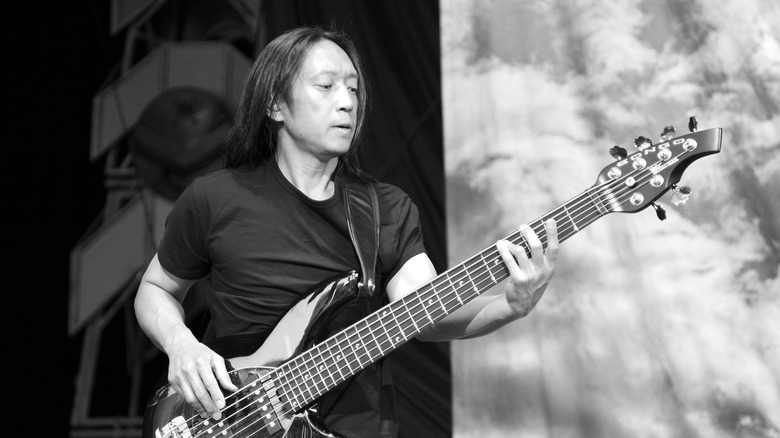
Bassists are the strong and sturdy backbone of any great band, but sadly they often go unappreciated. Bands might not lose their bassists to mega-successful artists if that wasn't the case. The best bass riffs in classic rock are just as iconic as their six-string counterparts, yet we give the glory to the guitarists. Well, fair enough since the instrument is what rock 'n' roll was built around, but sometimes the four-string maestros even turn in solos that rival the lead work of their nearby colleagues. That's what we're going to celebrate today.
The best bass solos are a diverse and interesting lot. After all, they're not a required part of the basic rock structure, so when they do show up, they have to go above and beyond to justify themselves. Here are our picks for the five best bass solos in rock history and what makes them worthy of the title.
Cliff Burton — (Anethesia) Pulling Teeth
A confident "bass solo take one!" is heard at the start of this track-length solo from Metallica bassist Cliff Burton. Recorded for the group's 1983 debut "Kill 'Em All," "(Anesthesia) Pulling Teeth" stands as a testament to Burton's virtuosity, compositional prowess, and innovation. The piece opens with an arpeggiated neo-classical passage reminiscent of J.S. Bach's solo suites for cello, albeit channeled through a fuzz-wah bass guitar. That first half of the performance certainly shows Burton's technical ability, but in a structured, melody-oriented manner that eschews the over-the-top noodling of so much metal soloing. The result is a contemplative eye in the storm of Metallica's thundering debut.
That peaceful reverie is interrupted by an abrupt shift into wailing rock guitar style runs accompanied by drummer Lars Ulrich. Suddenly we are given a window into what it might have sounded like if Jimi Hendrix had taken up bass instead of the six string. The solo has been extensively analyzed by bass and guitar aficionados and rightly so: it was a bold statement that defied the stylistic conventions of thrash metal and helped to establish Metallica not just as rising stars but as genuine artists.
Burton's work as a player and composer would be heard throughout "Kill 'Em All" and the subsequent two Metallica albums, 1984's "Ride the Lightning" and 1986's "Master of Puppets," but his time with the band was cut short due to his 1986 death in a bus accident. The follow up album, 1988's "...And Justice for All," would feature an enigmatic recording of Burton doing spoken word as his final contribution to the band.
John Myung -- Dance of Eternity
Every member of Dream Theater has been exalted for their technical prowess as musical virtuosos, and that is by design. Formed in 1985 at the Berklee College of Music, the founding membership of guitarist John Petrucci, drummer Mike Portnoy, and bassist John Myung sought to create a progressive metal ensemble that would showcase outstanding instrumental capacity. Myung has remained a constant member throughout the group's four decades, serving as the famously low-key personality in a band full of larger-than-life shredders.
Myung compensates for that retiring nature with bass guitar parts that explode out of their support role and into the limelight time and again with solos that stand alongside the rapid-fire guitar and keyboard leads firing off all around him. His solo on "Dance of Eternity," is a fiendishly intricate instrumental off of the group's 1999 concept album "Metropolis, Pt.2: Scenes From a Memory." Played on a six-string bass, it emerges from a blistering haze of 123 time signature changes. Myung's chops-heavy display matches the furious intensity of the piece as its own spiraling onslaught, but what's most notable is its brevity. He knows how to play his position even in an epic progressive instrumental. The solo steps in as a quick wink and a nod in between prolonged leads from Petrucci and keyboardist Jordan Rudess, dazzles for a moment, and bows out just as quickly. "Dance of Eternity" is the last place you'd expect to hear tasteful displays of musicianship, but Myung pulls it off.
Les Claypool -- Tommy the Cat
The whole of Primus' catalogue could probably be summarized as one long bass solo. Les Claypool fills track after track with madcap subwoofer stimulation, and guitarist Larry Lalonde and a changing lineup of drummers fill in the sonic cracks. Whether it's the "South Park" theme song or covering the entire "Willy Wonka and the Chocolate Factory" soundtrack in their signature deranged-funk style, Primus have a penchant for making the demented sound hip.
"Tommy the Cat" showcases that inverted ensemble beautifully: Claypool is front and center with his signature frantic slap-bass style while Lalonde's opening lead work feels more like high-end atmospherics than an actual guitar part, and the midsection solo continues to unfold even as Claypool lays down hillbilly rap vocals. For those seeking to probe the gleeful mad hatter world of Primus, it's a fine introduction and a fretboard smoking practice regimen for technique hungry bass guitar students.
Geezer Butler — Bassically/NIB
Black Sabbath didn't set out to be heavy metal pioneers (and there really wasn't such a codified genre when they started). Their original incarnation was as the jazz and blues band Earth (not to be confused with the later stoner/doom band of the same name). Even after they embraced walls of guitar distortion and sinister lyrics, their jazz inclination towards improv and exploration never really went away.
That ethos emerges in several critical places throughout their self-titled debut LP, not the least of which is "Bassically," a notably funky lead-in to "NIB." What stands out most prominently about the wah-wah pedal-infused passage isn't the technicality but the way it implies an underlying chord progression. Butler isn't just firing off impressive chops: he's sculpting an actual compositional phrase. It's a passage that, like the mellow groove drum solo that precedes it, reminds us that there was more to Black Sabbath than just demonic imagery and decadent rockstar buffoonery. There was, at the core, real learned musicianship informed by a wide stylistic vocabulary.
Geddy Lee — YYZ
Canadian prog legends Rush sculpted their signature sound out of the minimalism of their ensemble. As a humble power trio, all members were forced to step up their game in terms of harmonic and tonal presence. Guitarist Alex Lifeson filled tremendous space running extended chord voicings through massive walls of distortion, and drummer Neil Peart gave drumming the kind of intellectual intricacy normally associated with jazz musicians. Stradling the gap between those two extremes was Geddy Lee, who more than had his hands full with vocals and keys on top of his bass duties (and sometimes all at once).
That sort of necessity-as-the-mother-of-invention innovation led Rush down some fascinating musical paths in their time, not the least of which is "YYZ," a whimsical but no less ferocious instrumental off their 1981 masterpiece "Moving Pictures." Named after the airport code for Toronto's Lester B. Pearson International Airport and built around the rhythmic motif of the letters YYZ played out in Morse code, the piece captures the fast-moving hubbub of the titular airport and the sense of relief that comes in the midst of it all when arriving home from a long tour.
Solos abound in "YYZ," but they never feel indulgent. Instead, there's a sense that each piece exists in conversation with its counterparts, and Lee's fluid phrasing comes in and out as part of a larger whole. Lee tosses the spotlight back and forth with Peart in a captivating dialogue. It's as much a lesson on ensemble cohesion as it is on dazzling chops.