

The 5 Best Bee Gees Songs For Getting Over A Breakup
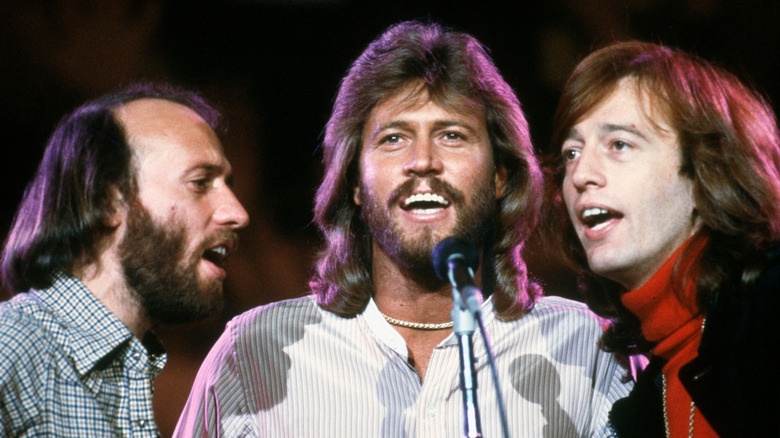
To the extent that a beautiful voice can help cure a broken heart, the exquisite three-part harmonies of the Bee Gees are some of the best medicine there is. The Brothers Gibb (not what Bee Gees actually stands for, as you might believe) made a career out of taking anything and everything middle-of-the-road — soft rock, pop, soul, disco, adult contemporary, and more — and using their angelic voices to elevate it to its emotional peak. This bend toward the sentimental and knack for vocal expressiveness naturally makes the Bee Gees a good fit for anyone looking to feel something deeply after a breakup, whether that be getting in touch with their sadness or simply (and please forgive us) stayin' alive.
From among the band's expansive collection of tender ballads and danceable disco, we've pulled together the best at exemplifying aspects of the post-breakup existence, everything from despair to bargaining all the way to blissful acceptance. Within these tracks lie all the breathy, vibrato-laden falsettos and stirring strings needed to feel and heal. Here, then, are five of the best Bee Gees songs for making it through a breakup.
How Can You Mend a Broken Heart
Easily the most on-the-nose breakup song among the Bee Gees' bigger hits, "How Can You Mend a Broken Heart" is also fittingly one of the genre's most definitive. It hit No. 1 on the Billboard Hot 100, and its single was nominated for a Grammy, losing to the Carpenters' brilliant self-titled album. Undoubtedly, a huge part of what made it so successful was its unadulterated melancholy and total earnestness. The song was one of the first the band wrote after their 1970 reformation following Robin Gibbs' brief exit, and it's apparent that at least part of the broken hearts in question came from the brothers' separation.
One of the track's most interesting pieces lyrically is its chorus, which asks a series of dour, seemingly rhetorical questions about healing, only to then sincerely ask for help in doing so. "How can you mend this broken man? / How can a loser ever win?" it ends, before shifting to "Please help me mend my broken heart and let me live again." The conclusion is a huge fluctuation in mood from hopelessness to desperation — a dichotomy many who stumble their way through breakups will be familiar with. A nice added touch comes from Robin and Barry Gibb each getting a solo verse to sing their own trembling poetry before the group, Maurice included, finally joins in the lead-up to their plea for help. To answer the song's titular question: A great first start is the voices of all three Gibbses together.
The Way It Was
A lot of songs about heartache lament a love that was perfect — something once-in-a-lifetime that was tragically lost, leaving things forever changed. On "The Way It Was," the Bee Gees chose instead to focus on the other 99% of relationships. You know, the ones that don't fit into a neat category of emotion or memory that are made from equal parts good and bad. Refreshingly, the Bee Gees really do sing about the way it was, or is, for the vast majority of people lamenting a relationship lost while still trying to make sense of all the parts that never quite fit.
Fitting for a song about such imperfection, it's stuck in a middling spot toward the end of "Children of the World," an album that saw the band experimenting with new producers, production techniques, and musical directions. "The Way Is Was" rests somewhere between the soft R&B of their earlier work and the disco that followed next. It could be that this personal and professional flux inspired the Gibbses to tackle the messiness inherent to the track.
"There were smiles and there were tears" is the simple premise of the song. In the chorus, Robin and Barry opine, "Wasn't that the way it was? / Two strangers reaching for a worthless cause." Yet they imply the cause is only worthless thanks to a lack of effort, as in "Wasn't that the love we shared / Or just the restless years when no one cared?" Perfect or imperfect, the relationship only dies when those in it give up.
Baby as You Turn Away
Like its immediate successor "Children of the World," 1975's "Main Course" was made during the Bee Gees' transition from flowery soft rock to disco. At times, the change led to awkwardness, and "Main Course" wasn't immune (Rolling Stone, for example, panned the album even as they praised it). With that said, songs like "Baby as You Turn Away" serve as reminders of the Bee Gees' core strengths: Crafting moving, memorable ballads and applying their skillful vocals to ensure the lyrics soar.
One of the biggest claims to fame for "Baby as You Turn Away" is that it was one of the very first recordings in which Barry used his falsetto. In later albums, the style became his signature and a large part of the band's signature sound as a whole. Here, it's still softer and more feathery than the eventual uber-high version, but it's enough to give the song a sense of soaring.
You won't find many Bee Gees ballads with lyrics as bleak as on "Baby as You Turn Away." Lines like "You thought I had you chained / And now you're free" imply the speaker acknowledges their own issues, while "I'm still your man / There's proof of who I am / Except without your love I'm dead inside" is borderline unhinged. Ultimately, "Baby as You Turn Away" is about the pain caused by both parties, and that sometimes, it truly is "easier to say goodbye."
Love Me
The Bee Gees' "Love Me" is an odd song, and it's all the better for it. On the one hand, despite releasing in 1976, it shows early signs of the band's eventual shift to disco, like the chicka-bows of a wah-wahing guitar, trebly falsetto singing, and, especially during the bridges, some funky synth lines. But the confidence expected of the genre is not here. Instead, the song's pleading message and Robin's timid vocal quavering make it one of the band's more desperate, almost pitiful subjects. But that, too, can be a big part of the breakup process and is worth its own ode.
Barry sang lead on the overwhelming majority of the Bee Gees' songs from the '70s onward. For this reason, it's clear that they were intentional when it came to using Robin. His voice — more plaintive, warbling, and almost unsure of itself despite his considerable vocal talent than Barry's — is the right choice for "Love Me," lending the song a much-needed feeling of vulnerability.
The track distilled into a single line is "Love me please, just a little bit longer," and it's a plea that almost anyone broken up with can relate to. Adding depth is the first bridge, which admits that the speaker may be at fault more than anyone: "Never even try to see things her way / It's hard on a woman when love ain't no love at all." Regret, shame, desperation, and bargaining — all themes in "Love Me" and all big parts of many breakups.
Stayin' Alive
Ultimately, some of the best breakup songs aren't there to help you feel your heartache or even make sense of it at all. Some of the most useful and impactful, like the Bee Gees' disco-defining hit "Stayin' Alive," are perfect simply for helping you move on and put the next foot in front of the other. And with one of the most infectiously catchy beats in music history, that next foot forward will almost certainly be tapping, strutting, or hustling along to its surprisingly famous tempo. (If you didn't know, "Stayin' Alive" has been recommended by a number of major health organizations, including the American Red Cross, as a mental guide for maintaining the right speed and consistency needed for CPR.)
The song gives tiny glimpses into its underlying darkness, like "I get low and I get high / And if I can't get either, I really try," and of course, the bridge that repeats, "Life goin' nowhere, somebody help me." But those little bits of harsh reality only make the song's overarching confidence more relatable and stronger by contrast, because staying alive without making it through struggle would be merely existing, not living. The song's speaker has been through the ringer, like being "kicked around since I was born," and that makes their relentless swagger seem like a well-earned triumph. That type of emotional and psychological victory is what many seek after a split, which is just one reason why "Stayin' Alive" is an exceptional song choice for getting over a breakup.