

3 Songs You Didn't Know Van Morrison Wrote For Other Famous Musicians
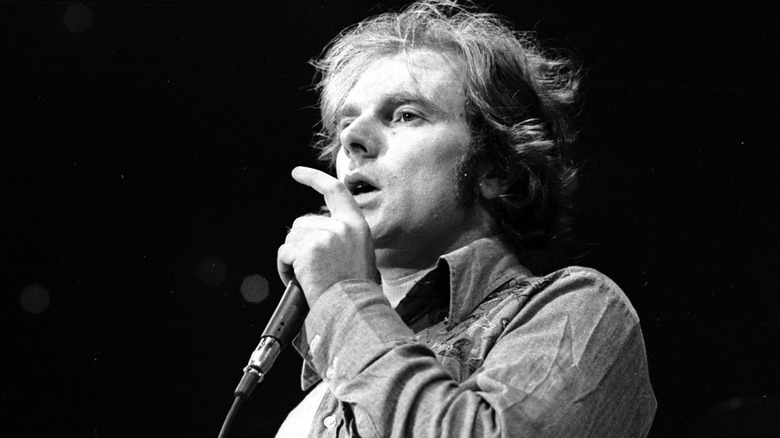
Van Morrison is one of the most legendary vocalists and songwriters of the 20th century, who incorporated a wide range of disparate elements from Christian mysticism to American folk tales in his work, as well as a huge sonic palette that took in a range of genres from folk to jazz. It's no surprise, then, that many of Morrison's own compositions have been widely covered, such as his classic songs "Into the Mystic," "Moondance," and "Gloria," but in some cases during Morrison's long career, he intentionally wrote for other artists.
Here we look at the few occasions we can find where that happened, including a surprisingly low-key duet with a major band that's something of a revelation, especially for those not familiar with his deeper cuts. Going beyond his signature songs, these are the Morrison compositions that were first recorded by other artists before he performed them — which, as you will see, is a surprisingly rare occurrence.
Carrying a Torch — Tom Jones
Though many fans consider Van Morrison to have been at his critical and commercial peak in the late 1960s and early 1970s, by the 1990s he was still a force to be reckoned with, with the "Belfast Cowboy" turning out hit albums while also managing to find the time to act as producer for other artists. In 1991, he was at the controls for Tom Jones' studio album "Carrying a Torch," the title track of which Morrison wrote.
Morrison and Jones had a common interest in rock 'n' roll, as well as shared spiritual leanings. The Irishman brought the song to Jones, who decided to both record it and invite Morrison to work on his album. Morrison himself plays on Jones' version of "Carrying a Torch." He also penned three other songs on the album: "Some Peace of Mind," "I'm Not Feeling It Anymore," and "It Must Be You." Jones' album was a middling success, with the title track released as a low-charting single in the U.K., but Morrison later recorded his own versions of the four tracks for his 1991 album "Hymns to the Silence," which some fans identify as his best work of the decade.
Flamingos Fly — Jackie DeShannon
Jackie DeShannon is a well-connected, versatile singer who collaborated with some of the cream of the music industry in the 1960s and 1970s. A songwriter who co-wrote the song "Bette Davis Eyes," which was a huge No. 1 hit for Kim Carnes in 1981, she was also a skilled interpreter of others' songs. Her 1972 studio album "Jackie" is replete with lush covers, and an extended version of the album released in 2003 included a number of other Morrison-penned compositions, including "Flamingos Fly."
Recorded in 1972, DeShannon's version of "Flamingos Fly" is bright but somewhat lightweight, despite the emotional weight of the lyrics, and the juxtaposition perhaps explains why it remained in the archives. Nevertheless, it is admirably performed; the track was only later released on Morrison's 1977 album "A Period of Transition," a year after Sammy Hagar released his own cover soon after leaving Montrose.
4% Pantomime — The Band
Van Morrison shares a writing credit with the Band, Bob Dylan's one-time backing band, who later went on to enjoy considerable critical acclaim in their own right. Appearing on the Band's 1971 album, "Cahoots," the track "4% Pantomime" was recorded at Bearsville Sound Studio in Woodstock, where Morrison lived at the time. He shared a friendship with the Band's frontman Richard Manuel, with whom he would duet on the song, and the composition itself was a spontaneous collaboration with songwriter Robbie Robertson, who had a complicated relationship with the Band.
The result is a loosely performed, gritty piece about hard-living musicians, reflective of where Morrison and Robertson found themselves within the industry at the start of the 1970s. Like "Cahoots" as a whole, "4% Pantomime" isn't considered among the Band's defining work. However, it is a fine example of Morrison as a duettist; his entrance on the line "Oh, Richard!" — addressing Manuel directly — lends the song a pleasing amount of intimacy. This is also the track in which Morrison's "Belfast Cowboy" nickname originates — an invention of the Band's.