

The 5 Wildest On-Stage Moments In Rock History
Rock 'n' roll is well known for stage spectacle, as anyone who's attended an old-school Kiss or Alice Cooper concert could have told you. But even the less obviously theatrical acts have a little something up their sleeves when it comes to live shows. Some have been so memorable that they're still talked about years or even decades after the fact, even if they didn't involve pyrotechnics or decidedly un-family-friendly imagery (with all due respect to Ozzy Osbourne's most notorious stage stunts, we'll let the bat incident sit this one out).
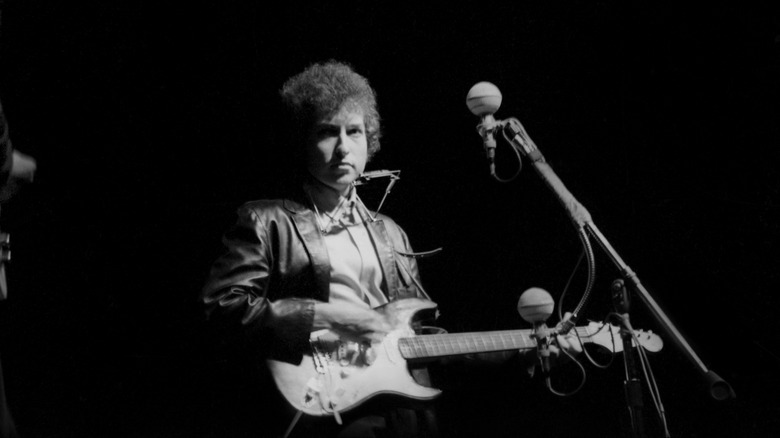
What makes a moment wild? That depends. Some are overtly shocking, as when Foo Fighters frontman Dave Grohl took a nasty tumble off a stage or Keith Moon lost consciousness mid-performance with The Who (an especially wild band that's also dealt with an onstage brawl and one of the shortest concerts in all of rock). Others might not seem like a big deal today but were extremely consequential at the time. For instance, to the young whippersnappers out there, the sight of Bob Dylan wielding an electric guitar is hardly worth a second look, but his defiant reaction to criticism at a 1966 performance sure is worthy of inclusion on this list.
Jimi Hendrix set his guitar on fire
It's an iconic image: Jimi Hendrix kneeling before a flaming guitar. The incident happened at the Monterey Pop Festival in 1967, which proved a tremendously consequential year for him (arguably the best of his career). The motivation? Jealousy. Well, kind of. Tasked with following the bombastic The Who, Hendrix felt he had to distinguish himself, too ... and began hunting for some lighter fluid. So, the final song of his performance ("Wild Thing") saw Hendrix kiss the guitar, set it alight, smash it to splinters, and then throw what was left to the crowd. To be fair, his motivations weren't totally about attention: Hendrix really believed in his artistry and new sound. "So I decided to destroy my guitar at the end of a song as a sacrifice," he later said (via Museum of Pop Culture). "You sacrifice things you love. I love my guitar."
Though the Monterey guitar burning was the most infamous, it wasn't the first time Hendrix set his instrument aflame. While on tour in Britain in March 1967, Hendrix and manager Chas Chandler decided to do the stunt for the first time ... after playing "Fire," of course. Chandler applied so much lighter fluid that the flames leapt 4 feet high and burned Hendrix's hands slightly (he finished the performance but sought treatment at a hospital afterward). That first burned guitar actually survived and was sold for over $450,000 at a 2008 auction, while a piece of the Monterey specimen made it to Seattle's Museum of Pop Culture.
Paul Simonon smashed his bass at a show for the Clash
Got a copy of "London Calling" somewhere nearby? Go grab it — or, you know, pull up an image search — and you'll see a blurry image of someone smashing a guitar against the ground. This is the Clash's bassist, Paul Simonon, destroying his instrument in a spur-of-the-moment act of rage that went down in rock history. It started with the band's performance at the Palladium in New York City on September 20, 1979. Security at the show just wasn't having it when fans tried to get up out of their seats to dance. Simonon witnessed all this and simply couldn't contain himself. "So that frustrated me to the point that I destroyed this bass guitar," he later told Fender. "Unfortunately, you always sort of destroy the things that you love in temper."
That all might have been just the stuff of excited post-show conversation if it weren't for legendary British rock photographer Pennie Smith, who caught the moment Simonon smashed his bass into the stage. The resulting image, though blurry, captured the frenetic energy of that performance so well it was turned into the album cover for the Clash's "London Calling." What was left of Simonon's bass eventually made its way to Cleveland's Rock & Roll Hall of Fame and then on to his home country, where it was sent out on long-term loan to the Museum of London, to go on display November 2026.
Dave Grohl broke his leg and kept playing
Rock stars have been injured onstage from time to time, be it Gene Simmons setting his hair on fire (on multiple occasions!) or Iggy Pop collecting an array of injuries courtesy of his high-energy stage antics. Of incidents in recent memory, one of the wildest is what happened to Foo Fighters frontman Dave Grohl at a 2015 performance in Gothenburg, Sweden. Attempting a jump, Grohl miscalculated and fell offstage. "I think I just broke my leg," he informed attendees while still on the ground, saying that he would somehow return to the stage posthaste (via BBC).
You can't blame audience members for being skeptical, but Grohl later said that doctors reset his dislocated ankle backstage. As for returning to the performance, someone would have to hold his very definitely broken leg until it could be stabilized in a cast. An especially dedicated paramedic named Johan did just that, kneeling front and center for the rest of the show.
That sort of dramatic injury and dedication to performing was indeed legendary, but reality prevailed eventually. The Foo Fighters canceled some subsequent shows, including an appearance at Glastonbury. When the tour resumed, Grohl performed while seated in a throne bedecked with spare lights and guitar necks. He fully recovered, but the throne lived on when Guns N' Roses singer Axl Rose injured his foot on tour. Grohl loaned him the same throne, for which Rose sent him a vintage Gibson guitar as a thank-you gift.
A fan emerged from the audience to cover for Keith Moon
It sounds too fantastical to be true: A last-minute emergency leaves a band pulling a fan onstage for help. But for Scott Halpin, it was real life. It began at a November 1973 show at San Francisco's Cow Palace, featuring the Who and opening act Lynyrd Skynyrd. Before an estimated crowd of 14,000, it soon became clear that something was really wrong with drummer Keith Moon. Known for his destructive onstage pranks and more tragic history that included substance misuse, Moon passed out. Lynryd Skynyd's drummer, Artimus Pyle, was too nervous to step in. At that point, Pete Townshend asked the audience if there was a competent drummer in the house.
That's when a friend volunteered 19-year-old Halpin. After a quick interrogation from the concert promoter, Halpin took the stage, fortified by a nip of brandy. Though he stumbled in places, he did a fine job — and remained conscious, giving him a distinct edge over Moon. Halpin said it was all such a whirlwind he barely remembered what happened.
Afterward, Halpin was invited backstage, where Roger Daltrey told him a check was coming for his efforts. That never showed up, though. "They did give me a tour jacket, which someone stole," he told NPR. When Halpin died in 2008, his wife Robyn wrote to inform Townshend. "He showed such youthful courage and humour standing in for Keith Moon that fateful day," Townshend replied (via Far Out), later adding: "I measure my life by great and good people I have occasionally met. Scott is one of the great and good ones."
Bob Dylan got defiant
Nowadays, a musician playing electric is no big deal. But when Bob Dylan started doing just that in the '60s, some fans took serious exception. Could he really play folk rock if he cast aside the acoustic guitar? Dylan certainly thought so, yet there were definite speedbumps, including one that popped up during a performance at Manchester's Free Trade Hall on May 17, 1966. Dylan had already been touring with his electric setup for a while, though it hadn't exactly been inspiring. The 1965 Newport Folk Festival saw the debut of Dylan's electric sound, and he gave up after just three songs and much booing from the crowd (he did shortly return to the stage with an acoustic guitar).
There was definitely a faction who felt Dylan had pulled a bait-and-switch. Others were more upset at the distorted sound coming through the speakers ... or the sheer volume of it all. Alan Snook, who attended a 1966 Bristol show featuring the new setup, told the BBC that attendees shouted "too loud, too loud, turn it down" and were stunned into silence between superpowered songs.
Toward the end of the Manchester performance, someone broke. As witnessed in concert footage from that night, an audience member shouted "Judas" at Dylan. "I don't believe you. You're a liar," he told the heckler, before turning to the band and telling them to "Play it f****** loud!" as they launched into "Like a Rolling Stone." Given the prominence of electric sound nowadays, Dylan clearly had the last laugh.