

Bands Who Lost Career-Defining No. 1 Hits To Another Act
It's both difficult and rare for a band to attain a No. 1 single — and it's all the more difficult when somebody else notches that career milestone with a song that group rejected. It's part of the dark side of the 1960s music industry, and beyond that, even the most prominent bands didn't always write their own material. They relied on outside songwriters to create and pitch the songs that would become the big hit singles. Songs might be thoroughly shopped around before a match was made. The result: Some of the best-known songs in rock 'n' roll history that went to No. 1 on the Hot 100 were intended for or offered to other bands before they were recorded by the acts that took them as far as they could go.
Even huge groups weren't immune to the phenomenon of passing on what were obvious classic tracks. The Jackson 5, the Monkees, the Beach Boys, and others all rejected songs that went on to bring fame, fortune, and artistic credibility to a bunch of other acts.
The Jackson 5 — One Bad Apple
The unlikely meteoric rise of the Jackson 5 was complete in 1970, when the family band scored four No. 1 hits, including "ABC." They were so massive that they opened up the charts for other, similar brother acts, such as the Osmonds. Like the Indiana-raised Jacksons, the Osmonds were from a non-showbiz hotbed state, Utah, and generated hooky bubblegum pop. Rebranded from a novelty youth vocal group into a pop-rock band, the Osmonds hit the Billboard Hot 100 for the first time in 1971 with "One Bad Apple," which spent five weeks at No. 1.
That song was written by George Jackson, a house songwriter at the Muscle Shoals, Alabama R&B enclave Fame Studios, and it was secured by the Osmonds' producer, Rick Hall. A big reason why the finished product sounds like it could've been a Jackson 5 song is because it was. At a KOST 1035 radio station event in 2011, Donny Osmond revealed that his counterpart in the Jackson 5, Michael, told him as much about "One Bad Apple." "'That was written for me. That was a Jacksons song, and we passed on it and went with 'ABC,' and that's how you guys got 'One Bad Apple,'" Osmond recalled.
The Monkees — Sugar Sugar
Extremely popular in the late 1960s, the Monkees scored four No. 1 albums in 1967 alone, along with three chart-topping singles across their career. But the band's commercial prospects began to fade as the years wore on, as did their enthusiasm for music that was often composed and played by others. Had the Monkees not rejected a breezy, hooky gem entitled "Sugar Sugar" presented by producer Don Kirshner, the band could've feasibly kept their phenomenal streak going a bit longer. "Mike and Peter said, 'It's a piece of junk, we're never gonna do this song.' Mike proceeded to put his fist through the wall," Kirscher recalled of the reactions of Mike Nesmith and Peter Tork in "Soundtrack of the Century: Modern Pop."
Kirshner lamented his decreasing control over the Monkees, but soon afterward, he found his solution via his son's Archie comic books. He struck on the idea of assembling a new band of studio musicians, with their members represented by fictional, animated characters. In 1968, "The Archie Show" hit the airwaves, and in the following year, a group of elite studio musicians recorded "Sugar Sugar." Credited to "the Archies," it spent four weeks at No. 1 on the Hot 100 and was named Billboard's biggest single of 1969.
The Beach Boys — Seasons in the Sun
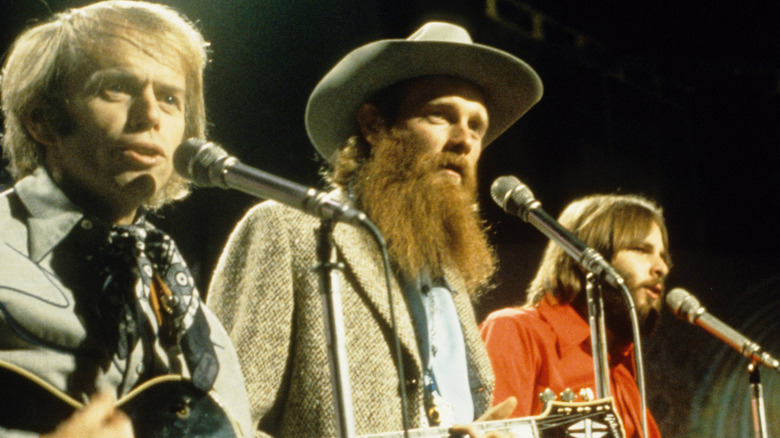
After amassing tons of hits and fans in the mid-1960s with songs of sun, surf, and cars, the Beach Boys got experimental and artsy. While their albums like "Pet Sounds," "Smiley Smile," and "Surf's Up" were lauded by critics, they weren't as popular with the general public as their earlier stuff. Had the band gone ahead and released a song they'd considered for inclusion on the 1971 LP "Surf's Up," the they could very well have landed a No. 1 single.
The Beach Boys asked folk-rock musician Terry Jacks to produce that album. During a session, Jacks tossed out an idea: The Beach Boys should record an English version of "Le Moribond," a French song about a man approaching death recalling a well-lived life. Poet Rod McKuen composed a translation, "Seasons in the Sun," and it had been recorded by the Kingston Trio previously before the Beach Boys gave it a go. Recorded under Jacks' watch, and with Carl Wilson on lead vocals, "Seasons in the Sun" didn't make it onto "Surf's Up," because member Mike Love thought it wasn't an appropriate Beach Boys song. So, a couple of years later, Jacks cut "Seasons in the Sun" himself. In the spring of 1974, it occupied the No. 1 spot on the pop chart for three weeks.
The Association — MacArthur Park
On two occasions — in disparate styles and more than a decade apart — "MacArthur Park" was a smash hit. Esteemed British actor Richard Harris gave a dramatic reading of the epic ballad in 1968 and hit No. 2 on the Billboard Hot 100, while Donna Summer's shimmering disco version held the No. 1 position for three weeks in 1978. Interestingly, "MacArthur Park" started out as the seven-minute final piece of a multi-part suite, or cantata, composed by ambitious '60s pop songwriter Jimmy Webb.
Webb enjoyed working with producer Bones Howe, who helped the vocal-stacking pop-rock band the Association make its No. 1 single "Cherish." After completing his cantata, intended to occupy one side of an LP, Webb urged Howe to get him in touch with the Association, his preferred artist to bring his project to life. After some rehearsals and arrangements, the Association backed out, in part because they didn't want to commit to half of an album and because some members didn't think Webb's suite was as good as what they'd cooked up themselves.
The Tokens — Happy Together
The Tokens made it into the Top 5 of the Billboard Hot 100 once: In 1961 with "The Lion Sleeps Tonight." The Vogues did it twice in 1965, with "You're the One" and "Five O'Clock World." Both of those voice-powered acts could've had a longer-lasting and more robust legacy had they decided to record and release a certain song that came their way. Those bands are just two of the 12 or so groups that had been made privy to a demo made by songwriters Gary Bonner and Alan Gordon of their playful, joyous, and slightly ominous love song "Happy Together."
The well-distributed, often-played, and ultimately dismissed acetate on which the music appeared was almost falling apart by the time the members of the Turtles got their shot. Listening to it backstage at a show in New York in January 1967, the band liked it so much that they quickly recorded a studio version. By February, the single was on the charts, and at the end of March, "Happy Together" was the No. 1 song on the Hot 100. Before "Happy Together" hit, the Turtles had reached the Top 10 just once, with a cover of Bob Dylan's "It Ain't Me Babe." But then "Happy Together" rocketed to No. 1, the first of a string of major hits including "She'd Rather Be Mine," "Elenore," and "You Showed Me."