

The 5 Best Covers Of Classical Music In Rock History
Humans have been making music for thousands of years. We began with just our voices, but soon we progressed to using instruments, from banging rocks to blowing bone flutes. For centuries in the West, classical music was the dominant form, and pianos, guitars, and drums evolved to become the tools with which millions of us are entertained. With a back catalogue that would make modern musicians weep, there's no wonder that rock bands — whose genre is a young upstart in comparison — turn to classical music for inspiration.
Perhaps most famously, Freddie Mercury gave Queen's operatic rock anthem "Bohemian Rhapsody" an original, classical twist (even if you might be confused by the lyrics). Other rock musicians and bands drew more directly on the work of composers who not only weren't around any more but who, in some cases, were probably unknown to modern, rock-loving audiences. Pull up a chair and find out how the music of Beethoven (who faced many tragedies, including deafness), Rachmaninoff, and others featured in some of the coolest classical covers in rock history.
Hall of the Mountain King — The Who
You'd think any piece of music whose composer said in a letter to a friend sounded like "cow pats" and they "literally cannot bear to listen to [it]" would be consigned to the dustbin of history, but no. Edvard Grieg's vivacious "In the Hall of the Mountain King," composed for Henrik Ibsen's play "Peer Gynt" in the 1880s, is one of the world's most recognizable classical tunes. So naturally, The Who decided to give it their own inimitable spin, which ended up as a bonus track on the 1995 remastered version of their 1967 album "The Who Sell Out."
Roger Daltrey provides looping, whooping vocals that blend with Pete Townshend's thicc guitar and Keith Moon's chaotic drums. And although it's nothing like the Billboard Top 10 hit "I Can See for Miles," which came from the same album, it's still compelling. Frustratingly, there is little information from the band members themselves about this incredible instrumental. While we love it, there are lots of opinions out there. One reviewer said it sounded "funny and wimpy" compared to Grieg's rousing original, which they also suspected the band had never heard. We think that's a bit harsh.
Another on Only Solitaire opined: "The main function of the composition is to evoke thoughts of (naturally) King Crimson and (unnaturally) Pink Floyd, because in parts it sounds exactly like 'Interstellar Overdrive.'" A third, who wittily dubbed the song "Edvard Grieg as done by Cream," said (via Since I Left You): "It's almost as if they're saying, "We're finished with a prior version of what we can be and what others have done — time to move on."
Difficult to Cure — Rainbow
Beethoven had entirely lost his hearing by the time he composed his ninth symphony, known as "Ode to Joy," but we reckon if he'd been around when Rainbow performed their version, he'd have felt every single note. Bearing the rather more downbeat title of "Difficult to Cure," it was the title track of their 1981 album. It had been six years since Ritchie Blackmore quit Deep Purple to form Rainbow, giving him the perfect vehicle (or excuse) to mine his love for classical music. For a while, it worked, and heavy rock stans were thrilled. But the band's fifth album divided Rainbow's fans like nothing else.
Blackmore's quest for a more commercial sound managed to alienate part of their base, some of whom would have preferred he clung to his rock roots. Although few could deny the virtuoso skills he displays on "Difficult to Cure," the praise certainly wasn't universal. One Ramzine reviewer described the album as "rife with class and professionalism," while another on AllMusic called Blackmore's playing on the title track as "impeccable" but also called it a "pretentious pseudo-classical instrumental that functions as nothing more than a guitar showcase."
At an Alpine Valley stadium concert in 1985, Deep Purple's Ian Gillen introduced "Difficult to Cure" as an "Old-West London nursery rhyme," before Blackmore and Jon Lord put on a blistering display. The crowd (quite rightly) lapped it up, but naysayers remain. One Redditor recently sniffed: "Technically proficient, but a novelty act. Does Beethoven no favours whatsoever."
Pictures at an Exhibition — Emerson, Lake, and Palmer
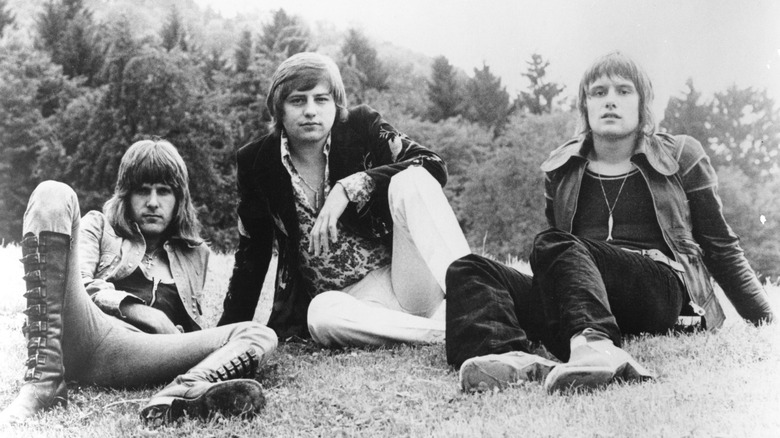
When Keith Emerson, Greg Lake, and Carl Palmer joined forces and launched themselves into the musicverse in 1970, they probably didn't realise they would go down as one of the best supergroups in history. Yet the scale of their ambition was clear right from the start, as demonstrated in their 1971 album "Pictures at an Exhibition" (which was rushed out the following year in the United States). While other bands feathered in a single classical piece, ELP went further and reinvented Russian composer Modest Mussorgsky's 1874 suite of the same name.
Mussorgsky wrote "Pictures at an Exhibition" in honor of his friend, artist Viktor Hartmann, who died suddenly in 1873. ELP took elements of his classical work and combined them with their own original pieces — "The Sage," "Blues Variation," and "The Curse of Baba Yaga" — to create something truly amazing. The work stood out from the inventive 1970s prog rock landscape and remains compelling listening to this day, even allowing for the slightly daffy "Notrocker."
They had performed it many times before recording their live performance at England's Newcastle City Hall in 1971 — "reason enough to classify Newcastle City Hall as an historically important building," according to one Progrography reviewer. But it was their second attempt at getting it on tape after the first left the trio unimpressed. They needn't have worried. "Pictures at an Exhibition" was a hit on both sides of the Atlantic, and it remains a much-loved work among fans — including us.
Full Moon and Empty Arms — Bob Dylan
We've previously explored a handful of underrated Bob Dylan songs, but it's no surprise that an artist with a more-than-60-year career found inspiration in all sorts of different places, including the classical genre. In 2014, Dylan surprised everyone with the release of the ballad "Full Moon and Empty Arms," which was notable for two reasons. First, it was a cover version. Frank Sinatra previously lent his dulcet tones to the ditty in 1945, and second, the melody at its heart was adapted by Buddy Kaye and Ted Mossman from the third movement of Sergei Rachmaninoff's Piano Concerto No. 2. To their credit, they named him as one of the song's writers.
For Bob Dylan to cover "Full Moon and Empty Arms" — complete with Rachmaninoff's gorgeous musical framework — was a delight to fans of the Russian composer. It was also a notable departure in style for the veteran singer-songwriter. Why does it rank among our choices here? We love Dylan's smooth, crooning sound and how it combines seamlessly with the classical melody, and we're not alone. It went down a storm with fans and critics alike. Anyone who has followed Dylan over the decades knows he's a quixotic artist who loves to circle back and reinvent, and "Full Moon and Empty Arms" is a brilliant example of that in action. As well as showcasing Dylan's undoubted greatness as a singer, it also helped bring Rachmaninoff to a fresh audience.
Beck's Bolero — The Jeff Beck Group
In a letter to fellow composer Arthur Honegger, Maurice Ravel reportedly wrote that his work "Bolero" was a "masterpiece" but added dryly: "Unfortunately, it has no music in it." Members of the Jeff Beck Group would likely beg to differ (as would we, because "Bolero" is a banger). Fresh from the breakup of the Yardbirds, Beck got together with Jimmy Page, John Paul Jones, Nicky Hopkins, and Keith Moon in 1966 to record a one-time, all-star version of the classical piece, known as "Beck's Bolero."
The project was the brainchild of Simon Napier-Bell as a way to keep Beck occupied after all the red flags signalling the end of the band, and the Yardbirds went south. According to Napier-Bell, "After less than an hour we had a good basic track to work with." Unfortunately, rising tensions between Beck and Page, about the direction of the song, prompted Napier-Bell — who couldn't (or wouldn't) pick sides — to leave the studio and watch the three-hour movie "Doctor Zhivago" at a nearby cinema. By the time he returned, "the track was finished and it sounded splendid."
"Spendid" is an understatement. "Beck's Bolero" is a raw, visceral feast for the ears. It takes Ravel's instantly recognizable sound and embellishes it with howling guitar and thundering piano before Moon signals the barnstorming, brief, change of tempo. Beck and Page bickered for a long time about who wrote which part of "Beck's Bolero," and dare we say: It doesn't matter? We think even Ravel would admire their take on his work.