

These Classic Rock Legends Started Out As Cover Bands
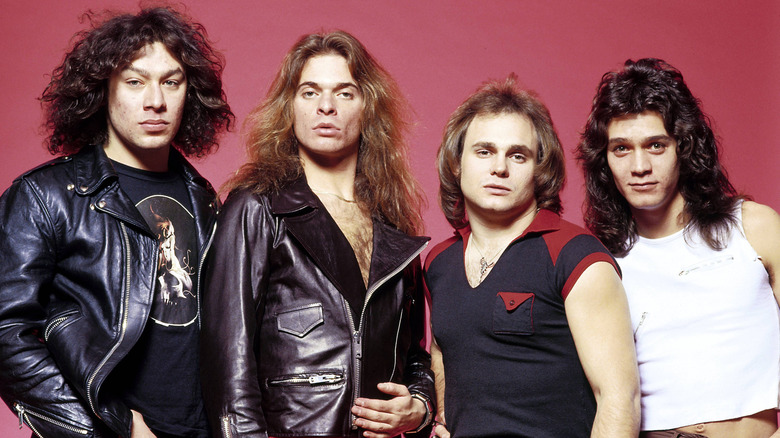
There's a certain stigma attached to cover bands, yet we're going to look at some legendary classic rock outfits that got their start as exactly that. How big? Are the Beatles major enough for you? Or the Rolling Stones? Van Halen? Yes, all of these bands and quite a few more started out playing all or mostly covers, sometimes pretty different from their later work, as the tale of the Rolling Stones' very first gig illustrates.
Someone in the audience might well be wondering why a band can't just play their own original work ... while also enjoying a performance of songs they already know and love. This underlines the tension that so many young bands have to navigate as they begin booking performances at clubs, parties, and other venues. You want to be known for original artistic creations, sure, but to actually earn money, you have to give people what they want. And if those band members ever do feel a sense of shame for capitulating to the cover band thing, they ought to know that some of the biggest names in classic rock started out doing the very same thing.
For the legendary acts that started out that way, it was mostly a matter of necessity, as promoters, club owners, and patrons all demanded familiar material before they were ready to pay out to upstart young musicians. Over time, these groups began to work in their own material, though you'll find that their love and respect for other musicians' work means they're not above playing covers even after becoming famous themselves. Let's dive in.
The Rolling Stones
In the summer of 1962, an upstart young band played their first gig together at London's Marquee Club. But the group, which included Mick Jagger, Keith Richards, Brian Jones, and Ian Stewart, with Dick Taylor playing bass, was then going by the Rollin' Stones. This early version of the group wasn't booked because of their unique songs. Instead, their set that night was to be all covers, with a focus on American blues and rock artists, including Chuck Berry, Robert Johnson, and Muddy Waters.
Actually, that inclusion of Chuck Berry was potentially controversial, at least in a small-scale way for the crowd that night. The Marquee was really a jazz club, so audience members were expecting music along those lines. The group agreed, at least kind of. "I hope they don't think we're a rock 'n' roll outfit," Jagger told Jazz News at the time (via Oxford University Press). Their deviation from jazz and blues with a cover of Chuck Berry's "Back in the USA" may have led to some patrons getting sniffy, though. And though they eventually shot to superstardom on their own songwriting merits, the Stones still played covers here and there, even releasing a blues covers album, "Blue & Lonesome," in 2016.
The Beatles
In a way, the Beatles had to start out as a cover band. Like so many acts trying to get their start back then, it was part of the deal when booking clubs and other venues. People already liked these songs, and club owners wanted to make sure their patrons were happy and ready to return. Playing covers also provided an opportunity for a band to get used to performing and develop a unique style with one less factor to worry over. Plus, record company execs were drawn in by the hope of easy sales with the help of a good cover or two in the mix. So, in their early performances in Liverpool and beyond, the Beatles played many covers.
They also recorded quite a few, though it's not clear exactly which cover was first recorded by the Beatles, though it may have been something from Buddy Holly ("That'll Be The Day") or Ray Charles ("Hallelujah, I Love Her So"). To confuse things a bit further, at that point they would have been going by The Quarrymen, as the band didn't change their name until 1960. The first recorded cover as "the Beatles" proper appears to have been a 1961 version of "Ain't She Sweet," a much-recorded classic from the Tin Pan Alley scene of the 1920s. Later on, they cut and performed many other covers, like Little Richard's "Long Tall Sally" along with "Please Mr. Postman," originally released by Motown girl group the Marvelettes in 1961.
Metallica
Don't just take it from us; even Lars Ulrich says that Metallica got its start making its own versions of other bands' work right around the metal band's formation in 1981. As he told Rolling Stone in 2017, "We started out as a cover band and we sort of were in that grey area. We just went up and played the songs. We didn't tell anybody that they were cover songs — but we also didn't tell anybody that they were our songs. [...] But yeah, we basically started out as a Diamond Head cover band." Ulrich also recalled being blown away by his discovery of Motörhead in 1979, so it's no surprise that Metallica also covered their track, "Damage Case."
Their admiration for other bands continued on through their careers, even when they became heavy metal royalty. Their 1998 cover album, "Garage Inc.," was a tremendous two-disc cover album including group-favorite Diamond Head, as well as Bob Seger, Lynyrd Skynyrd, Blue Öyster Cult, and, of course, Motörhead. In fact, there are a whopping four Motörhead covers at the end of the track list, speaking to Ulrich's starry-eyed initial encounter with their work.
A cheeky commercial presented the album as a home shopping product, complete with an overly chipper host in a pink skirt suit touting it as the perfect holiday gift. But perhaps the wildest detail of all is the fact that "Garage Inc." was certified 5X platinum by the RIAA and hit No. 2 on the Billboard chart, proving that a Metallica setlist of the right covers still has staying power all those years later.
Rush
Even prog rock superstars have to get their start somewhere. For Canadian band Rush, that included an early stint as a cover group while they found their musical footing. Inspiration was especially forthcoming when it involved a certain British supergroup. "Cream was such an influence on early Rush and me as a bass player," singer and bassist Geddy Lee told Rolling Stone. "We would do our own version of 'Spoonful'. We would play in the coffeehouses and the high-school dances and all that stuff." But why stop there? Guitarist Alex Lifeson told Prog Magazine of the band's very first gig, even before Lee joined them (he would replace Jeff Jones by the next show). There, in a coffee shop in 1968 Toronto, he said, "we played covers: 'The House Of The Rising Sun,' 'I'm A Man,' stuff like that."
Even their first single was a cover, specifically of Buddy Holly's "Not Fade Away," though it hasn't aged well, especially if you ask the band members themselves. Geddy Lee has criticized the single's sound quality, while also acknowledging to Prog that "we couldn't get work in the bars unless we played some cover songs."
Rush also put out a cover album, 2004's "Feedback," which focused on the music of the '60s that influenced them even. Lee was particularly proud of their cover of "Heart Full of Soul," originally a 1965 single from the Yardbirds, even going so far as to call that particular track "One of the best things we've ever recorded" (via Far Out).
Van Halen
If you traveled back in time to 1974 Pasadena and L.A., you would have seen the fresh-faced Van Halen ... playing someone else's stuff. But it was all just part of getting started. "We played everything just to get the people in," bassist Michael Anthony told KLOS. "And once they were there, we would sneak in some of the original stuff and kind of grow our original stuff from there."
As the stories behind Van Halen's popular songs illustrate, most of its members preferred rock, but vocalist David Lee Roth also championed "Get Down Tonight" by KC and the Sunshine Band for some funk. Van Halen eventually played covers of songs by Black Sabbath, Led Zeppelin, David Bowie, and Aerosmith, even after they made it big. Heck, Van Halen's first single was even a cover — The Kinks' "You Really Got Me," from their 1978 debut album. Far from issuing a straight cover, they transformed the original and used it as a showcase for their unique energy and Eddie Van Halen's virtuosic guitar playing.
Van Halen's experience with covers wasn't all hugs and rainbows, though. Their version of Roy Orbison's "(Oh) Pretty Woman" came back to bite them hard, even though the track was cut as part of a scheme to get breathing room in their punishing recording schedule. Only, the Van Halen magic came into play a bit too effectively: the cover was a hit and made the label all the more eager for the next album, "Diver Down." That album was recorded in an eye-watering two weeks, so it makes sense that they popped in four covers.