

The 5 Best Rock Drum Solos Of The '70s
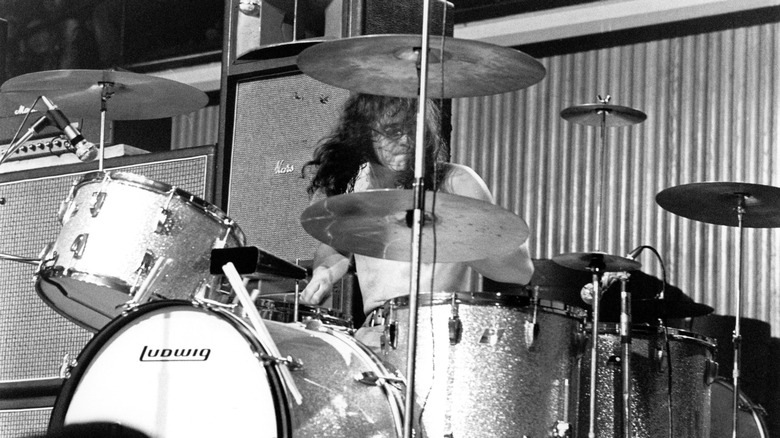
As rock got bigger in the 1970s, so did the drum solos. After all, it was the era of hard rock, prog rock, and heavy metal. While drum solos were usually displays of technical mastery (some of which still give us chills), the '70s were the time to get loud. It was the time to get epic. It was the time to call down the thunder, resulting in some of the most grandiose, mind-blowing, heart-pounding performances from behind the drum kit. Some of the rock drum solos of the day continue to echo, inspiring drummers to pick up the sticks and keep the beat going. It's why we raise our lighters and throw up the horns to these mighty performers.
Having previously covered the best drum solos in rock history, this list presented a challenge. Instead of just repeating the prior choices to once again praise legends like Bill Ward, Ron Bushy, and John Bonham, why not go deeper this time around? Why not highlight a chart-topping song with a monstrous beat? Why not pay homage to a hall-of-fame drummer mastering a notoriously difficult piece? Or a science-fiction-inspired work from one of heavy metal's forefathers? So, if there are certain odd admissions, that's because we've already given respect to Led Zeppelin's "Moby Dick," and these drum solos deserve love, too.
Frankenstein — Chuck Ruff of the Edgar Winter Group
The Edgar Winter Group unleashed a monster of a drum solo with "Frankenstein," a nearly five-minute-long instrumental that closed out their debut album, 1972's "They Only Come Out at Night." Opening up with a nightmare guttural riff from Ronnie Montrose's guitar and Edgar Winter's keys, "Frankenstein" calls down the lightning at the 2:22 mark, when Chuck Ruff launches into the first drum solo. Lasting about 30 seconds, Ruff's swinging solo has inspired millions of rockers (likely in vans with airbrush on the side) to drum along on their steering wheels. But it's toward the end, when Ruff plays against Winter's synthesizers, that the song earns its place in drum Valhalla.
First whipped up in the lab when Edgar was playing alongside his brother, blues rocker Johnny Winter, the latter told OnMilwaukee that the song was originally called "the double-drum song because of the drum solos in it." When it came time to edit it, they had to physically cut the master recording with a razor blade and tape. "At one point," said Winter, "Chuck Ruff, the drummer, mused, 'Wow man, it's like Frankenstein,' I said, 'That's the name of the song!' So the monster was born." And the monster ran amok up the charts, eventually reaching No. 1 on the Billboard Hot 100.
Tank — Carl Palmer of Emerson, Lake & Palmer
Progressive rock, man. Intricate time signatures. Verbose lyrics. Drum solos of bombast and precision, each more technical and astonishing than the last. The '70s was the home of prog rock, and one of its biggest flagbearers was Emerson, Lake & Palmer. Arriving in November 1970, the band's self-titled debut album is perhaps the most proggy of all prog rock LPs. There are arrangements by composers Béla Bartók and Leoš Janáček, as well as a three-part suite based on figures in Greek mythology. And toward the end, you have "Tank," an instrumental showcase for Carl Palmer's impressive skills.
After a little dabbling of Greg Lake's bass, Keith Emerson paints a pretty picture with his clavinet before handing the floor over to Palmer's drums. It's a spectacular solo, one that goes on for two minutes before the band comes together for the final part, a swinging outro. "Tank" was an early indication as to what ELP was capable of, a potential they'd achieve on follow-up albums "Tarkus," "Trilogy," and "Brain Salad Surgery" (best known for the "Karn Evil 9" suite, which features another powerful Palmer solo).
The Mule — Ian Paice of Deep Purple
Ian Paice's entrance into drum Valhalla (Drumhalla?) happened at the start of 1971 with not a crash, but a fireball: Deep Purple released "Fireball," their fifth studio album. The highly influential work — Metallica's Lars Ulrich sang its praises when inducting Deep Purple into the Rock & Roll Hall of Fame in 2016 — kicks off its second side with "The Mule." With lyrics inspired by a character from Isaac Asimov's "Foundation" series, the song thrives and blossoms alongside Paice's distinct drum pattern.
Paice credited his approach on "The Mule" to Ringo Starr's drumming on the Beatles' "Tomorrow Never Knows." "Ringo "plays wonderfully, but his pattern is much darker and more eerie than mine," Paice told Classic Rock. "I just took the rhythmic emphasis and played it in a slightly more violent way." Paice eschewing "peace and love" for "violence" paid off: "The Mule" became a fixture in Deep Purple's live set. In 1972, an extended version of the song (with the epic drum solo) was included on their live album, "Made In Japan."
The Black Page — Terry Bozzio
Though he's known for being an unparalleled virtuoso on the guitar, Frank Zappa's first instrument was the drums (you can see him behind the kit during the "Lonesome Cowboy Burt" segment of "200 Motels"). So, it should be no surprise that he expected a lot of his drummers, pushing them to great lengths with near-impossible challenges — like "The Black Page." After hearing some orchestral musicians confess their biggest nightmare would be taking a job only to see a "black page" (a page of sheet music covered with so many notes), Zappa decided to write his own "Black Page" for his drummer at the time, Terry Bozzio.
After coming into rehearsal one day, Zappa handed Bozzio the sheets to his newest composition. "My words were, 'Gee, Frank. I'm impressed.' It was a really complex piece of music," Bozzio told dw drums. "There were parts I could sight-read ... but there was some, as he called it, 'statistical density' to the piece." Yet, Bozzio proved why he was one of the best to ever play with Zappa, mastering the complex arrangement for Frank's live album, 1978's "Zappa in New York." Since then, "The Black Page" has taken on a mythic reputation among drummers for its difficulty.
La Villa Strangiato — Neil Peart of Rush
It wasn't a question of "will Neil Peart appear on this list," but more of "which epic drum solo of his will we choose?" And since Rush took flight in the 1970s, releasing six now-classic rock albums before the decade was done, picking just one solo from the late drummer was quite the task. Is it "Xanadu," from 1977's "A Farewell to Kings," or the version of "Working Man / Finding My Way" from the "All the World's a Stage" live album? Or is it "By-Tor and the Snow Dog," the nine-minute epic closing out the first side of "Fly by Night"? Each of those could take the crown, but it's the performance on "La Villa Strangiato," which closes out their sixth and final album of the '70s, "Hemispheres."
"La Villa Strangiato" is, as Geddy Lee told Prog in 2019, "a soundtrack to an insane person's dreams." It's a ten-minute opus, and though Neil Peart wrote lyrics for Rush, this shining moment is purely instrumental. That isn't to say you can't hear the trio speak: Though Lee and Alex Lifeson get moments to shine, Peart's drumming is the song's main character. Instead of one single solo moment where the other two instruments drop away, Peart gets his own moments here, there, and everywhere on the track. It's impossible not to drum along.