

5 Times Steely Dan Turned Musicians Into Legends
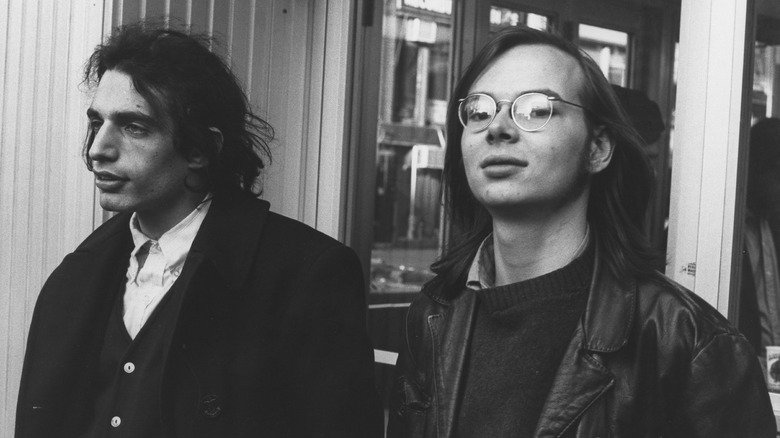
Though their first two albums featured a relatively stable lineup, Steely Dan were never truly a band in the traditional sense. The brainchild of professional songwriters Donald Fagen and Walter Becker, the project became a hub for ultra-slick jazz pop that combined cerebral musicality, lyrics full of literary depth, and infectious melodies into a series of chart-topping albums. It was a remarkable feat — one that enshrined the duo's legacy in the upper echelon of popular music — and it was notable for giving the spotlight to some legendary session players.
Beginning with 1974's "Pretzel Logic," the duo began using a rotating roster of hired talent that changed not only album to album but song to song. Their 1977 magnum opus "Aja" features a staggering 29 session players in addition to Becker and Fagen. Michael MacDonald's vocal performances throughout the Dan catalog may have made him one of the backup singers who helped put '70s rock on the map, but there's a wellspring of instrumentalists to celebrate there as well. We wanted to take a look at five standouts from an incredible cast of players.
Steve Gadd -- Aja
Every legendary band has that album. For Pink Floyd, it was "Dark Side of the Moon." For Led Zeppelin, it was "Led Zeppelin IV." It's that album that towers above the rest of the band's catalog, not just as their best work when contrasted with the rest of the output, but as an album that contributes to the zeitgeist of its era. For Steely Dan, that album was 1977's extraordinary "Aja," an album that would go on to enter the Grammy Hall of Fame in 2003.
The title track is a mammoth 8-minute epic that builds slowly with no indication out front that drummer Steve Gadd is going to steal the show. Fagen's lyrics wax rhapsodic about an exotic Eastern woman (the titular "Aja") and the pleasant joy of her company. The song structure builds, climaxes, and starts again twice before the extended middle section — with its progressive rock overtones and interwoven solos — takes over. Tenor saxophone legend Wayne Shorter eventually steps forward, only to have the spotlight stolen by Gadd, who unleashes a captivating cavalcade underneath him. In a moment of role reversal, the sax phrase becomes accompaniment to a drum solo that interrupts the smooth jazz/adult contemporary proceedings with chops on par with Keith Moon or Neil Peart.
The solo definitely has an "everything but the kitchen sink" quality, but one that has endured with fans throughout the generations. In 2021, Far Out Magazine dubbed it one of the 10 greatest drum solos of all time.
Larry Carlton -- Kid Charlemagne
The real story behind Steely Dan's "Kid Charlemagne" is pretty dark, but you wouldn't know it to hear Larry Carlton's bright, chipper guitar solo. The hard-driving funk opener of 1976's "The Royal Scam" sees Steely Dan fully ensconced in the jazz rock fusion sound only hinted at on their previous albums. Track after track flows by, full of genre-bending dips into a wide range of stylistic directions without ever distracting from the inherent listenability of the songs themselves.
At the forefront of all that avant-garde hipster ethos is Carlton's intricate but melodic lead work. The solo for "Kid Charlemagne" flows so smoothly that its deep melodic content almost feels like an afterthought, and it's an outstanding example of that Steely Dan penchant for making blinding virtuosity sound chill and laid back.
The solo became the stuff of guitar legend with Rolling Stone ranking "Kid Charlemagne" at No. 80 on their "Greatest Guitar Songs of All Time" list. The article summarizes the solo's scene-stealing nature succinctly: "It's so complex it's a song in its own right."
Bernard Purdie -- Home at Last
Nobody can accuse drummer Bernard Purdie of being modest. The R&B/soul phenom was even known to show up to recording sessions with signs on either side of his kit which read "you done it!" followed by "you done hired the hitmaker: Bernard Purdie!" With a resume boasting over 3,000 recordings including James Brown, Aretha Franklin, and Miles Davis, it would be hard to blame him.
While Purdie's intoxicating grooves also show up on the single "Deacon Blues," it's his signature "Purdie shuffle" that drives the deep cut "Home at Last." Tasked with producing a half-time beat that shuffled without sounding like a shuffle, Purdie knew his unique trademark would fit nicely in the larger framework of the song. Listening to the track, it becomes clear just how well the arrangement hangs on Purdie's groove and how nicely it accents Fagen's vocal melody. Indeed, the whole thing sounds like it was written as a melodic accompaniment to Purdie's drum work and as such shows us that Becker and Fagen saw arrangements as more than just window dressing for the vocal hook.
Becker and Fagen would bring Purdie back for "Babylon Sisters" on the 1980 album "Gaucho." The performance is more restrained, in accordance with the song's pensive nature, but it shows once again the satisfying nature of the man's trademark beat.
Jeff Skunk Baxter -- East St. Louis Toodle-Oo
1974's "Pretzel Logic" found Steely Dan in a transitional phase between a dedicated "band" lineup and rotating studio ensembles. As such, the album, which featured the signature hit "Rikki Don't Lose That Number," finds Becker and Fagan straddling the gap between the early 70's AOR rock of their early days and the slick jazz fusion of their most accomplished period. The result is the sound of road-tested, established players mingling with their hired-gun counterparts, and it makes for interesting listening.
One such point of interest comes in the form of Jeff "Skunk" Baxter's solo on "East St. Louis Toodle-Oo," a recreation of a Duke Ellington composition from 1926. Always on the cutting edge, Steely Dan recreated the horn arrangements with heavily processed guitars for a sound that remains remarkably authentic despite its electrified nature. Baxter's solo takes over for Becker's wah-wah guitar lead, turning in a snaky run that rolls gently back and forth between arpeggiated changes and lyrical sliding passages, indicating a mature jazz vocabulary underneath Baxter's hard-rocking exterior. It's a reminder that while "Pretzel Logic" might have been Baxter's swan song with Steely Dan, he was still an equal match for the session players that would replace him.
The "Skunk" left Steely Dan that year to join the Doobie Brothers, first as a touring player and then as a full-time member. The departure came as the guitarist yearned for the thrills of the open road while Becker and Fagen became comfortable leaving touring behind to focus on their studio work.
David Palmer -- Dirty Work
There are plenty of details you didn't know about Steely Dan, but passing listeners to the band's catalog might be surprised to learn that the band wasn't always fronted by Donald Fagen. In the larger spectrum of Steely Dan history, that seems almost bizarre to consider. After all, Fagen's signature hipster sneer and sardonic line delivery are as core to the sound as funk drum cadences and beatnik lyrics. But there were others: the band's 1972 debut LP "Can't Buy a Thrill" features lead vocals from drummer Jim Hodder on "Midnite Cruiser." More notable, however, are "Dirty Work" and "Brooklyn (Owes the Charmer Under Me)," which feature the work of original frontman David Palmer.
With hindsight, it becomes readily apparent why Palmer's recorded contributions are so minimal: his cheerful hippie vocal delivery has more in common with the folksy likes of James Taylor or Paul Simon than the R&B/soul stylings of Becker and Fagen's vision. "Dirty Work" is a rare example of Palmer's sound paying off in a Steely Dan context. With lyrics that tell the story of an extramarital affair and the deep-seated regret it brings, "Dirty Work" benefits from the wispiness in Palmer's voice and the emotional weakness it implies. Later tracks would tackle relationship cheating in songs like "Everything You Did" and "Gaucho" with Fagen's particular brand of cynical snark, but the tender "Dirty Work" shines with Palmer's emotionally naked delivery.
Steely Dan producer Gary Katz eventually persuaded Fagen to take over the vocal duties completely, and Palmer was relegated to background duties on the follow up album, 1973's "Countdown to Ecstasy," before quietly exiting the band altogether. Palmer would pursue other musical avenues thereafter — including, notably, providing lyrics for Carol King's "Jazzman" — before leaving music altogether and pursuing a career in photography.