

The 5 Best Keyboard Solos In Rock History
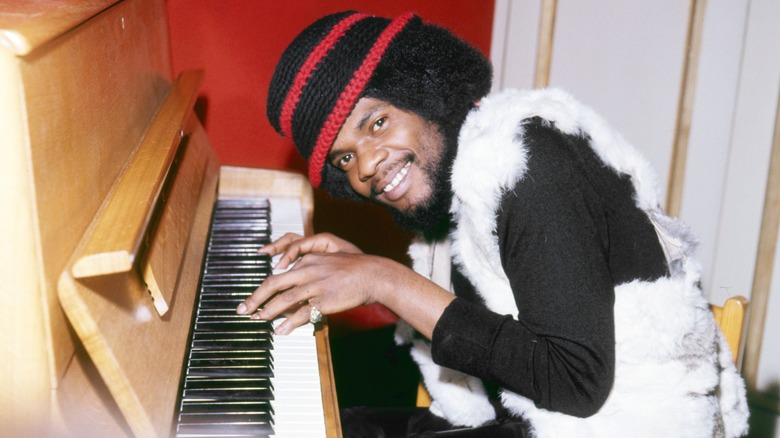
If drummers are often dismissed as the least important members of the band, keyboardists are sadly barely acknowledged. And that's a shame, because there are plenty of keyboard players who haven't received nearly enough recognition, including some epic solos.
The five keyboard solos we included in this article are only a few of many, but they are the kind that, upon hearing them, you'll instantly know why they are among the best in history. We chose these entries because they don't just complement the songs; they make them. Indeed, they are the most recognizable part of each track, perfectly capturing the spirit of the tune.
From the Beatles to the Doors, there are numerous keyboard solos that have defined the sound of music as we know it today, and in some cases, they have quite literally saved the group. The musicians responsible for these masterpieces haven't always been given their due credit, so we're doing our part by praising their genius.
She's a Rainbow — Nicky Hopkins with the Rolling Stones
The Rolling Stones released one of their most iconic albums, "Their Satanic Majesties Request," in 1967, and, perhaps inadvertently, they created one of the greatest keyboard solos in rock music. For the song "She's a Rainbow," they recruited an acclaimed session musician, the legendary Nicky Hopkins. A musician of prodigious talent, he played with some of the greatest bands and solo artists in history, including the Beatles (as a band and as solo artists), Joe Cocker, and Rod Stewart. So, of course, the Rolling Stones also wanted him in a studio album, and his contribution quickly became timeless.
Hopkins' solo in "She's a Rainbow" sounds both ominous and dreamy, as if it either came out of a fairy tale or a fever dream. It complements Brian Jones' Mellotron perfectly, and its clarity and delicacy are incredibly moving. Hopkins faded into obscurity while the Rolling Stones cemented their legendary status, but his part in rock history lives on with this song.
Get Back — Billy Preston with the Beatles
In January 1969, the Beatles got together to fulfill an ambitious project. The band were at their peak creatively, but the strained relationships among the band members made the process grueling. To make matters worse, the band had agreed to have cameras recording their sessions to make a TV show about it, and the pressure of making a record with a constant audience only created more obstacles. Enter Billy Preston, whom Beatles fans will likely recognize for his incredible solo in Paul McCartney's tune, "Get Back," and for good reason.
It was George Harrison who thought to bring Preston into the session, whom the Beatles knew from years before when they were starting out. They got along great, and Harrison knew his expertise would improve the situation. The second Preston started playing, the chemistry in the room changed. Without having heard any of the songs, Preston improvised a solo that ended up being the gem of "Get Back." He was then invited to play on the Beatles' last live performance on the rooftop of Apple Studios.
Billy Preston's influence on the "Let It Be" album is still palpable. He added a fresh sound to a band who felt like they were stuck in a rut, and gave the world one of the most legendary solos in one of the greatest rock songs.
Light My Fire — Ray Manzarek with the Doors
The Doors would be unrecognizable without the powerful work of the late great Ray Manzarek. While his incredible contributions shine on every song and album, most fans would agree that the solo in "Light My Fire" is his masterpiece. It was the perfect example of both his musical expertise and his ability to improvise. The song was initiated by guitarist Robby Krieger, but it was Manzarek who made it unforgettable.
In an interview with NPR, Manzarek said that his jazz background was essential in helping him come up with his solo. "It's basically a jazz structure," he explained. "It's verse, chorus, verse, chorus, state the theme, take a long solo, come back to stating the theme again." In addition to jazz, he also used his knowledge in classical music. "I put my Bach back to work, put my Bach hat on, and came up with a circle of fifths," he went on. Sadly, the solo wasn't heard on the single version, since the original track was seven minutes long, and the single had to be under three minutes. But the band's 1967 self-titled album includes the whole song, and fans can appreciate the full three minutes of a keyboard solo that rocked the world.
Highway Star — Jon Lord with Deep Purple
"Highway Star" is one of Deep Purple's most popular songs, and a big part of what makes it immediately recognizable is Jon Lord's organ solo. Lord and the rest of the band drew inspiration from classical music to create this hit track; guitarist Ritchie Blackmore told Guitar Player that they adapted a Bach progression for the song.
While it might not sound classical at first listen (it is a heavy metal song, after all), this fast-paced six-minute-long track features a minute-long Hammond organ solo that Lord composed with that earlier genre in mind. It quickly became one of the most famous heavy metal solos, and it is perfectly complemented by Blackmore's guitar. Unfortunately, this song ran into the same problem that so many other iconic songs with significant instrumental parts have, and the single version had to be cut down from six minutes to three minutes. Be sure to listen to the album version to fully appreciate this amazing solo.
Nineteen Hundred and Eighty-Five — Paul McCartney with Wings
Paul McCartney might be better known for his prowess as a bass player in the Beatles, but he left an indelible mark on rock music with his piano and keyboard work in his solo career. After the Beatles broke up in 1970, he went on to create Paul McCartney and Wings alongside his wife Linda, and in 1973, their most successful album, "Band on the Run," included one of his greatest organ solos. "Nineteen Hundred and Eighty-Five" was the closing track of the album, and it was heavily piano-led, with multiple synthesizers and a mellotron.
The song closes with a two-minute outro, which includes a complex piano solo played by McCartney, overdubbed with synth sounds that give it a futuristic feel. In his book, "The Lyrics: 1956 to the Present," McCartney explained that it was inspired by George Orwell's "1984," and how the future can seem so far away. "The idea behind the song is that this is a relationship that was always meant to be. No one in the distant future is ever going to get my attention, because I've got you ... So, this is basically a love song about the future." His solo really brings this concept to life, and to this day, when he plays it live, it makes stadiums roar.