

5 Classic Rock Hits With No Known Authors
Inspiration can come from anywhere, and there are a few well-known classic rock hits whose origins will probably forever be unclear — they have no definitively known songwriter. In the 1960s and 1970s, rock bands and singers usually wrote their own material, or they looked to trusted outside sources like music publishing companies. Very occasionally, they pulled from way back, into the public domain and the musical traditions of the centuries prior, taking old folk songs or those of otherwise unclear or mysterious origins and making them their own. They adapted those old tunes into rock songs, and then those songs became hits — no songwriter royalties paid.
There's an earnestness and humanity to plucking songs from the collective musical history. Not only did that give mid-20th-century rock bands a chance to show off their influences and musical backgrounds, but they could do it with deeply culturally imprinted stuff. They must have known that on some level, audiences would respond well to songs with which they already had at least a passing familiarity. Here then are some of those memorable hits from beloved acts like Janis Joplin, Ritchie Valens, Johnny Rivers, the Beach Boys, and the Beatles that don't have a known author.
Down on Me
"Down on Me" is a personal, vulnerable, and introspective response to an uncaring and cruel world. The song dates to the 1920s and the freedom song movement, a genre linked to blues and protest music that would prove explosively popular later on. History didn't record who actually wrote "Down on Me" and poignant lyrics like "When you see a hand that's held out toward you / Give it some love, someday it may be you."
In the 1960s, Janis Joplin revived the song for the counterculture, recording it for her first album, Big Brother and the Holding Company's 1967 self-titled release. Five years on, and nearly two years after the tragic death of Joplin, the song registered as a hit single. "Down on Me" opens "In Concert," Joplin's 1972-released double live album of which half of the songs come from 1968 shows. That live take of "Down on Me" spent a month on the Billboard Hot 100 in the summer of 1972, peaking at No. 91 — the last charting single for the singer. In both circumstances, "Down on Me" wasn't listed with a credited songwriter, although Joplin was credited with the contemporary rock arrangement.
La Bamba
Son jarocho is a type of music native to the eastern Mexican state of Veracruz, a blend of forms from indigenous populations, Spanish colonists, and enslaved people from Africa. Associated with Afro-Caribbean music, son jarocho is characterized by repeated rhythms and melodies, aggressive use of the harp, and informal lyrics. Many Mexican folk songs started out as son jarocho compositions, including "La Bamba," which was already a well-known, anonymously composed song by the 1940s when Andres Huesca modernized it. In 1958, Mexican-American California resident Ritchie Valens took another stab at the track, adapting "La Bamba" into a rapid-fire rock 'n' roll tune powered by acoustic guitar.
After the release of the original pop ballad "Donna" in 1958, Valens issued his recording of "La Bamba." It peaked at No. 22 in early February 1959, the same week that 17-year-old Valens died in a plane crash that also killed Buddy Holly, known as "The Day the Music Died." When Valens' brief life story inspired the 1987 film "La Bamba," Los Lobos provided the bulk of the soundtrack. Their cover of Valens' interpretation of the tune went to No. 1 for three weeks, the first chart-topping Spanish-language song in U.S. history.
Midnight Special
A well-received but since forgotten pop-rock star of the 1960s and 1970s, Johnny Rivers changed his style with the times, and he was rewarded with 17 Top 40 hits that run the gamut from soft rock to soul to harder rock to raucous blues. Along with "Poor Side of Town," "Baby I Need Your Lovin,'" and "Secret Agent Man," one of Rivers' best-known recordings and biggest hits is "Midnight Special," a No. 20 hit in 1965. Rivers didn't write the hard and heavy blues-rock song, but he did earn an "arranged and adapted" acknowledgment.
It's tough to tell who created "Midnight Special," but musicologists theorize the early 20th-century song with numerous variations made its way around the South and was a particular favorite among prisoners. While the titular "Midnight Special" may be a name or nickname of any number of trains, the lyrics could also be coded: The "ever lovin' light" emitted by the vehicle means that a prisoner will soon be paroled, or it's the joy resulting from a conjugal visit.
Blues legend Lead Belly delivered an iconic foundational recording of "The Midnight Special" in 1941, and Rivers wasn't the first nor the last musician of the 1960s to give the song a try. His studio version followed recordings by Harry Belafonte, Hoyt Axton, and the Kingston Trio, and Creedence Clearwater Revival covered it on their 1969 LP "Willy and the Poor Boys."
Sloop John B
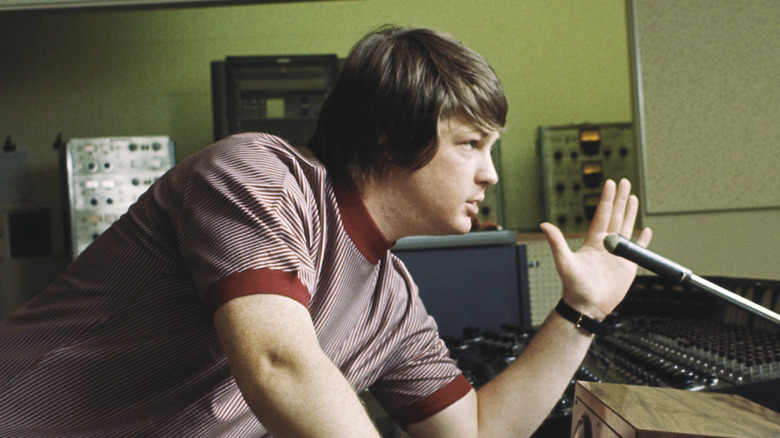
Under the direction of Brian Wilson, the Beach Boys abruptly and significantly matured with the experimental and progressive LP "Pet Sounds." Released in 1966, the best year of the Beach Boys' career, the album found the band moving away from songs about surfing and much farther into the ocean for inspiration, such as on the standout track and initial single "Sloop John B." In the liner notes and on the labels, no songwriter was listed, but Wilson was a credited arranger, having adapted and expanded what was a folk song dating back to at least 1903. That's when "Hoist the John B Sails" was first published, recounting the story of a ship that crashed near Nassau, in the Bahamas, set to a well-worn Bahamian sailing shanty.
After hearing folk act the Kingston Trio's 1958 take on "The John B. Sails," presented as "The Wreck of the John B.," the Beach Boys' Al Jardine suggested to Wilson that their band do the song, too. It became one of the group's biggest hits, sailing to No. 3 on the pop chart in May 1966.
My Bonnie
In 1961, the Beatles decamped to Hamburg, Germany, to play small clubs. There, they quickly connected with Tony Sheridan, a minor British singing star in the city for the same purpose. They played shows together, and after German label Polydor Records convinced the collective to cut some tracks, they recorded "My Bonnie." Issued as a single in Germany in the fall of 1961, the artist on the sleeve was "Tony Sheridan and the Beat Brothers," because company personnel didn't think the wordplay-based name "the Beatles" would translate into German.
What did carry over for German audiences: The content of "My Bonnie." A lilting folk song from Scotland, it's also known as "Bring Back My Bonnie to Me" and "My Bonnie Lies Over the Ocean." Seemingly about an individual pining over a missing lover, the song's age is indeterminate, but it was popular in sheet music form as early as the 1870s. Sheridan got a credit for the arrangement, which became a top 5 hit in Germany.
"My Bonnie" hit U.K. record shops in early 1962, but it didn't make an impact on the chart in the band's home nation until the summer of 1963, after Beatlemania was underway and "From Me to You" had ascended to No. 1. Now properly declared a recording by Tony Sheridan and the Beatles, the new take on the old song spent a week on the U.K. pop chart, landing at No. 48.