

4 Mysteries Every Classic Rock Fan Wants Solved
Despite the scores of written material and online speculation devoted to uncovering the stories behind every element of every classic rock song, there are a handful of true enigmas that remain. And fans of that old time rock 'n' roll of the '60s, '70s, and '80s would love to know the answers to the questions that have haunted the world of classic rock for decades. An ongoing cultural fascination with the music of yore, and all of its extremely popular bands and their widely known songs, has led to some legendary stories about rock. Still, unsolved mysteries remain, and it's possible that no satisfying answer or explanation will ever be revealed.
From who prompted Rick Springfield to write "Jessie's Girl" to whatever became of Green Day's missing album, these are the sometimes-creepy but mostly tantalizing questions that keep classic rock fans awake at night and discussing with friends.
Who is Jessie's Girl?
In August 1981, Rick Springfield scored his first No. 1 hit with the guitar-driven rocker "Jessie's Girl." Springfield's parallel success as an actor on the soap "General Hospital" boosted the song, as did its delicious back story. "Jessie's Girl" is an anthem of unrequited love for an unavailable woman that Springfield wrote from experience. In the 45-plus years that have passed, the song's subject has never been identified.
In 1979, Springfield enrolled in a stained-glass-making class in Southern California and glimpsed a classmate. "She was stunning and hot and everything. But she had a boyfriend. His name was Gary," Springfield told Yahoo Entertainment. With a couple of alterations, Springfield parlayed his feelings into "Jessie's Girl." But who was the woman behind the hit? "I've forgotten her name. I just remember his name was Gary," Springfield told Entertainment Weekly.
Investigations attempting to find the real "Jessie's girl" have proven fruitless, too — even one by "The Oprah Winfrey Show." "Oprah went and found the stained-glass class in Pasadena, but the teacher had died two years before she had found them, and they'd thrown out all his paperwork a year later," Springfield said, likely closing the book on "Jessie's Girl" forever.
Who's that shadowy figure on the Sgt. Pepper's Lonely Hearts Club Band cover?
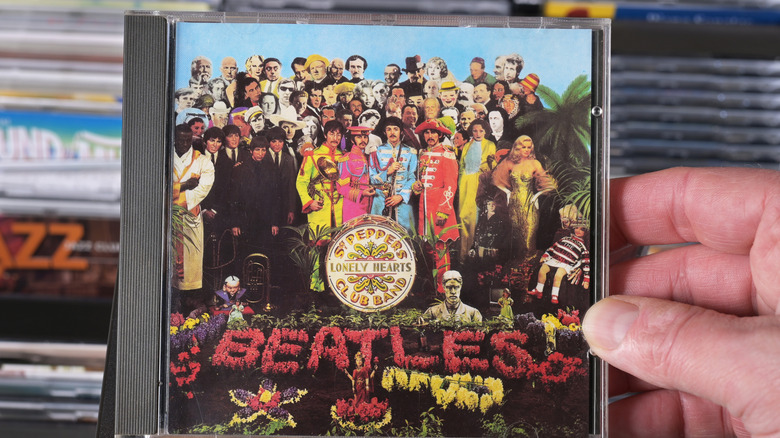
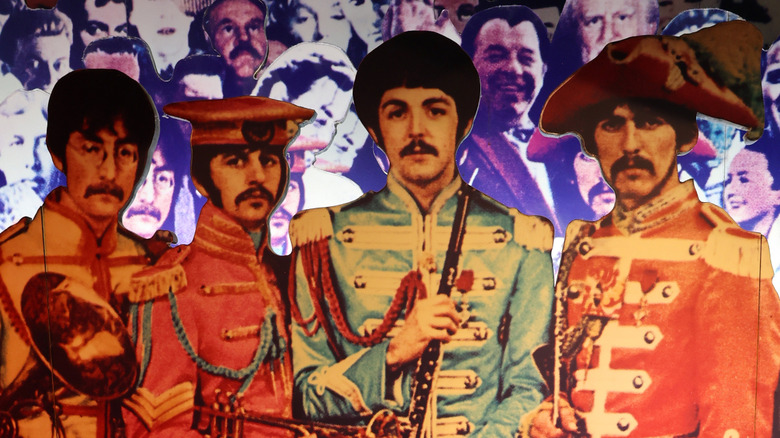
Album covers often have hidden meanings, but the sleeve of the Beatles' 1967 LP "Sgt. Pepper's Lonely Hearts Club Band" includes a mystery in plain sight. Perhaps the best-known rock album cover ever, the well-populated image was constructed by pop artists Jann Haworth and Peter Blake out of photos, cutouts, and wax dummies to create a virtual crowd of prominent historical figures and artists. Included are the highly recognizable likes of Edgar Allan Poe, Marilyn Monroe, Bob Dylan, Marlon Brando, Karl Marx, and the Beatles themselves. And yet there's one figure who hasn't been conclusively identified, despite their presumed status as a very important person. Presented in black-and-white, low resolution, and behind a wax model of the Beatles' George Harrison is a hard-to-spot individual whose identity is in dispute.
Fans think it could be famed early 20th century aviator Amelia Earhart, but the most common notion is that it's silent film superstar Charlie Chaplin, albeit not in costume as his famous "Little Tramp" character. In 2024, album art historian Richard Forrest went so far as to write to cover designer Blake to ask him to settle the argument once and for all. Even Blake hadn't a clue.
Who does Carly Simon think is so vain?
Carly Simon is one of the most popular and acclaimed examples of the 1970s singer-songwriter movement, but she only had one No. 1 hit in her career: 1973's "You're So Vain." A gleeful takedown of obnoxious male arrogance, "You're So Vain" is loaded with choice and precise insults, like "You walked into the party like you were walking onto a yacht" and "You're so vain / you probably think this song is about you." A hit song that built a larger-than-life character, coupled with Simon's many high-profile romances with other celebrities, left the world wondering who was so awful that Simon had to write a song about them.
For 40 years, Simon steadfastly refused to share the story behind "You're So Vain." At a 2003 charity auction, she sold the identity (or identities) of the real-life "You're So Vain" subject to NBC Sports head Dick Ebersol for $50,000. He's kept the secret, although in 2015, Simon let People know that '70s superstar actor Warren Beatty inspired verse two of the song. "Warren thinks the whole thing is about him!" she quipped. But still, the full breadth of the song's targets remains unknown to the vast majority of humanity.
What happened to Green Day's Cigarettes and Valentines?

In the early 2000s, rock juggernaut Green Day completed production on an album called "Cigarettes and Valentines." They recorded 20 songs, and the master tapes were ready and waiting at the band's Studio 880 in Oakland, California, to be sent out for mass production. Then, in November 2002, those tapes vanished.
A lost album and one-of-a-kind relic associated with one of the most popular rock bands on the planet, those "Cigarettes and Valentines" masters could've fetched a fortune on the open market or via ransom. But more than 20 years later, they've never surfaced, seemingly gone without a trace. The recordings were presumably stolen by someone who knew what they were doing, but nobody really knows what happened. In the end, Green Day reconvened and recorded the "American Idiot" LP not long after, rather than re-assemble "Cigarettes and Valentines."