

Quote Of The Day By Leonard Cohen: 'Nothing Can Stop You From ...'
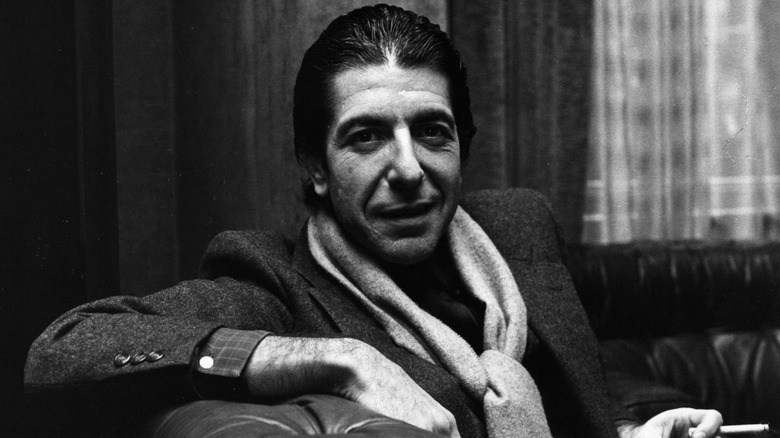
Poet and singer-songwriter Leonard Cohen never seemed like an easy person to understand. But that's only if you assume all poets, writers, and musicians retain some special wisdom simply because they're poets, writers, and musicians. Cohen knew that he didn't know — that art is praxis and not dogma. As he said in interviews in one way or another, humanity is a tangle of unanswerable contradictions and insatiable appetites that he never stopped questioning.
Cohen had always been driven to ask and wonder, even from a young age. He didn't come from a struggling family, but a well-to-do, well-educated one. His intellectual interests were obvious from a young age: poetry, music, and religion, particularly his family's Judaism. At the same time, Cohen was so possessed by a love of women that posthumous articles have taken to describing his "womanizing" ways, as the Walrus says. Or as Cohen's 2014 biography, "A Broken Hallelujah: Rock and Roll, Redemption, and the Life of Leonard Cohen," describes such duality, even the biblical Isaiah, "understood that humankind's spiritual and sexual yearnings were intertwined" (per Sharp Magazine).
In a 2006 interview with Brick, Cohen included himself in his own evaluation of human nature, saying, "... Our impulses and our motivations, they're hopeless. First of all, we don't determine them. We receive them, we act on them, and we fall in love with things and with ideas and with people, and we can't help ourselves." This self-inclusion acts as a thesis to Cohen's musings and life, right down to his mid-life turn towards Zen Buddhism. This is why he gets our quote of the day.
Quote of the Day by Leonard Cohen
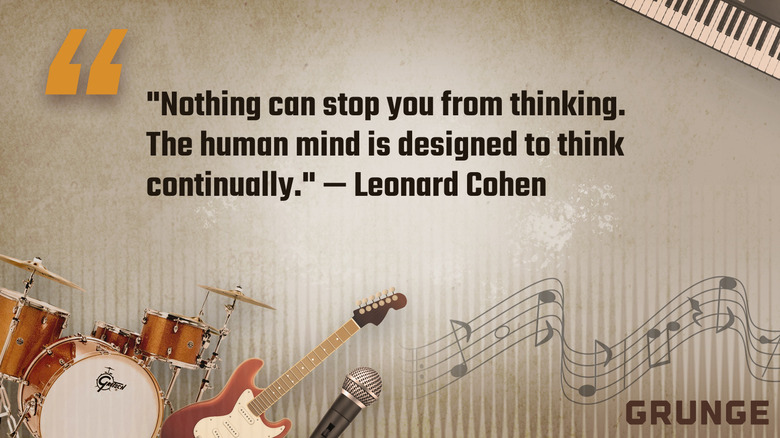
"Nothing can stop you from thinking. The human mind is designed to think continually," Cohen told Interview way back in 1995 (reprinted following his death in 2016). As if to illustrate his own statement, Cohen continued by quoting his former self, "Something I wrote quite a few years ago was, 'The voices in my head, they don't care what I do, they just want to argue the matter through and through'." Those voices reached no conclusion, which then forced Cohen to live up to his own quote, again and again.
Even though that interview came a full two decades before Cohen's death, it also came over 25 years after his 1968 debut, "Songs of Leonard Cohen," followed by an enormously underrated song like 1971's "Avalanche." The interview also came eleven years after Cohen released his landmark track, "Hallelujah," a song with 837 official covers (some of the best being from Jeff Buckley, Rufus Wainwright, and Bob Dylan). It was also just one year after he first fled to Mount Baldy Zen Buddhist monastery near Los Angeles to do little but think (while trying not to, per the history and practices of Zen Buddhism).
On that note, Cohen continued in his 1995 interview: "It is a common mistake, to think you're going to go into some kind of spiritual practice and you're going to be relieved of the human burdens, from human crosses like thought, jealousy, despair — in fact, if anything, these feelings are amplified." Some folks might wonder why Cohen went to Mount Baldy at all, then, or why he couldn't be happy with his success. That'd be missing the point. He wanted to understand himself and others, and he couldn't stop if he tried.
Deeper Meaning of Cohen's Quote -- Acceptance
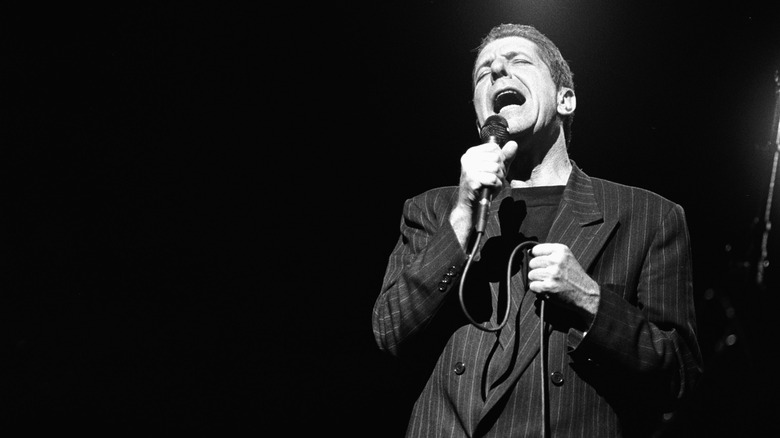
Let's be real: Plenty of folks would rather not think about anything. Whether out of a fear of the absolute emptiness pervading one's final, truest interior, or (let's keep being real) an inability to do so, we can't say. Neither could Leonard Cohen. He only commented on what he saw and felt, as one of a species of "bloodthirsty homicidal predators" who are also "tender creatures filled with the highest ideals and the profoundest aspirations," as Brick quotes. Subject to those same dual pulls, as evidenced even in his young-life poetry vs. the flesh duality, Cohen at least had the wherewithal to be honest about them in poetic form. But more to the point: He didn't fight them.
We just used the word "duality" to describe the seemingly opposed pulls of poetry vs. the flesh, which sat at the heart of Cohen's work. But as The Michigan Daily describes, a song like Cohen's "Hallelujah," which was originally staggeringly long, fuses the two — "the holy and the horny." Indeed, the 1984 album that featured "Hallelujah" was called "Various Positions." This isn't a new notion (remember what Cohen's biography said about Isaiah), as plenty of other artists have tackled the same topic, down to Hozier's "Take Me to Church."
So when Cohen talks about such contradictions, he's not necessarily lamenting them. He never expected to reach any final conclusions about humanity's sundry (and seeming) contradictions, himself included. But he still needed to articulate such thoughts that never ended because "the human mind is designed to think continually." He accepted things the way they were, unvarnished and tarnished, same as he accepted that he'd never get final answers.
More Quotes from Cohen
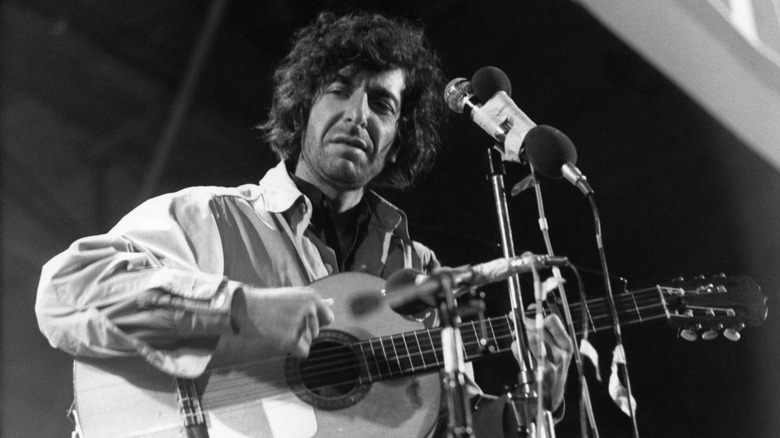
- "I think my opinions are second-rate, but when you submit yourself to a form, then something happens ..."
- "I've never had much faith in my own take on things, and I know that the world is far too complex, first of all, for a solution."
- "You should never throw anything away, including people and ideas."
- "Any of the decisions that I made, if one could actually locate a shape or form, were all within a wall, the landscape of music."
- "I think love lasts. I think it's the nature of love to last. I think it's eternal, but I think we don't know what to do with it much of the time."
- "We all feel when we're loved that some concession has been made."