

5 Phil Collins Drum Performances That Cement His Place In Music History
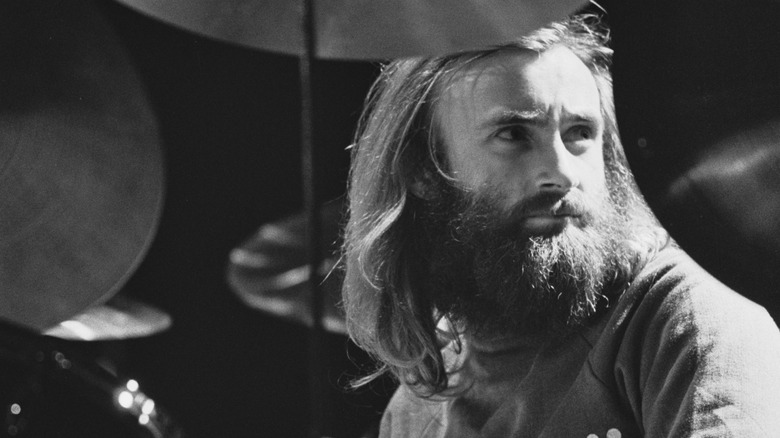
There's plenty of things that secure the legacy of Phil Collins, his consistent hit-making career as a songwriter outstanding among them. But those laurels seem almost like a fluke compared to the intricate mastery he exhibited behind the drum kit in his days with Genesis. Those years of intimidating mastery behind the kit came with the remarkable truth about his Genesis audition: that he learned much of the music on the fly while listening to the other try-outs from the comfort of a nearby swimming pool.
With that in mind, we wanted to take a look at five of the standout solos that earned Collins formidable respect as a drummer before he made even more dramatic leaps into the realm of soft rock crooning. Whether it's dizzying displays from a young prog-rock powerhouse or the tasteful smack in the face of "In the Air Tonight," this is a foray into the work of a percussionist who has more than earned his place in the pantheon of music history.
Genesis — Supper's Ready
By the release of "Foxtrot" in 1972, Phil Collins had fully integrated into the ensemble's intricate interior world. Having joined the band on the album's predecessor, 1971's "Nursery Cryme," he was now a central player in the group that was rapidly defining the newly emergent concept of progressive rock. Led by singer Peter Gabriel's high concept theatricality and epic poetry, the band had defied the conventions of rock radio to emerge not as hit single merchants but as a collective of virtuoso visionaries who produced operatic suites on rock band instrumentation.
The full realization of that grand vision and musical growth is readily apparent on "Supper's Ready," the sprawling closer to "Foxtrot." A cryptically worded exploration of romantic and biblical themes that seems to be asking prophetic questions about human nature. It is a complex, thought-provoking musical journey that answers the question "is progressive rock about cerebral lyrics or instrumental virtuosity?" With a defiant "yes."
Collins has a lot to say throughout the work but standout moments abound. Six minutes in (with a mere 16 to go), Collins sits down on the snare with accenting fills across the toms for a solo that mounts the tension beneath Gabriel's euphoric vocals. What feels like it should be a short drum passage to signal the next section continues with such prolonged ferocity that we're forced to wonder if someone asked "is he okay in there?" during the drum recording sessions. That kind of blistering scene stealing pervades the song's runtime with Collins making the track a masterclass time and again.
Genesis — Watcher of the Skies
Central to "Watcher of the Skies," the first track on "Foxtrot," is a militaristic, staccato guitar riff that, in hindsight, sounds like the kind of palm-muted grooves that would be favored by thrash and speed metal bands in the decades to follow. But where those bands would use such passages purely for percussive pummeling, Genesis is happy to build harmonic and melodic development around them and in so doing find a wellspring of musical interplay.
Central to that cohesive interaction throughout that motif is Collins' motivic development in his own drum part. A parade style march groove (albeit one in 6/4 time) is first implied on the hi-hat, then introduces the snare as the intensity builds. Eventually the groove transfers completely to the snare and at the moment of peak intensity only to erupt into a full kit drum cadence carried by the ride cymbal when the song takes off. By that point, what began as ominous pummeling feels like the odd meter jazz of Dave Bruebeck.
As the song takes flight, it becomes readily apparent that Collins is aware of the motif's melodic content and his role in accentuating it. But Collins is quietly stealing the show underneath Gabriel's soaring vocals: each verse builds that intense cadence to climactic breakdown point that affords Collins the opportunity to throw down solos that, for all their impressive chops, feel like a respite from the militaristic bravado before deftly reintroducing it. By the end of the piece, we are gloriously beaten into submission and grateful for the privilege.
Phil Collins — In The Air Tonight
A year prior to his 1981 debut solo album "Face Value," Phil Collins had already spearheaded the transition of Genesis from progressive-rock titans into purveyors of sophisticated artpop with the release of the band's landmark album "Duke." It was a dramatic shift, one that had come about in the years since Collins replaced the departing Peter Gabriel as frontman, but by that point the drummer had already more than proven himself from a technical standpoint.
"Face Value" finds Collins fully embracing album-oriented soft rock with no indication of the wild progressivisms of the early Genesis albums. Collins pulls double duty as both drummer and vocalist throughout the album, as he would in the studio with Genesis, but the focus was squarely on low-key, mellow songcraft, not virtuosity. That shift in direction proved wise as it yielded the album's lead track, the enduring classic "In the Air Tonight."
While the song's ice-cold tone would lead many listeners to speculate about the hidden meaning of "In the Air Tonight", the ominous aura lends some captivating opportunities from an arranging standpoint. Prominent among them is the drum solo at 3:41. That sudden and overpowering phrase steps up the tone dramatically: what had previously been coolly detached resentments explodes into a full-scale confrontation. It's a simple part, but in the context of the song it's the musical equivalent of flipping over a table. There's been debate through the years about whether or not the iconic part is a proper solo or just a fill (with Collins himself in the latter camp). But did it cement his place in music history? Without question.
Brand X — Nuclear Burn
The popular understanding of Phil Collins' timeline begins with drumming for the prog era of Genesis, continues with fronting a more mainstream incarnation of Genesis, and finally arrives at megastar solo act status. That's a decent overview, but it doesn't fully capture the multifaceted musical multiverse that Collins occupied. For that, we turn to Brand X, the fusion jazz group he founded with musicians from his session work.
Stripped of the literary context afforded by Peter Gabriel's high-concept lyrics, Brand X sees Collins' progressive virtuosity doing its own explorations. Guitarist John Goodsall, keyboardist Robin Lumley, and bassist Percy Jones dance around the nimble hurricane of chops that Collins lays down. On "Nuclear Burn," the opening track off 1976's "Unorthodox Behaviour," that means navigating a treacherous groove in 11/8 time.
Collins' performance throughout the track could almost be described as one continuous drum solo: even the consistent, timekeeping parts of the groove feel designed to center the drums in our attention. There's enough compositional structure that it doesn't feel completely random — quite the opposite. There's a deep internal cohesion so tightly wound around the percussion that the whole ensemble feels like an outgrowth of Collins' seemingly frenetic playing. By the time his solo arrives (and it comes to consume the latter half of the track) it comes as a glorious sense of release, as though he'd been building to this rapturous climax all along. Once again, Collins shows that his prodigious chops are deeply rooted in compositional necessity, no matter how complex the piece at hand may be.
Genesis -- Duke's Travels
A central event in how Phil Collins became the lead singer of Genesis came when the band's guitarist Steve Hackett came to Collins' wedding and convinced him to give the position a shot. Thus, the Collins-as-vocalist era of Genesis got underway with 1976's "A Trick of the Tail." At first the band continued in the progressive-rock style it had pioneered but by the end of the decade two things were very much in jeopardy: the enduring popularity of prog and Collins' marriage. Those two developments would inform the musical and lyrical direction of 1980's "Duke," an album that marked the band's shift away from epic concept rock and into the hit singles driven world of 80's synth pop.
The album tells the story of Albert, an obsessive lover fixated on an enigmatic woman known only as "Duchess." Knowing that prog rock was quickly becoming a verboten idea in the post-punk/new wave era, the band wisely sublimated the album's narrative throughline. Instead of presenting the interconnected tracks as a unified suite, the band opted for a series of seemingly independent standalone works whose thematic unity only becomes apparent on deeper examination.
That sense of polite restraint heralds the end of Genesis as a prog band, but the transitional album still affords Collins and company plenty of opportunities to shine instrumentally throughout. Not the least of these can be heard on the largely instrumental "Duke's Travels," where Collins' worldbeat solo moves the piece out of its opening synthesizer statement and into the primary groove. It's a triumphant final bow for a drumming style that had built an entire genre and one that deserves to be studied alongside his more well-known technical work.