

5 Orchestral Albums Every Classic Rock Fan Should Own
Nowadays, orchestras are a resource that bands and artists from all genres like to use. They give depth and a sense of cinematic immersion to an album; when used well, they are a huge game changer, and there are some exemplary LPs that belong in every classic rock collection.
Mixing rock and orchestras wasn't always such a no-brainer, and the first rock albums to do so had to disrupt the status quo, often with innovative producers like George Martin encouraging the bands to push boundaries. Eventually, it extended beyond just including classical instruments, and led to arranging rock bands like orchestras, creating a massive, orchestral sound even with traditional rock instruments.
Even though we've focused on orchestral classic rock albums that were released in the '60s and early '70s, narrowing our list down to five wasn't easy. We focused on selecting the ones that were truly groundbreaking for their time — those albums that every rock fan should own — but that are also, perhaps unknowingly, the albums that inspired artists from other genres. After all, while the bands and artists listed here might be rock stars, part of what makes their legacy great is their ability to mix genres, and that is a statement that transcends personal musical tastes.
Sgt. Pepper's Lonely Hearts Club Band — The Beatles
Released in 1967, "Sgt. Pepper's Lonely Hearts Club Band" was one of the most groundbreaking albums of the 20th century. A few years before it was released, the Beatles had already dipped their toes in orchestral rock. In fact, "Yesterday", the most covered song in modern history, included a string quartet at the insistence of producer George Martin. Paul McCartney was skeptical at first, but seeing the song's success, the band were excited to experiment more, and "Sgt. Pepper" was the perfect opportunity. They included orchestral arrangements for songs like "She's Leaving Home," "Being for the Benefit of Mr. Kite!", and of course, their masterpiece, "A Day in the Life."
It was George Martin who arranged the orchestral pieces for them, and in "A Day in the Life," it especially brings the song to life with an intense series of rising notes. McCartney knew what he wanted from the orchestra, and Martin, being a classically trained musician himself, was able to bring his vision to life. To this day, the outro of that song remains one of the most celebrated pieces of music in history.
A Night at the Opera — Queen
The name of the album says it all. In 1975, Queen were steadily rising in their career, and they were ready to experiment. Freddie Mercury in particular was very keen on bringing elements of classical music into their classic rock sound. But rather than bringing in classically trained orchestra musicians and molding them to the band's sound, Queen decided to go for a simulated orchestra for "A Night at the Opera." The clearest example of this is, of course, the legendary song "Bohemian Rhapsody." It's hard to hear it at first, but Queen did not deviate from their usual instrumentation to achieve the orchestral sound that inspired generations of musicians.
"Bohemian Rhapsody" purposely mixed hard rock with classical music elements, and it changed popular music forever. It was Mercury's ambition to bring classical genres such as opera, orchestras, and ballet to the masses, and with this album, he certainly achieved it. Guitarist Brian May arranged a traditional rock band like a conductor would, and the result was a wall of sound that made four guys playing guitar, bass, piano, and drums sound like a 60-piece orchestra.
The Soft Parade — The Doors
"The Soft Parade" is the Doors' orchestral statement. It was a unique era in their career, as they had never experimented so much with mixing genres, and it was a clear departure from their first three albums. Nonetheless, the incorporation of orchestral arrangements shows how versatile the group was. Ray Manzarek described this album in his autobiography, "Light My Fire: My Life with The Doors," as a "sonic extravaganza, with horns and strings augmenting our basic guitar, keyboards, and drums sound. We were going to bring in jazz cats, country-and-western pickers, and classical pickers."
They recruited Paul Harris to arrange brass and string sections that greatly enriched their sound, and this change in direction becomes evident on the very first song. "Tell All the People," a track written by guitarist Robby Krieger, shows a new side of the band and of Jim Morrison as a singer. His way of singing is almost like a crooner, and sounds beautifully clear against the brass arrangement that opens the song. It was certainly a challenge for the fans when the album came out in 1969, but decades later, it's still a must-have in any classic rock fan's collection.
Band on the Run — Paul McCartney & Wings
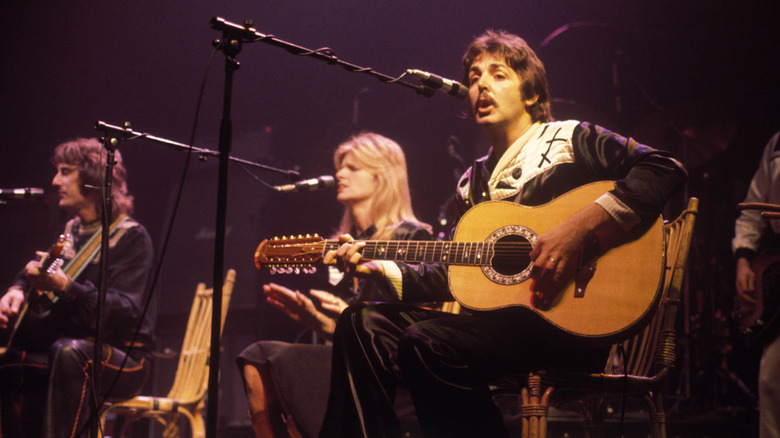
"Band on the Run" was a high-production album that cemented Paul McCartney's career after the Beatles. Produced by Paul McCartney himself, this 1973 album, featuring only three Wings members — the McCartneys and guitarist Denny Laine — was a masterpiece of experimentation. The title opening track is an ambitious three-part song about being on the run from the law. It features a 60-person orchestra arranged by producer Tony Visconti, and to this day, "Band on the Run" is one of McCartney's most popular tracks.
Orchestral arrangements were a recurring theme throughout the record. The song "Jet" includes brass sections and opens with an ominous orchestra intro that blends beautifully with the fast-paced rock sound. The album closes as intensely as it opens: "Nineteen Hundred and Eighty-Five" is a cinematic track that starts with a tense piano solo, and gradually grows musically. The outro features one of the greatest keyboard solos in rock music, backed by a string and brass section that provides the epic, futuristic sound McCartney was going for.
David Bowie — David Bowie
David Bowie was the king of bending genres, and even before he became world-famous, he was already bold enough to experiment with making orchestral albums. His self-titled sophomore album, popularly known as "Space Oddity" thanks to its opening track, is the prime example of that. Inspired by a famous Stanley Kubrick film, "Space Oddity" is the song that introduces one of Bowie's most famous characters, Major Tom. This song features string musicians and flutes, arranged by Bowie's trusted producer, Tony Visconti.
Visconti explained on a Bowie TV video that Bowie had a vision for the whole album, but it lacked focus and needed direction — as did Bowie. Visconti's way of doing that consisted of having Bowie be the "click track" for the orchestra, strumming on his 12-string acoustic guitar. He said he would sit him down amid a 50-person orchestra and have him just keep the rhythm on his guitar and listen to the orchestra. The album is extravagant and psychedelic, but at its core it's an acoustic guitar album. Bowie just needed an extra push to turn his acoustic musings into a revolutionary record.