

Commonly Misunderstood Elton John Lyrics You May Be Singing Wrong
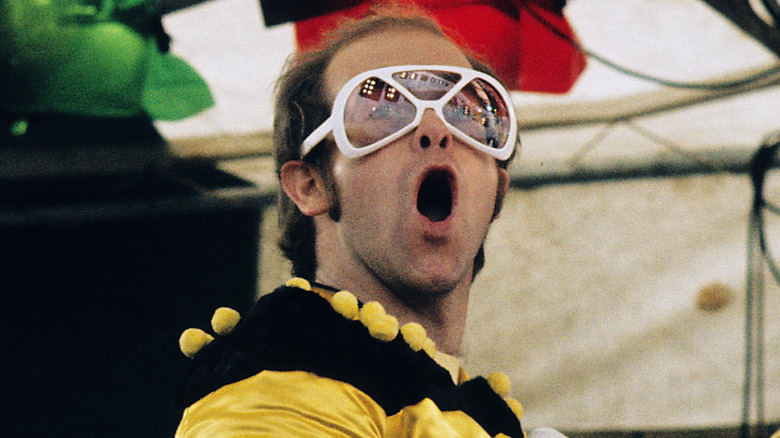
Singing along to Elton John songs that come on the radio, a streamer, or karaoke is fun and irresistible — but all this time, since the early 1970s, you might have been getting the words completely wrong. John, a pianist and composer untouchable by his classic rock peers, also possesses one of the most recognizable and distinctive voices in music. He sings from the heart and with plenty of emotion and wit, but very often, when he's delivering the lyrics written for him by longtime collaborator Bernie Taupin, he's tough to understand. John can get a little mumbly or garbled when he's belting out a ballad or tearing through an uptempo number, so much so that even his biggest fans inadvertently have no idea what he's saying.
John is among the most commonly misunderstood classic rock artists, and he sang one of the most famous wrongly heard lines ever. In "Tiny Dancer," he doesn't actually cry out "Hold me closer, Tony Danza." Similarly, his many hits have lodged incorrect lyrics in the minds of the masses. Here are some of Elton John's most memorable songs, including "Daniel," "Goodbye Yellow Brick Road," "Rocket Man," "Bennie and The Jets," and "Can You Feel the Love Tonight," that have frequently been totally misinterpreted by listeners.
Daniel
In 1973, Elton John reached No. 2 on the pop chart with "Daniel." A showcase for the musician's deeply empathetic and powerful vocal skills, the song itself is a poignant first-person story about the narrator's relationship with a troubled character named Daniel. Referred to as a brother, he's coping with so much pain that, to escape, he boards an airplane bound for Spain. The nature of Daniel's issues and what happens next is left up in the air, leaving listeners scrambling for answers, to the extent that scores have heard and processed very wrong versions of the lyric sheet.
Just about every line in "Daniel" has been taken wrong by someone over the years, but perhaps none more so than the central chorus bit, "Daniel, my brother, you are older than me." Various individuals thought he was recognizing his brother for being "oh so dandy," "awful and mean," "all bones and meat," or "origami." The singer goes on to metaphorically describe his brother as "a star / in the face of the sky." Some thought John called Daniel a star "in the faithful old sky," "in a fateful disguise," or "in the purple-blue sky." And when Daniel boards that plane to Spain, listeners thought the narrator could see "reptile eyes," not "red tail lights," while others thought the character was traveling on a "train" or a "flame" or just "dwelling tonight on the plains."
Goodbye Yellow Brick Road
Spooky, epic, and haunting, "Goodbye Yellow Brick Road," the title track from Elton John's emotionally complicated 1973 LP, nevertheless made it all the way to No. 2 on the Hot 100. Producers employed all kinds of studio tricks, as well as a number of more organic methods, to make "Goodbye Yellow Brick Road" emotionally affecting. Odd effects, shrill backing vocals, and John himself singing in a high register, if not a falsetto, make a robust recipe for lyrical misinterpretation.
It's a meditation on the perils of fame, evidenced by the lines "You can't plant me in your penthouse / I'm going back to my plow." That one has been misheard as "I can't help eating your pen pal," "The cat locked me in the penthouse," "The cat just peed in the penthouse," and "I can't stand reading the 'Penthouse,'" with a promise to return to a "cow" or "cloud." In another portion, John sings about one needing "a couple of vodka and tonics / to set you on your feet again." Among the other potential solutions to the problem, listeners thought the song discussed "accurate talents," "arguing townies," "aspirin tablets," "wonderful turnips," "hot young accountants," and "hot urine towels."
Rocket Man
The true story behind Elton John's "Rocket Man" is that lyricist Bernie Taupin was inspired by Ray Bradbury's sci-fi short "The Rocket Man." It remains seemingly drenched in metaphor and hidden meaning, as a song about an ennui-affected astronaut dealing with the dreariness of space flight simply had to be about something. Ever since "Rocket Man (I Think It's Going to Be a Long, Long Time)" appeared on John's 1972 "Honky Château" LP and subsequently hit No. 6, fans have filled in the suspected holes by hearing some of the lyrics extremely wrong.
John rushes and slightly slurs the final line of the chorus, leaving not all of his fans to realize he sings "burning out his fuse up here alone." People thought they heard some truly bizarre phrases, such as "burning on the streets of Babylon," "burning down the streets of Oregon," "burning all the shoes off everyone," "burning up the beasts of tarragon," "girl, you gotta leave my hair alone," "turnin' up these useless pheromones," and even a self-referential "Bernie Taupin fuse of hairy long." As for the "rocket man" whom the song concerns, a few listeners thought he was a "Wonka man" or stuck in "Rocky time."
Bennie and The Jets
"Bennie and The Jets," Elton John's 1974 No. 1 hit, is all about imagination and misdirection. It's told from the point of view of a fan of the titular band, a not-real "proto-sci-fi punk band" per Bernie Taupin to Rolling Stone, and it's not a live song either — the cheering fans were added in the studio, taken from another recording. Moreover, the lyrics of "Bennie and The Jets" are so puzzling as to be widely misunderstood by the masses, who substituted even more inscrutable turns of phrase.
"Bennie and The Jets" takes place in a fantastical world, and fans decided for themselves what John was singing about. He quips, "We kill the fatted calf tonight so stick around." Some heard that line as "a camel farted and coughed on my tongue" or "everybody's talking Lysol so stick around." The concert by Bennie and The Jets is just that good, although a few listeners thought the "b-b-b" line beginning ended not with "Bennie and The Jets" but "baby, it's a gas," "and his guests," "baby take a chance," "Bennie is in debt," "Bennie and the checks," "Bennie's into jazz," or "Betty in a dress." And while Taupin tried to write as many visual clues into the song as he could, numerous strangers didn't understand Bennie's costume of "electric boots" and a "mohair suit." To some, she took the stage with "electric b***s and mole hair, too."
Can You Feel the Love Tonight
With a whole bunch of songs he wrote and performed expressly for the 1994 animated film "The Lion King," Elton John was responsible for many movie moments that made everyone secretly cry. The most popular of those tunes was the dreamy love ballad "Can You Feel the Love Tonight," a Top 5 hit that earned John his first Academy Award for best original song. Clarity of individual lyrics isn't something that developed over time or with the song being heard endlessly since the mid-1990s.
John so passionately belts out the title lyric that numerous listeners didn't catch it correctly. It's been widely misheard as "can you feed the lungs tonight," "can you feel alarmed tonight," and "can you feel the laughter now." Later in the chorus, John sings that the love he's witnessing is so overwhelming that "It's enough to make kings and vagabonds / believe the very best." Simply put, but not taken that way. Listeners report hearing John speak of "kings and mega buns," "thieves and metaphors," "kings and bag-of-bones," and "kings and veggie buns" who believe the very best, or sometimes "Cameron Diaz the very bed." And while they don't believe the very best, those subjects would do all kinds of things if it were up to the audience, like "leave the prairie's lands," "bleed the very best," or, as is appropriate for "The Lion King," "believe the fairy tale."