

The 5 Longest Drum Solos In Rock History
Like masters of any craft, the best drummers make it look way, way easier than it really is. A bone-deep sense of rhythm and groove, power and precision, a multi-limbed octopus brain, creativity and musicality, composition that interlocks with a band: Drummers need all this and more. Plus, they need one more overlooked attribute: endurance. This is just one reason why the longest solos in rock drumming history are awe-inspiring.
The drum solo has a lineage going all the way back to legends like Gene Krupa (from the 1930s) and Buddy Rich, history-making drummers that every classic rock fan should already know. They were so well-known that they did drum battles on TV or made appearances on late-night talk shows to blow the socks off the crowd. Over time, solos — and drumming, in general — grew to such immense, virtuosic heights that we wound up with entire mini-shows within shows, like Neil Peart's Der insane "Der Trommler" from Rush's 30th Anniversary Tour in 2004 (nearly nine minutes long). It's not just length, of course, but all the attributes we mentioned above: creativity, power, precision, etc., which had been building like layers in the pyramid of rock's entire history, with drummers upping their game one generation after another. And Der Trommler isn't even the longest.
A lot of the longest drum solos have been captured in live settings, rare recordings, bootlegs, etc., so we're opening the floor to any source. Some drummers, like Peart and Led Zeppelin's John Bonham, won't surprise anyone. Others definitely will.
The Mule (Made in Japan version) — Ian Paice
Don't worry, folks, we're not going to subject you to "Smoke on the Water" for the 20,000th time. We are, however, going to point you in the direction of one of rock's most overlooked drummers: Deep Purple's Ian Paice. Paice was a trailblazer who built intricate drum licks, fills, and rhythmic backbones that elevated Deep Purple's music into top-tier status. Such is the case with his fundamental groove for "The Mule," an instantly recognizable snare roll and descending tom cluster, which he expanded from the song's original 1971 studio version into a six-minute-long solo for 1972's "Made in Japan" live recording.
Much like Paice's drumming on the whole, his drum solo from "The Mule" from "Made in Japan" isn't just mechanically exact; it's musically inventive in the coolest way possible. It veers off-tempo, follows its own stuttered, on-again/off-again rhythmic patterns that still echo the song's main percussive refrain, focuses highly on varying snare patterns, dies down in energy, skyrockets up, and by the end goes full gatling gun before the rest of the band rejoins him. You kind of get the sense that Paice could have kept going on and on not for the presence of a paying crowd (who might have actually enjoyed every second of it, anyway).
Paice told Louder Sound that "The Mule" was basically written for him to solo on. He did semi-improvised drum solos during the song when Deep Purple toured, though he considered the version from "Made in Japan" his best from that year, as he told the now-defunct UKDrummer. The band was just lucky enough to capture it.
Der Trommler — Neil Peart
Finally, in 2004, Neil Peart evolved into his final form. The 10-second-long drum solo from Rush's "Tom Sawyer" might be his most well-known, most air-drummed solo, and his solo from "YYZ" might be one of the best drum solos in rock history, but it's "Der Trommler" that's one of his longest (tied more or less with live variations on "Clockwork Angels"). But as always, it's not just the length that matters. Peart could do more in nine minutes than other drummers could do in 85 hours. "Der Trommler" represents a distilled nine minutes of decades' worth of the world's finest musicianship, like a capstone to Peart's career up to that point and a monument to his unparalleled work.
"Der Trommler" is a standalone performance in Rush's repertoire, not connected to a song but performed as part of their 30th Anniversary Tour, released in album form in 2005 as "R30." But really, you've got to see the video version of "Der Trommler" from Frankfurt, Germany the year prior in 2004 to really understand the talent and musicality on display.
The very first overhead shot of Peart's colossal drum kit ought to tell you everything about the performance to come. Peart rotates through his kit to sit at different positions for different movements in an entire, orchestral series of musical passages. He swings for interlocking toms, kicks, snares, cymbals, and pads (which play marimba-like tones) composed with a scientist's precision and behemoth's strength. Hence Peart's nickname, "The Professor," as there was always something incredibly studied or puzzle-like about his approach to percussion that went light-years beyond mere timekeeping. And as always for Peart, it's still accessible to non-musicians and fans with no musical training.
Moby Dick (1977 Earl's Court version) — John Bonham
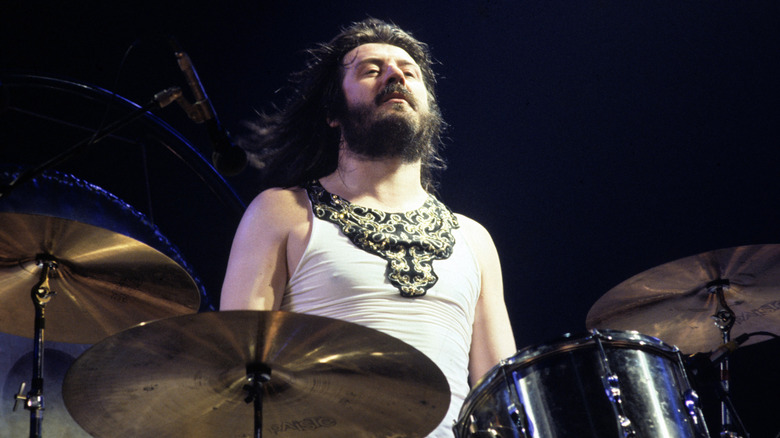
We all know John Bonham could play, but did anybody know he could play a drum solo for 17 minutes straight? Or 15 minutes — it varied. Either way, Bonham's extended drum solo for Led Zeppelin's "Moby Dick" was a whale of a feat. The studio version of the song from Zeppelin's second album, 1969's "Led Zeppelin II," was already a protracted, three-minute-long tinker-fest where Bonham tooled around with some creative fills, tom play, and layered grooves featuring some extremely oddly placed kicks. The extended, 17-minute version of the solo from Zeppelin's famed 1977 Earl's Court performance in London is basically an entire EP of three-minute rock songs.
We really don't know if Bonham orchestrated his 17-minute-long version of the "Moby Dick's" drum solo ahead of time, or if he just rolled with it (so to speak). It's not unreasonable to think that he could have improvised the whole thing, as Bonham tops many, if not most, lists of greatest drummers ever. Ferociously powerful, instinctively groovy, and technically impeccable in equal portions, Zeppelin would have been a very different band if not for his rhythmic genius. But it wasn't just rhythmic talent that got him through a 17-minute-long drum solo; it took physical endurance practically beyond comprehension while moving through unique percussive segments and never fumbling his precision once. That's why this solo is not just one of the longest in rock history, but one of the best.
As a final cherry on top, Bonham dedicated this performance to his son, who was in the audience at the time. That son, Jason, has gone on to have a career in drumming himself.
Drums — Mickey Hart and Bill Kreutzman
Trying to hunt down a single Grateful Dead performance is like diving down to the Titanic to find a lost chia seed. The most tie-dyed of psychedelic bands has released a world record 233 official live albums. But, in comparison to the band's one-off, bootleg recordings, this is a pittance. At present, there are about 18,300 entire, unique, multi-hour-long, officially endorsed Grateful Dead concert recordings on the Internet Archive, all of which are free to listen to and many of which contain extremely long drum solos. We can't pretend that we surveyed all possibilities here, but we can at least point you to one such 1990 show caught on video at Nassau Coliseum in Uniondale, New York. The performance's percussive solo, played by the Dead's drummers Mickey Hart and Bill Kreutzman titled "Drums," lasts about 10 minutes until the show's next section, called "Space" (followed by "Dark Star" and "The Wheel," naturally).
Over the years, and in different projects the drumming duo is sometimes known as the Rythm Devils, but as Hart told Rock And Roll Globe, when they go out and play the "Drums" portion of their concerts, "That's when me and Kreutzman explore, we go into the zone and try to find out who we are that night." We're talking fully spontaneous, improvised, floaty drums that comprise a section of a show that also contains straight-up songs (including plenty of underrated rock songs, we'd add). Those wishing to dig deeper into Grateful Dead drum solos can probably spend the rest of their lives doing so.
100,000 Years (live versions) — Peter Criss
Hang on, you ask: Peter Criss from Kiss played one of the longest drum solos in rock history? Like, the cat guy? Yes, the cat guy. Criss regularly played a drum solo during performances of "100,000 Years" that was as long as two to three typical Kiss songs, depending on the show, but which typically equaled about six minutes or so. We're not going to pretend that this solo encroaches on John Bonham or Neil Peart levels of musical virtuosity, but it does eschew Kiss' radio-friendly arena rock for something more unconventional that still sits squarely in "rock out, bruh" territory. Plus, it showed that Criss was more than just the Kiss guy with the worst makeup.
In fact, Criss might have always had tastes far different from his face-painted brethren. His first solo album, 1978's "Peter Criss" — released three years after Kiss' "Alive!" and its official "100,000 Years" drum solo — is more mellow roots rock than anything. In an interview on his official website, Criss cites jazz, Latin jazz, and swing amongst his influences. You can hear this in his solo on "100,000 Years," too, no matter how smothered he was by Paul Stanley trying to hype up the crowd. There's a big band-like, swing feel to Criss' solo, particularly in how the snare and kick play off each other, that you 100% are not going to find in any big Kiss hit. Plus, it finally gave Criss a chance to meow his way to the forefront of a big band with big music and even bigger personalities.