

5 History-Making Drummers Every Classic Rock Fan Should Already Know
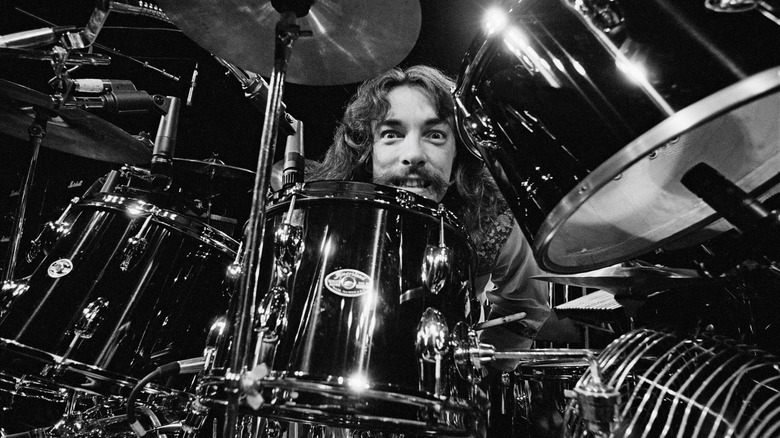
While the masses hum along to big melodies and waggle their fingers over air guitars, drummers pound on in the back of the stage, often underappreciated and overlooked. But good percussionists can make or break a band, and superb ones completely revolutionize them. Thankfully for music listeners, the 20th century granted us some history-making drummers that pushed rock as far as it could go, particularly in classic rock's golden era (1964 to 1982).
Choosing a handful of these drummers is not an easy task. We've got to home in on those who are not only the most technically proficient, physically coordinated, rhythmically gifted, compositionally creative, etc., but also the most relevant to classic rock. This means reaching back before the official advent of "rock 'n' roll" in the mid-'50s to those predecessors that influenced rock's entire lineage, like Buddy Rich and Gene Krupa (two no-brainer choices). Drummers, like other musicians, often influence each other in generations, which creates a thread of continuity that winds to some of the world's best modern percussionists, like Danny Carey (Tool), Mike Portnoy (Dream Theater), and Mario Duplantier (Gojira). But even as we keep this in mind, we've also got to choose drummers whose work stands on its own and suits their time and songs. Unfortunately, we have to leave off a boatload of worthy legends (apologies, Bill Bruford).
Besides Rich and Krupa, we've got a couple of names folks would expect, like Led Zeppelin's John Bonham, and a final choice cited more amongst drummers than fans.
Buddy Rich
It'll take about five seconds of watching Buddy Rich play to go from, "Huh, this guy is good," to scraping your jaw off the floor. A big band drummer of the 1930s through the '60s, he was gifted with superhuman control, precision, power, speed, coordination, timing, etc. Rich was also one of the greatest drummers of all time, even as he made due with the much smaller, simpler kits of the day. He was so good that you don't even know how amazing he really is because he makes everything look so easy. Importantly for this article, Rich laid the groundwork for all forms of band-based music, like rock, metal, punk, you name it.
That's because Rich didn't just play the drums well: He was a showman. He sounded like he had enough power to punch a hole straight through a concrete wall, plus flash, pizzaz, and guts that made people want to watch him over other band members. The legendary percussionist did hand crossover tricks, did drum battles on TV, cracked his sticks together like their own mini-drum kit, and rolled his snare faster than most people could shiver while freezing. In other words, he was a rock star before rock stars existed.
Much like other drummers in this article, Rich was drawn to percussion and music from childhood. He was tossed in his parent's vaudeville act before he was 2 years old, led a band by age 11, played in jazz outfits by his early 20s, and led his own band through the '70s. Indeed, Rich was the gonzo OG of the drumming world who set the standard from then on out.
Gene Krupa
A contemporary of Buddy Rich and a big band master drummer who rose to prominence in the '30s, Gene Krupa oozed groove, coolness, and control as much as he did an ecstatic love of rhythm. His face radiated every time he got behind his kit, and it's this natural wellspring of enthusiasm that buoyed him to superstar status. And even though he never really worked outside a small musical wheelhouse of big band and jazz, his playing style both predicted rock's future and echoed all the way to hip hop.
Nothing explains Krupa's talent and influence better than an anecdote about a 1950 drum battle between him, Buddy Rich, and Max Roach. As Jazz Journal quotes the 2025 Krupa-based book, "The Master of Drums," he was the only drummer who "got people out of their seats and moving." Listeners can hear this in Krupa's playing, which, yes, is eye-catching, precise, and powerful in equal portions. But above all, it's danceable. And when he keeps driving the beat forward with his kick drum and builds syncopated, off-beat snare hits, tom hits, and fills into his playing? You could copy-paste this technique onto anything from a classic rock band to a modern metal band and wouldn't know the difference. Indeed, legendary Zeppelin drummer John Bonham called Krupa "a god" who influenced every drummer from then on out (per MusicRadar).
And to be completely fair, Krupa actually preceded Buddy Rich as the person who elevated drums beyond being a mere metronome. For the first time, folks were looking at something beyond the frontline musicians on stage. In Krupa's case, it was hard to look to anything else — watch a video and just try not getting swallowed into his vortex of kinetic charisma.
Ginger Baker
We've got to be careful here, because Ginger Baker was such a notoriously acerbic person that his ghost might haunt us if we call him a "rock drummer." He hated the label even though he played for the short-lived but nonetheless immensely influential Cream. In a late-life interview with Rock and Roll Globe, he said that he'd prefer to be remembered as "the best drummer" in history, period. While we could debate that point, we can't argue his undeniably one-of-a-kind, overwhelming talent that sounded like no one else while simultaneously influencing everyone after him.
Even when listening to a fairly simple Cream hit like "White Room," you can hear what makes Baker so unique. Notably, he was not content to merely play a standard, somewhat mindless "kick, snare, kick, snare" rock pattern throughout the whole song, which he could have done. Instead, he built a scaffolding of syncopated rhythm that interwove with the track's guitar and vocal work, added some shuffle work and oddly placed snares into the mix, and very clearly drew from his jazz background. In fact, Baker hated dull, 4/4 drum work and took huge inspiration from Nigerian Afrobeats, to the point where he moved to Lagos and largely lived there through the '70s.
Baker had already developed his unique, fusion take on drums by the time he found himself in Cream in the late '60s. After Cream disbanded, he more or less vanished. But he was such an explosive force and demonstrated how versatile "rock" drumming could be that his influence reverberated on.
John Bonham
John Bonham is the name that materializes at the top of practically every list of greatest drummers ever, across all genres and decades of time since music started getting recorded and modern drum kits were employed. Of course, Bonham's instinctive ferocity and multi-limbed wizardry built the structural and rhythmic spine of one of rock's most colossal bands, Led Zeppelin. But he also set a virtuosic and creative standard so high that few could hope to even emulate him.
This might sound hyperbolic until you listen to a drum solo like that on "Moby Dick" from 1969's "Led Zeppelin II," one of the five best drum solos in rock history. Even folks who don't know a hi-hat from a kick drum ought to be able to hear the inventiveness, control, and mastery behind Bonham's drumming. And when we get to a gonzo cavalcade of physical endurance and concentration like the nigh-mythical, 17-minute-long version of this drum solo played at Earl's Court, London in 1977, there's really nothing to do except give up trying to comprehend such talent.
That talent came from a love of drums that bordered on obsession. Taking musical cues from our aforementioned Buddy Rich and Gene Krupa, Bonham assembled his first drum kits from cans and containers around the house at 5 years old. Mirroring his own opinion about his skill and future ("Drumming was the only thing I was ever good at," per CultureSonar), a teacher once said that Bonham would "become a dustman or a millionaire." Turns out it was the latter.
Neil Peart
Another often-cited contender for best drummer in human history, even topping some lists above Led Zeppelin's John Bonham, lives Rush's Neil Peart. Yet again, we could heap superlative after superlative on Peart, citing crushing muscularity blended with absolute grooves, interlocking polyrhythmic sorcery, and an extremely musical, melodic approach to drumming that wielded the full potential of his entire kit. We could also point to all of Peart's predecessors who raised the bar for him to reach and exceed. Or, we could let his playing do the talking, especially on songs like the live version of Rush's stupendous "YYZ" from 1981's "Exit ... Stage Left," which still gives us chills every time we listen.
Peart was nicknamed "The Professor" for good reason. No matter all the bodily intuition audible in his playing, there was something big-brained and architectural about his playing. Tracks like "La Villa Strangiato" and "2112" are considered by some to be the most difficult drum tracks ever, although Peart cited Rush's biggest hit, "Tom Sawyer," as one of his personal hardest to play. He also never stopped trying to improve his craft and always assumed he could get better — stronger, more accurate, more precise, more refined, smoother, etc. This is why, when Rush's new touring drummer Anika Niles won over even the band's most loyal fans, it came as an unparalleled accomplishment.
And even though every drummer and classic rock fan ought to already know Peart, some might not know that he was Rush's lyricist, not Geddy Lee. He wound up writing lyrics for the band because he was a reader and was the best at it, simple as that. Other drummers can try their hand at this, too, but good luck.