

The 5 Best Male Duets
Duets have long been popular musical events, giving listeners the chance to hear the interplay between two singers' voices and to enjoy the kind of dynamism that a single voice alone cannot provide. While many of popular music's most famous duets have paired male and female performers, this article celebrates what we believe are five of the best male vocal duets of all time.
Each of these songs shows two male singers at the top of their game. Not only are the vocal performances themselves commendable in their own right, but they complement their partners perfectly, taking each song somewhere a single vocalist couldn't. From an iconic danceable duet between Queen's Freddie Mercury and glam rock icon David Bowie to a country classic from Johnny Cash and Bob Dylan, these selections span multiple genres and showcase the power two male voices can bring to a song, whatever genre it happens to be. Enjoy.
Under Pressure – Queen and David Bowie
David Bowie famously duetted with none other than the velvet-voiced crooner Bing Crosby on the song "Peace on Earth/The Little Drummer Boy," recorded for a 1977 Christmas television special and released as a successful single five years later. But while that recording was popular, it pales in comparison to "Under Pressure," the legendary, spontaneous collaboration between Bowie and Queen, from the latter's 1982 album "Hot Space."
At the time, both acts were in Switzerland, a tax haven for many U.K. musicians of the era, and Bowie paid a visit to the British hard rock band while they were cutting their album, resulting in a playful jam session with vocalist Freddie Mercury and the other members of Queen. After performing a few rock 'n' roll classics together, they began collaborating on original material for "Hot Space." Bowie originally provided vocals for the track "Cool Cat," though, ever the perfectionist, he later had these removed from the track.
Much more successful, however, was the jam-derived "Under Pressure," a disco-infused dancefloor filler that sees Bowie and Mercury trade mock-operatic interjections and vocal improvisations over an infectious bassline, despite friction between the two strong-willed artists in the studio. A commercial smash, it hit No. 1 in the U.K. In 1992, after the tragic death of Freddie Mercury in 1991, Bowie performed the song with the Eurythmics' Annie Lennox as a memorial concert for the Queen frontman to raise AIDS awareness.
Don't Let the Sun Go Down on Me – Elton John and George Michael
Elton John was a force of nature during the 1970s and 1980s, topping the Billboard Hot 100 nine times and filling the chart with countless hit singles. "Don't Let the Sun Go Down on Me," which was released in 1974, narrowly missed the top spot, peaking at No. 2 in July that year. It has gone on to be one of John's best-loved ballads, but the fact is, it had a checkered recording history.
A lofty track in keeping with big Phil Spector-style hits like The Righteous Brothers' "You've Lost That Lovin' Feelin'," the song demands a full-bodied vocal performance that John initially struggled with, prompting him to grow angry during recording sessions and threaten to farm the song out to another artist.
But despite John's reservations, the public loved it, including Wham's George Michael. Michael incorporated "Don't Let the Sun Go Down on Me" into his live shows, having invited John onstage to perform it with him during Live Aid in 1985. They performed the song together once more in 1991, with John coming onstage as a surprise guest during one of Michael's concerts. The vocal duet is arguably the finest version of the song, with the two Brits bringing it to new emotive heights. The live cut was released as a charity single, topping singles charts across the world.
Say Say Say – Michael Jackson and Paul McCartney
In 1983, two of the biggest artists in history collaborated on one of the year's catchiest songs, which claimed the top spot on the Billboard Hot 100 for an incredible six weeks. "Say Say Say" was Michael Jackson's second duet released with Beatles legend Paul McCartney, who had appeared on "The Girl Is Mine" from the former's "Thriller" album the previous year, establishing a close working relationship and friendship.
Whereas "The Girl Is Mine" is a Jackson-penned slow ballad, "Say Say Say," which was cut for McCartney's solo album "Pipes of Peace," is an upbeat number loaded with hooks and danceable instrumentation. Written by both artists, the song plays to both of their strengths and straddles a number of genres in terms of influences, from rock to funk and disco.
The song arrived during the extraordinary commercial run of "Thriller," which would ultimately produce seven top-10 singles, including the No. 1 hits "Billie Jean" and "Beat It." But while "Billie Jean" spent two weeks longer on the Hot 100, "Say Say Say" is calculated by Billboard to have been the most successful single of Jackson's career in terms of overall chart performance, while it proved to be the final U.S. No. 1 single of McCartney's career.
Easy Lover – Philip Bailey and Phil Collins
By 1984, Phil Collins, the drummer and lead vocalist of the legendary progressive rock group Genesis, had established himself as a chart-dominating powerhouse as a solo artist and, in doing so, became in demand as a producer for other artists. Philip Bailey, the immaculate four-octave vocalist who had become famous as a member of Earth, Wind & Fire, was at the time looking for a change of direction on his album, "Chinese Wall," and turned to Collins.
Toward the end of the sessions for the album, the two decided to collaborate on a duet, resulting in "Easy Lover." It proved to be a stroke of inspiration, providing "Chinese Wall" with its biggest highlight, as well as its biggest single, which hit No. 2 in the U.S. and No. 1 in the U.K. for four weeks.
"Easy Lover" is a bright and glossy pop gem featuring pristine instrumentation and the kind of driving drums that Collins fans had come to expect. But it's the vocal chemistry between the two men that truly elevates the track, with their crystal clear harmonizing becoming the song's major earworm.
Girl from the North Country – Bob Dylan and Johnny Cash
Bob Dylan had spent much of his early career performing sweet, emotive duets with Joan Baez, with their live shows earning them a loyal following among American folk fans. By the end of the 1960s, he had become an icon as a solo artist, having released some of his best-loved albums, including "Highway 61 Revisited" and "Blonde on Blonde," both of which pushed him far beyond his early folk aesthetic.
By 1969, Dylan was increasingly interested in performing rootsy country music, having traveled to Nashville, the home of the genre, for the final sessions of "Blonde on Blonde" and for the recording of 1967's "John Wesley Harding." Dylan and producer Bob Johnston returned to the city for 1969's "Nashville Skyline."
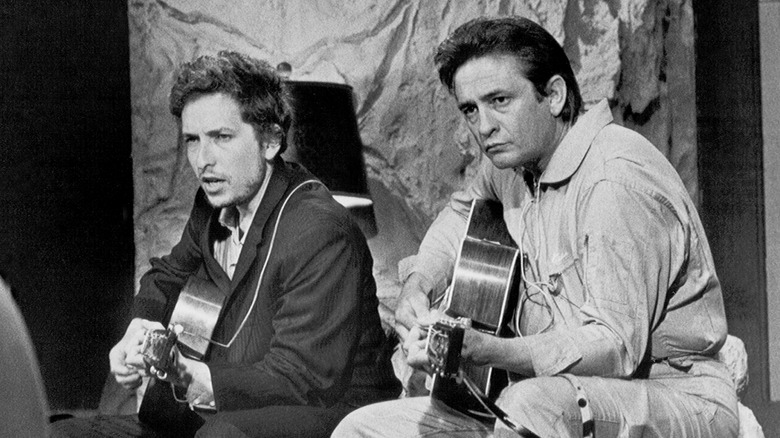
The decision led Dylan to team up with the Man in Black himself, Johnny Cash, who joined him for sessions that produced arguably Dylan's finest duet. A re-recording of a song from his 1963 album "The Freewheelin' Bob Dylan," "Girl from the North Country" sees Cash, who had previously recorded a version of Dylan's "Don't Think Twice, It's All Right," trading verses with the younger songwriter. Dylan had quit smoking prior to recording "Nashville Skyline," and his voice has a new clarity that contrasts beautifully with Cash's gruff bass-baritone.