

5 Underrated Deep Cuts Every Dolly Parton Fan Should Hear
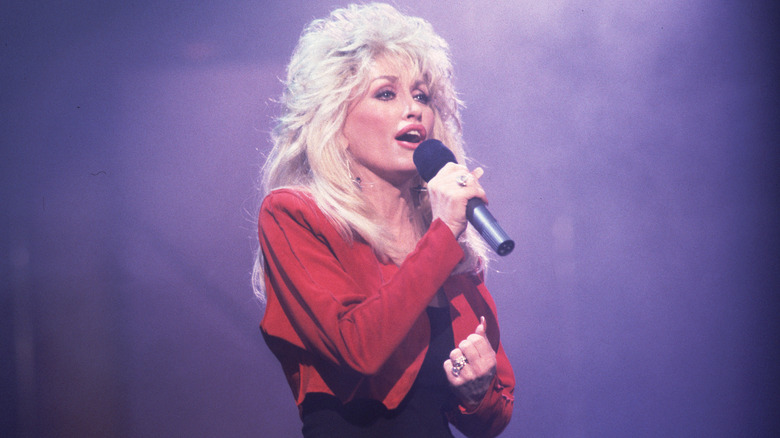
When you think of Dolly Parton (and we all do, from time to time), what song starts playing in your mind? You're probably already singing or humming the tune of "Jolene," her crossover hit "9 to 5," or that iconic Bee Gees-penned duet with Kenny Rogers, "Islands in the Stream." Still, plenty of her other songs are bound to get lost in the shuffle and join the ranks of deep cuts. But reconsider, as many of her underrated tracks deserve more play.
With a catalog that includes 49 solo studio albums starting in 1967, there's a lot of room for argument, and your deep cut may be someone else's repeat fave. While we can't account for personal bias, we think these songs could use way more attention. Perhaps they didn't chart quite as high as other Dolly singles, or maybe they did well at the time but were eclipsed by even bigger songs later on. Nonetheless, these songs capture the essence of what makes a Dolly Parton song so special: a beautiful voice full of character, lyrical complexity, arresting stories, and, often, not a small amount of sass. From a tune inspired by fried clams to a candid poke in misogyny's eye, you'll surely have to dig a ways through a Parton best-of playlist to find these tracks, but they're worth it.
Two Doors Down
For Dolly Parton, 1977 was a pretty good year. That's when she released "Here You Come Again," her 19th solo album and a self-produced effort that went platinum, won Parton her first Grammy, and saw the runaway success of the album's self-titled lead single. But don't sleep on the album's B-side, where you'll find "Two Doors Down." The song was covered by Zella Lehr later that year and, in that form, hit No. 7 on the Billboard Hot Country Singles chart.
This left Parton in a tricky situation. Should she promote her own original and ride on the cover's success? Nah. Instead, she re-recorded "Two Doors Down" with a poppy disco beat. Parton's reworked song eventually broke the Top 20 of the Hot 100, though it didn't chart on the country side. Not like that should matter, because this song is an upbeat delight. Its narrator sings of heartbreak assuaged by a party taking place — you guessed it — two doors down from her, where she meets a new beau in short order.
Parton told Kelly Clarkson she was actually inspired to write "Two Doors Down" by ... fried clams. While touring during the '70s, she attempted a diet that had her drinking a foul liquid protein beverage while her band enjoyed a meal at a Howard Johnson restaurant. Sitting in her hotel room, Parton could hear them having a good time — two doors down from her, of course. "I was just in there feeling sorry for myself because they was eating fried clams and I wasn't," she told Clarkson.
Little Sparrow
Parton's unafraid to express heartbreak and despair, and perhaps no other single communicates that in such haunting fashion as "Little Sparrow." Released on her 2001 album, also titled "Little Sparrow," Parton has linked the song to her uncle Bill Owens, who was instrumental in her early career. The bluegrass music was a callback to the kind of songs she composed and recorded with Owens. From a press release promoting the album, Parton wrote that "I believe Little Sparrow has more depth, breadth, and soul than all of the other albums I have done."
She's also said she was inspired by seeing a sparrow singing in the midst of a storm, which plays into the song's tenuous balance between strength and vulnerability. In the track, the sparrow is a metaphor of sorts for heartbreak and the singer's conflicting feelings — is the sadness warranted? Does she want revenge or at least closure with her erstwhile lover? Is it possible to move on and be all the stronger for it, or will this heartbreak really end her?
You're left to decide, though you may detect an edge of steel in Parton's voice that hints the singer of "Little Sparrow" will find her way through the overwhelming sadness. A live performance from London is even more striking than the album version, with minimal instrumentation that leaves Parton largely on her own to deliver a powerful, almost ghostly rendition that raises goosebumps every time.
The Pain of Loving You
On the surface, "The Pain of Loving You" may seem like yet another lovelorn country song, but think again. First, pay some respect to the members of Trio, the three-person country group who released the track in 1987. Parton's there, of course, but so is country-rock virtuoso Linda Ronstadt and legend Emmylou Harris. Together, all three created virtuosic harmonies that still managed to showcase the unique qualities of their voices, from Parton's twang to Ronstadt's power and Harris' steely delivery, all of which are beautifully on display in this track.
But this wasn't the first time "The Pain of Loving You" hit the airwaves. It debuted in 1971 as a duet between Parton and Porter Wagoner. Parton got a big break on Wagoner's nationally syndicated music variety program, "The Porter Wagoner Show," in 1967. However, when Parton wanted to go it alone in 1974, Wagoner took it poorly and even sued Parton. They reconciled by the late '80s, making the Trio version of "The Pain of Loving You" more a fond look back than a gesture of disdain.
The Grass is Blue
If you were to just look at the lyrics for "The Grass is Blue," you might think it would have the joking, saucy edge of Parton's "PMS Blues." As the song's narrator claims, "Rivers flow backwards / Valleys are high / Mountains are level / Truth is a lie." Only, the delivery makes it clear this is someone convincing themselves they don't miss their former lover ... and totally failing. "And I'm happy now / And I'm glad we're through / And the sky is green / And the grass is blue," sighs Parton.
Even if it doesn't rank among Parton's most-played Spotify tracks, "The Grass is Blue" is a standout song, with powerful yet fragile delivery and clever lyrics, but the rest of the title-track's album is worth a listen, too. Released in 1999, this is the first of Parton's trilogy of bluegrass albums, even winning her a Grammy for best bluegrass album in 2001. "All the songs are personal and wonderful and familiar for me," she told Billboard of the track list, which included the old-school "Silver Dagger" that her own mother passed down. That song warns of the ways in which men can take advantage of vulnerable young women; it reads like a foretelling of the defiant heartbreak of "The Grass is Blue".
Just Because I'm a Woman
Because it was released back in 1968 on what was only Parton's second solo album, you might be excused for having forgotten her song, "Just Because I'm a Woman." Now is your chance to rectify that oversight. This track is a foundational statement made all the more profound by when it was released. It began shortly after Parton's 1966 marriage to Carl Dean, when he asked his new wife if she'd had any romantic partners before him. "I told him the truth, and it broke his heart," she told Rolling Stone. "He could not get over that for the longest time. I thought, 'Well, my goodness, what's the big d*mn deal?'"
Whatever the details of their pre-marriage relationships, this incident inspired Parton to write "Just Because I'm a Woman" as a direct response. "My mistakes are no worse than yours / Just because I'm a woman," she sings boldly. It's worth remembering that this was an era that saw tremendous upheaval when it came to gender relations. Parton deftly breaks down the societal structures that apply different rules to different genders, arguing that there's nothing inherently better or worse about her actions solely because she's a woman. Can't women also make mistakes, or make choices for themselves? Why should her decisions carry so much more moral weight than those of a man? At any rate, the record reached a respectable No. 22 on the U.S. country album chart and, judging by their 58-year marriage, Dean and Parton clearly found a way forward together.