

The Greatest Self-Taught Guitarists In Rock History
There's a romantic myth that declares education the death of creativity. Even though this couldn't be further from the truth (it has more to do with virtuosos crafting inaccessible work), it's true that we've been gifted with some of the greatest self-taught musicians in rock history. This includes guitarists, many of the best of whom are almost completely, if not 100%, self-taught.
But first, we need to define "self-taught." If a player took two classes with a local teacher down the road at age 8, that doesn't count. Frank Gambale went to the Guitar Institute of Technology, so he's off our list. Steve Vai went to Berklee before playing with Frank Zappa and also learned under Joe Satriani, so he's off, too. We're going to have to be a bit flexible with our definition of rock, as well, because the best players often waver between genres and styles, especially (no surprise) jazz or jazz fusion. At the same time, the world's best guitarists aren't bashing out power chords on the nightly in big, hooky choruses (though everyone has to start somewhere, like with the easiest beginner guitar songs). So we're disregarding commercial success. Being good at popular songwriting doesn't necessarily follow from physical skill and knowledge of an instrument or music.
Out of all the guitarists in this article, folks might have heard of Allan Holdsworth (a favorite of Zappa) or Eric Johnson, aka the "Cliffs of Dover" guy. Besides them, strap in because fingers are about to fly.
Allan Holdsworth
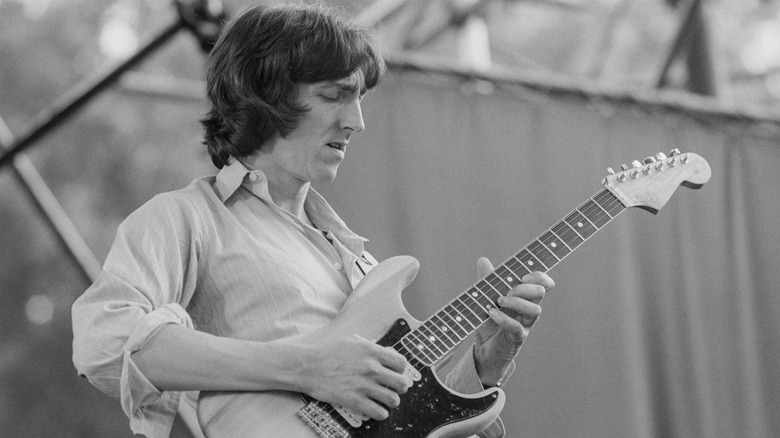
"The Man Who Changed Guitar Forever:" That's not a bad nickname for someone you've probably never heard of and who you might mistake for a high school chemistry teacher if you saw him walking down the street. But never make assumptions, because Allan Holdsworth is the final boss of god-tier guitarists who influenced all guitarists to come, whether they realized it or not. Playing for Gong in the '70s and branching out on his own until his death in 2017, Holdsworth's style was so idiosyncratic, fluid, and clean, as much as it was moving and technical, that other legendary musicians cite him as untouchable (including mainstream rock guitarists like Eddie Van Halen, who could never read music).
Listening to Holdsworth improvise solos during jazz/rock fusion sessions, you'd think that he went to elite music schools, but no. He did, however, come from a musical family — arguably the best kind of implicit musical training. As he told Louder Sound, his father was a pianist and played music all the time in the house. A young Holdsworth wanted to try his hand at playing something, so he started with pop and went from there. He tinkered with multiple instruments, like violin, clarinet, and saxophone, and was completely immersed in music via social circles. As a professional, Holdsworth kept doing the same thing, performing on 60 recordings across a variety of groups before joining drumming legend Bill Bruford of Genesis, King Crimson, and Yes to make the supergroup, U.K., in 1977.
Holdsworth himself wasn't opposed to musical education, but insisted that figuring something out oneself was more effective. Keeping true to his own advice, Holdsworth developed a one-of-a-kind approach to chord structures and musical scales that folks are still trying to decode today.
Shawn Lane
Shawn Lane is one of those guitarists who embodied the words "childhood prodigy." Everything you can say about him sounds fictional: In 1978, he became lead guitarist for the rock band Black Oak Arkansas at age 14; he'd borrow up to 40 books from his home library in Memphis and remember them all; he shredded at age 17 like he'd been playing professionally for 30 years, etc., etc.
A lot of what made Lane exceptional requires us to get into the weeds of music theory and hand positioning, like how his finger placement allowed him to approach solos in a grouped-note, insanely smooth, ultra-legato way. But even if you know nothing about music, you can still hear how he's absolutely intentional; he's focused on composition, not diddling away on the fretboard. Lane was relentlessly motivated, too. As Guitar World quotes Lane's friend and fellow musician Barry Bays, if Lane got a song in his head, he'd hack away for 18 to 20 hours straight until he got it. And wouldn't you know? Allan Holdsworth was one of Lane's biggest inspirations.
It should come as no surprise that Lane took to music from a young age. Leveraging his natural inclinations, he turned to the piano first before trying guitar at age 10; four years later, he was lead guitarist of Black Oak Arkansas. Like a lot of other virtuosos, Lane wandered between projects and put out some solo albums. He also crops up in tons of bootleg recordings and VHS-era instructional videos. In one such video uploaded to YouTube, Lane said that his guitar stylings developed from a love of classical piano and trying to adapt what he heard for his instrument.
Eric Johnson
Eric Johnson might be the most well-known of our choices, if only because of the copious amounts of YouTube reactions to him playing 1990s "Cliffs of Dover," for which he won a Grammy in 1992. And the thing is, you really wouldn't even know how hard "Cliffs of Dover" (or other Johnson songs) is to play unless you played guitar yourself. His quick changes between weird, hand-breaking chord shapes; his fluid speed moving up and down the fretboard; his perfect clarity of tone; his accents and overall timing and feeling: Johnson is a nutso, genius-level guitarist. And, he's self-taught.
Stop us if you've heard this before: Johnson took to piano at a young age before turning to the guitar at age 11. He told Guitar Player that he took guitar lessons for a few months around that time, found it nifty, and then went his own way, learning how to play the guitar by mapping notes from the piano. But mostly, he learned by listening to albums. Johnson is also a full-on technician when it comes to playing, relentlessly honing his nuts-and-bolts playing techniques and giving prospective guitarists tons of practical advice.
Johnson's reputation and talent have developed over time, brick by brick, along with his career. No matter the early-life talent that led him towards jazz/rock fusion in the '70s, he didn't release his first solo album until 1986. As recently as 2024, Johnson toured with Steve Vai and Joe Satriani. At this point, he's poked through so many styles — from blues to classical to rock — that he resembles a mad, tinkering chemist "going musically nuts," as Jazz Guitar Today says to him in an interview. In response, Johnson replies that "nobody in their right mind" would do what he does.
Guthrie Govan
Guthrie Govan is the guitarist whose skill scares other guitarists. He blew composer Hans Zimmer's mind during a live performance, as Zimmer told Rick Beato on YouTube. Govan is the guy who can pick a key, musical mode (pentatonic, Dorian, Phrygian, etc.), style or way of phrasing, and improvise an extended solo at will; so extensive is his musical knowledge and skill. He's like a polyglot whose 10 languages are all music. And once again, he's 100% self-taught.
If tales are to be believed, Govan started playing the guitar at age 3 and did his first gig at 5 years old; so young that Govan doesn't remember if it was Chuck Berry or Elvis. From there, he led a wanderer's life, attending Oxford to study English, turning down a record deal at age 20 because it wasn't a good fit, working at McDonald's for a bit, and generally keeping a low profile.
He's not even in the limelight in his band, the Aristocrats, but stays focused on making the most interesting music possible with only three band members. But a person as talented as Govan can only remain hidden for so long, which at this point means not at all. The Aristocrats embarked on a proper, Europe-wide tour in 2026.
To really understand Govan's talent, we can look at one recent Aristocrats song off 2024's "Duck" as a case study: "Hey, Where's My Drink Package." At its core, a straight-up rocker, the song's live version features extended improvised guitar solos where Govan takes the lead, passes the baton to Marco Minnemann (drums) and Bryan Beller (bass), and goes off on unplanned tangents. It's awe-inspiring stuff, especially remembering that Govan's had zero formal training.
Greg Howe
You won't understand how good Greg Howe is unless you just let the man keep playing. Unassuming and humble, Howe's skills are fathoms beyond mortal humans, but always deployed in service to a song and in due time as the song progresses. Swift, smooth, sensible, and inventive in equal portions, Howe is primarily a session player and guitar teacher. The shiniest feather in Howe's cap is learning Michael Jackson's entire set in a matter of hours the night before heading on a plane overseas, as he was listening to his Walkman and frantically getting packed in response to a last-minute gig request. Got that? And that was before having to learn stage choreography and wear a wig.
Yes, Howe is self-taught. As he told LickNRiff in a YouTube interview, he started playing guitar as a kid because he wanted to play songs — simple as that. He figured out the chords to whatever he heard on the radio, like Creedence Clearwater Revival, the Beatles, etc., and picked up on scales and lead playing by ear. He learned what he could from Jimmy Page, and yes, Howe is as blown away by Allan Holdsworth as everyone else. But it was Eddie Van Halen's tapping on 1978's "Eruption" that unlocked his thinking about the guitar (like so many others). Howe did take a summer's worth of guitar classes because he thought Eddie was playing flamenco style, and went to see the band live with a pair of binoculars to figure the whole thing out.
At this point, Howe's amassed a collection of solo albums, got nominated for a Grammy in 2019, and popped up on stage with the likes of Justin Timberlake, Rihanna, and Christina Aguilera.