

5 Signature Hits That Prove One Song Can Change A Career
Any successful recording artist will tell you that one good song can set a band for life. After all, there are one-hit wonders from the '60s that still have us hooked today. But while some careers are built off of a steady buildup of successful tunes, others launch into the stratosphere with a single hit that not only eclipses the artist's previous efforts but also dramatically alters the trajectory of their lives.
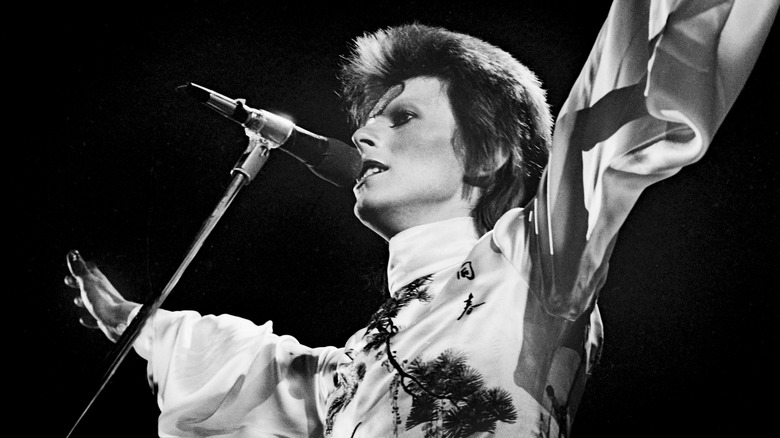
Sometimes it's a flannel-clad everyman tapping into the angst of a generation. Other times it's an extraterrestrial glam rocker lost among the stars. But in every case, these are the hits that were such unexpected, out-of-the-park grand slam home runs that they changed the lives of their creators overnight. Moreover, they became inextricably linked with the performers in question, sometimes to their chagrin. Here's a look at some of the more notable examples of those meteoric anthems.
Smells Like Teen Spirit — Nirvana
In retrospect, it might seem like Nirvana, the genre- and generation-defining band that eschewed hair metal and put grunge on the map, was destined to be a cultural milestone. But that wasn't always the case. The tragic story of Nirvana — one that, sadly, continued all the way up to frontman Kurt Cobain's untimely death — was a tale of homelessness and cycles of poverty finally interrupted by the mega-hit juggernaut that was "Smells Like Teen Spirit."
A high school dropout, Cobain drifted aimlessly during his late adolescence, eventually meeting future Nirvana bassist Krist Novoselic at a church service during a brief conversion to Christianity. While it is a strain to condense the early years of Nirvana, it was a pivotal meeting that eventually led to the founding of the landmark band. After just 18 months of gigging, the group entered the studio to record their debut album "Bleach" for the Sub Pop label for only $600. The album did not see initial chart success (that would come later, following the success of "Nevermind"), but it did receive positive support from critics.
It was with the release of 1991's "Nevermind," supported as it was by major label Geffen Records, that "Smells Like Teen Spirit" and the humble trio that wrote it not only achieved mainstream success but launched a cultural revolution as well. The song became an unwitting death knell for the hair metal that had dominated the 1980s and ushered in the alternative culture movement of the early '90s. Cobain would eventually become tired of the song to the point of refusing to play it live, but it was securely fastened to his legacy nonetheless. More than 30 years later, and we still haven't gotten over the loss of the band.
Sweet Dreams (Are Made of This) — Marilyn Manson
A well-placed cover song can pull a fledgling band back from the brink of extinction, as was the case with "Sweet Dreams (Are Made of This)" by Marilyn Manson. By 1995, he and his titular band were in career limbo. 1994's "Portrait of an American Family" had failed to make much of an impact, and real mainstream success remained elusive despite opening for Nine Inch Nails. With their label feeling the band wasn't ready for another full-length LP, the shock rockers entered the studio for 1995's "Smells Like Children," an EP of remixes, surreal soundbites, oddball skits, and three notable cover songs.
Said covers included a throbbing industrial rendition of the Screamin' Jay Hawkins blues standard "I Put a Spell on You" and a Patti Smith song whose name is unprintable. But it was the band's cover of the Eurythmics classic "Sweet Dreams (Are Made of This)" that proved to be pivotal. The unique take slows the Eurodance original down to a funeral dirge, with the hypnotic keyboard part becoming a droning guitar riff. Annie Lennox's sonorous vocal performance becomes Manson's menacing hiss that builds to a deranged shriek, and the goth-industrial reinvention is complete.
The inspired reinterpretation quickly caught on, propelling "Smells Like Children" to No. 31 on the Billboard Top 200. It also gave the band the momentum they needed to make their subsequent full-length album, 1996's "Antichrist Superstar," enter the Billboard 200 at No. 3. The mainstream popularity of one of rock music's most notoriously controversial figures was firmly in place.
Space Oddity — David Bowie
Sometimes the traditional path of pop success — public excitement around a newly established public figure and their infectious radio singles — isn't what gets an artist's career off the ground but rather cultural novelty. In the case of David Bowie and his 1969 breakout hit "Space Oddity," that was absolutely the case. By that point he had released one album, 1967's self-titled LP, to absolutely no success. The performer destined to make a career out of enigmatic personas seemed ready to vanish without being noticed in the first place.
That all changed when Bowie's imagination became, like so many at the time, captured by the endless possibilities of space travel. Between the step forward for humankind that had been the Apollo 8 moon landing and the release of Stanley Kubrick's cinematic epic "2001: A Space Odessey," interplanetary travel had become hip. Both loomed large in Bowie's thoughts when he penned "Space Oddity," a haunting, melancholic track that inverted the widespread public enthusiasm around outer space to explore themes of isolation and loneliness.
Wistful melodies and detached delivery make the song a hypnotic gem in its own right, but cultural tides were turning in Bowie's favor. BBC-TV used the song as a soundtrack for the launch of Apollo 11 — despite a ban from BBC top brass who felt it inappropriate to broadcast a song about the death of an astronaut during an active mission. The ban was lifted when Apollo 11's Neil Armstrong, Buzz Aldrin, and Michael Collins returned home safe and sound, giving Bowie his first Top 5 hit in the U.K. and inroads into the U.S. charts as well. His first hit had not only secured his legacy but also tied him forever to one of humankind's greatest achievements.
Butterfly — Crazy Town
The troubled history of Crazy Town isn't readily apparent in the ultra-chill grooves of "Butterfly," the rap rockers' only hit. Before the track hit the No. 1 spot on the Billboard Hot 100 in March 2001, the group had languished in obscurity as the chaos of life on the road threatened to derail their career before they'd even had a hit (they were booted from Ozzfest in 2000).
The first two singles off of "The Gift of the Game," the album that brought us "Butterfly," went by undetected, leaving the ode to a woman reminiscent of Papilionoidea to do a tremendous amount of heavy lifting. Built around a guitar riff sampled from the Red Hot Chili Peppers, the song was a rare departure from the aggro angst of the nu metal continuum, instead focusing on flirtatious benediction to a romantic partner.
It proved to be a well-placed gamble: The single stayed on the chart for 23 weeks. The song's chart-topping success quickly turned things around for vocalists Seth "Shifty Shellshock" Binzer and Bret "Epic" Mazur along with their accompanists, and they were finally able to enjoy the success they'd long pursued. The track even made an appearance in the 2002 film "Orange County" as background for a choreographed dance number.
Crazy Down enjoyed their moment, though it was a triumph the band were unable to reproduce. Subsequent singles failed to chart, but in the brief flash of success that came with "Butterfly," the long-gestating chrysalis that was Crazy Town briefly spread its wings.
Walk This Way — Aerosmith and Run DMC
Some hit singles launch a career, others revitalize one that's stagnated. In the case of "Walk This Way," it was both. Aerosmith had been a rock powerhouse throughout the '70s but floundered in personal issues and career stagnation in the early '80s. Run DMC, on the other hand, was a promising young rap group looking for crossover potential. The immense popularity of "Walk This Way" addressed both concerns while managing to cross significant racial and cultural barriers in the process.
For producer Rick Rubin, the project began not as a cultural milestone but as a clever gimmick: The opening groove of "Walk This Way" had long been a favorite loop for freestyle rapping at block parties. When Rubin proposed having Run DMC perform Tyler's scatted verse vocals, the group was initially reluctant. In an interview with Loudwire, DMC described their initial reaction to the song's actual lyrics as "hillbilly gibberish."
Eventually persuaded to give it a shot, both parties reaped the rewards. The video became an MTV favorite, introducing the up-and-coming rap group to mainstream middle America while Aerosmith revitalized a career that had seemed dead in the water. But there was more on the table than just a hit song. While rock/rap collaborations might be standard issue nowadays, there were very real stylistic and racial divides in place in the music culture of the 1980s. As such, the new "Walk This Way" represented a bridging of the gap between two disparate cultures.
DMC, now a frequent motivational speaker at high schools, describes the collaboration to students thusly: "Always be open to try something new, because it might not just only change your life, it could change the world."