

The Who's Keith Moon Earned His Place In Rock History With These Epic Drum Solos
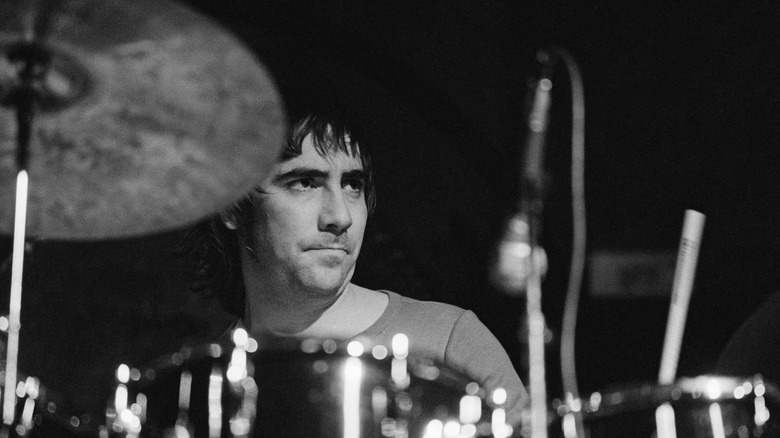
Keith Moon is remembered as one of rock 'n' roll's greatest drummers, but, as recorded in Tony Fletcher's definitive biography, "Dear Boy: The Life of Keith Moon," his relationship with drum solos was also a complicated one. Moon described drum solos, in his own words, as "boring," and according to Fletcher, Moon even refused to play proper solos during concerts. Despite all this, his drum solos (or rather, his fills later labeled as "solos") are heralded as some of the most iconic musical moments in rock history.
Born in Wembley, London in 1946, Moon took up drums as a teenager and then in 1964, he joined The Who and quickly established his playing style that emphasized tom-toms, cymbal crashes, and drum fills over the strict, conventional timekeeping of most drumming styles found in that decade.
Posthumously, Moon landed at No. 2 on Rolling Stone's list of the "100 Greatest Drummers of All Time," second only to Led Zeppelin's John Bonham. Below are solos that put his unusual style on display and showcase his technique and originality, proving he most certainly is, as he once called himself, "the greatest Keith Moon-type drummer" (per Far Out Magazine).
Wide World in Concert 1974
It is no surprise that Keith Moon had a flair for the dramatic. To understand Keith Moon, one only needed to wipe the slate clean of any expectations or tradition and be prepared for a stunt simply done for shock value. In October 1974 on ABC's "Wide World in Concert," Moon took the the stage as the show's host with his face painted like a cat and filled a Ludwig Vistalite drum with water and live goldfish.
Footage of his passionate performance still circulates today and his unpredictability is perfectly captured on camera before a crowd of people who were compelled to dance to Moon's solo. This recording sets itself apart from his usual performances, as Moon rarely agreed to this kind of showcase where he'd be playing an isolated solo. He was billed as the night's featured performer and was given full control over the performance from the very beginning.
He played with intensity and had a knack for treating the drums as the lead on stage with his quick bursts of cymbals and rhythmic fills. This clip has aged into one of the definitive artifacts of his career and it's easy to see why it remains one of the most-watched pieces of drum-solo footage online.
Won't Get Fooled Again May 1978
Moon's contributions to "Won't Get Fooled Again" from 1971 has already been recognized as one of the best drum solos in rock history, though labeling it a "solo" requires some flexibility to the definition. Both the original studio version and his final live performance from May 1978 are often ranked as Moon's greatest performances for a single "solo." Just before Roger Daltrey's iconic scream at the song's climax, Moon's tom-heavy fill barely runs at 15 seconds — and is not considered the kind of isolated solo showcase that Moon detested.
His well-placed fill functions as a sort of vessel that builds tension and rather than push against Townshend's ARP synthesizer pattern, Moon found a way to work with it, a departure from his usual free-form style he brought to the stage. His bass drum holds steady throughout, almost like a metronome, and he leaves Townshend's synthesizers enough room to come through before Moon crashes back down onto his toms.
Daltrey has said much about Moon's career, but he put it best when discussing this song in a 2013 interview with Dan Rather on AXS TV's "The Big Interview:" "There's something in the back of my head that tells me, Keith never would have made an old man," Daltrey told Rather. "He wouldn't have wanted to be an old man. He wanted to be the world's greatest rock drummer, and he died being that." Daltrey's words sum up Moon's ability to take something as simple as a drum fill and make it so inventive and original that it gets labeled as a drum solo anyway.
My Generation Live at Leeds 1970
Recorded in 1965, "My Generation" set the stage for Moon to build his zig-zag technique and evolve it into the iconic sound we know today. His cymbals are a perpetual driving force throughout the whole song and can be heard clearly in the isolated drum track from The Who's 1970 "Live at Leeds" performance. The clip is stripped of guitar, bass, and vocals, leaving only Moon and his drums.
The song's live, extended outro highlights Moon hammering through fill after fill with barely a break in pattern right alongside John Entwistle's famously transformative bass solo. On stage, the outro to the song got wilder and evolved into Moon's unpredictable drum patterns. The studio version of the song reached No. 2 on the U.K. singles charts and established The Who as one of the loudest and most confrontational acts in music.
Kenny Jones, who later inherited the role of The Who's drummer, described the true mayhem that embodied Moon's playing in an interview with Classic Rock: Moon "was all over the place" during the song's climax, full of sounds most drummers could only ever attempt to replicate. Jones summed up the challenge of following him, saying, "You can only put a Keith Moon hat on and hope for the best. There was only one drummer for The Who."
Pinball Wizard Live at The Isle of Wight Festival 1970
"Pinball Wizard" was supposed to be a way for The Who to be playful and light in what had otherwise been a heavier concept album, and Keith Moon's playing matches that tone. But critics have since dismissed Moon's sporadic timing as sloppy and clumsy. In fact, Pete Townshend himself said, on his part, that it's "the most clumsy piece of writing he'd ever done" (via Far Out). Despite Townshend's criticisms, the track remains one of the most beloved songs by fans.
However, The Who's performance at the Isle of Wight Festival in 1970 showcases Moon's ability to show restraint and the band's overall cohesive sound when playing to a live audience. There's an obvious irony in praising Moon's restraint when playing on a song about a character who is supposed to be defined by pure instinct, but that is what makes Moon's imperfections work with the song. It was also a historic moment for the band according to The Who's official YouTube, as this 2:00 a.m. performance for a crowd of nearly 600,000 people is considered to be at the peak of their popularity.
Who Are You, Live at Ramports Studios 1978
Filmed in May 1978 for what would later become a promotional feature tied to the documentary "The Kids Are Alright," The Who's performance of "Who Are You" in Battersea, London would be one of Keith Moon's final live appearances. The recording shows Moon with his headphones gaffer-taped to his head and the silly antics he'd get up to with his bandmates on and off screen. By early 1978, Moon was visibly declining as The Who wrapped their eighth studio album that would come out in August of that year.
Regardless of Moon's state of mind and health, this clip preserves his playful and lively spirit, portraying his epic, thunderous sound in all its chaotic glory. "Who Are You" would become the title track to their upcoming release, the song itself built on Daltrey's recognizable vocals and Townshend's guitar riffs that Moon rises to meet with the same intensity he brought to all his past performances. While it's a hard rewatch in hindsight knowing these were his final months with the band before Moon's tragic death, it only proves Moon's true talent and instincts were with him to the very end.