

The 5 Best Rock Supergoups Of All Time
Supergroups are to the music world what All-Star teams are to sports: The best of the best coming together to demonstrate the art form at the all-around peak of perfection. And as anyone who has watched an All-Star basketball team made up entirely of players that are as tall as the net will tell you, sometimes all that excellence isn't as much fun as you'd think. After all, how a team compensates for its weaknesses is part of the magic of the game, and bands are no different.
But sometimes supergroups manage to be more than the sum of their parts, and when that happens, the musical magic is transcendent. With that in mind, we wanted to take a look at some of the best of the best when it comes to combining the best of the best. Whether it's progressive rockers shooting to the top of the pops in the heat of the moment or grunge icons coming together to celebrate a fallen colleague, these are a few of the best supergroups in history.
Asia
On paper, Asia was a prog rock aficionado's dream come true: Steve Howe of Yes, John Wetton of King Crimson, and Carl Palmer of Emerson, Lake & Palmer were the sort of combo that seemed destined to create virtuosic dreamscapes with extended runtimes. That said, the group had other plans. By the dawn of the 1980s, punk and new wave were in full swing, and it was time for progressive rock bands to go mainstream with a pop hit or risk being consigned to the dustbin of yesteryear. Completed by keyboardist Geoff Downes of Buggles fame, the band set out to top the charts.
Stratospheric success was quickly secured with their 1982's self-titled debut, which led off with the massive hit "Heat of the Moment." With a gigantic wall-of-sound opening riff that feels precisely calculated to evoke air guitar performances from FM radio audiences the world over, the track shot to No. 4 on the Billboard Hot 100. The follow-up single, "Only Time Will Tell," hit a respectable No. 17.
Though the debut is filled with crowd-pleasing hooks and endlessly satisfying vocal harmonies, the band stacks plenty of righteous leads and intricate arrangements throughout the deep cuts. In other words, prog heads have plenty of dessert for working through the pop rock main course. The result satisfies in the same way as the synth-heavy "Duke," the similar-sounding sonic pivot point for prog pioneers Genesis.
While the group's sophomore effort, "Alpha," produced two hit singles, 1985's "Astra" failed to perform commercially, and the group temporarily disbanded. They would go on to reunite in 1990 following some lineup changes and continue to release albums, many of which start with the letter "A."
Temple of the Dog
The unassuming nature of grunge rock would, on the surface, not seem to lend itself to supergroups, but Temple of the Dog makes it work. Ironically, what makes the band so satisfying is that mutual sense of restraint and humility. The shared everyman ethos of the genre keeps even a room full of creative geniuses from upstaging one another. The result is a soulful creative environment where deep reflection and intimate observations are the order of the day.
The group's only album, 1990's self-titled LP, was conceived by Mother Love Bone bassist Jeff Ament and guitarist Stone Gossard as a tribute to their vocalist Andrew Wood, who had recently died. The pair would go on to form Pearl Jam, but for the purpose of Temple of the Dog, they collaborated with Soundgarden vocalist Chris Cornell and drummer Matt Cameron along with future Pearl Jam members Eddie Vedder (vocals) and Mike McCready (guitar).
Stunning performances abound on the album's 10 tracks, with Cornell and Vedder turning in rip-roaring vocals throughout. But the album's most attention-grabbing moment comes in the form of Mike McCready's extended five-and-a-half-minute guitar solo on "Reach Down." Where many guitarists would approach such a spotlight as an opportunity to deliver a masterclass, McCready meanders in the best sense of the word. Each phrase builds slowly with a sense of active thought being put into the lines, and we get the feeling we're following a contemplative journey from a guitarist prioritizing communication with his support players throughout. That mindset serves to underscore what makes Temple of the Dog so noteworthy: It's a supergroup where nobody thinks of themselves as super.
Transatlantic
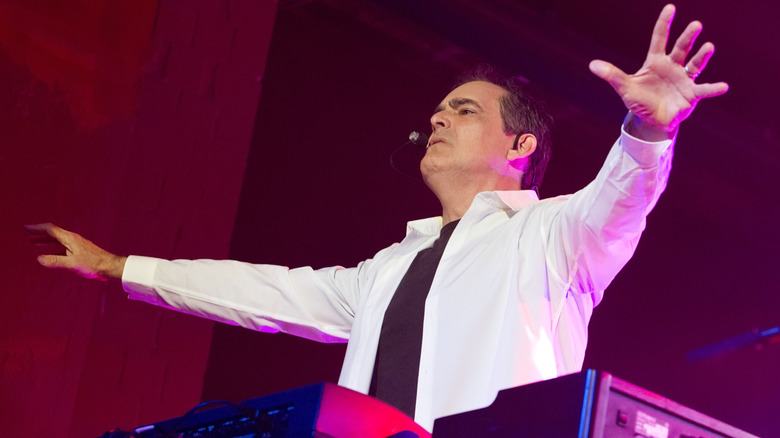
Progressive rock, with its emphasis on instrumental virtuosity, is a genre that feels tailor-made for supergroups, and there are certainly a lot of them. But even then, Transatlantic manages to stand out for a number of reasons. Certainly, the pedigree alone is enough to arouse interest: drummer Mike Portnoy of Dream Theater, guitarist Roine Stolt of the Flower Kings, bassist Pete Trewavas of Marillion, and, at the center of it all, former Spock's Beard frontman Neal Morse on keyboards, guitar, and vocals.
Those names might not mean much to mainstream music listeners, but in progressive rock circles, it's a convergence of modern masters from the groups that have helped to keep prog alive and well decades past its heyday. That was very much by design: The genre was experiencing an underground resurgence in the late '90s and early 2000s, and founder Portnoy saw an opportunity to bring together the leading lights of the new scene. In 2000, the group released their first album, "SMPT:e" (in showbiz, that's Society of Motion Picture and Television Engineers, but here, it's stylized to mean Stolt, Morse, Portnoy, and Trewavas). The follow-up, "Bridge Across Forever," was released in 2001. Both albums were critically acclaimed and followed by successful tours.
Given the already full schedules of the band members, Transatlantic albums tend to be followed by long hiatuses. That sporadic output is certainly understandable but also serves to underscore the gravitas of each release: This is a band that exists as a sort of meeting of progressive rock world leaders. Each new album is a symposium — and a transatlantic one at that.
Boygenius
Supergroups are hard to come by in the modern age, but Boygenius, the singer/songwriter trio of Julien Baker, Phoebe Bridgers, and Lucy Dacus, has emerged as one of the few contemporary instances of the concept — and an inventive one at that. For all the group's impressive hipster pedigree, they consider themselves a trio of friends making music. That relaxed aura permeates the band's folk-infused, contemplative aura.
As a Vogue noted around the time of the group's 2018 formation, public interest in the band coincided with the "pink wave" interest in women's issues that emerged toward the end of the last decade, especially with regard to the upcoming election cycle. The group's music isn't overtly political, but there's a certain earthy sincerity to the sound that calls for a sense of human resilience in the face of the overwhelming machinations of the world.
Momentum from the group's 2018 self-titled EP led to the release of their first full-length effort, 2023's "The Record." Opening with a cappella vocal harmonies that recall the doo-wop vocal stylings from the middle of last century, the album is a haunting and dreamy foray into the minds of three of modern alternative's leading voices. The album garnered immense critical acclaim, scoring a triumphant 90 out of 100 on Metacritic and racking up seven Grammy nominations, including wins for best alternative music album and best rock performance for "Not Strong Enough."
USA for Africa
USA for Africa may have only recorded one song, but the ensemble that tracked the 1985 charity benefit single "We Are the World" was less a supergroup than a pantheon of pop culture gods. Just publishing a full list of everyone involved would max out our word count, but suffice to say, Michael Jackson and Lionel Richie composed the track that featured vocals by themselves, Stevie Wonder, Ray Charles, Bob Dylan, Tina Turner, Billy Joel, and a whole host of other legendary names. Oh — and Quincy Jones and Michael Omartian produced.
The sheer logistical feat of getting pop music's top brass together in one room was an accomplishment unto itself, but the making of "We Are the World" goes deeper than that. The brainchild of singer Harry Belafonte, the project was intended to raise awareness and support for Ethiopian famine. The song arose from a grueling all-night recording session and clashing pop-star egos, and it was massively successful in its fundraising efforts. The impact also went a step beyond the aims of a mere charity: The cultural gravitas created by the song compelled the United States to partner with Ethiopia's communist government to address the crisis. Amidst the fearful divide of the Cold War, a supergroup did the superhuman and united the most bitter of ideological rivals.