

5 Songs By The Doors That Prove 1967 Was The Best Year Of Their Career
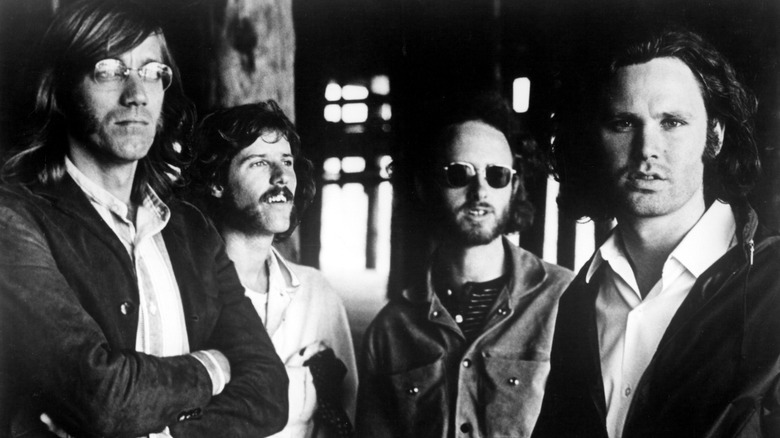
Choosing only five of the 21 songs the Doors released in 1967 was no easy task, but understanding why that year was the best year of the band's career was not. Their self-titled debut and "Strange Days" LPs are often considered the band's best albums and both charted well, solidifying the band's reputation.
The Los Angeles-based band made up of singer Jim Morrison, keyboardist Ray Manzarek, guitarist Robby Krieger, and drummer John Densmore, masterfully combined blues, psychedelic rock, and avant-garde theater, among other musical genres, into a unique sound that separated them from their contemporaries. The band formed in 1965 when UCLA film students Morrison and Manzarek met on a Venice, California beach and were soon joined by Densmore and Krieger to become the Doors, named for the Aldous Huxley book "The Doors of Perception" about the writer's experience with the psychedelic drug mescaline.
By July 1967, "Light My Fire" shot to the top of the charts, helping the album reach No. 2 on the Billboard 200. The band quickly released a follow-up album in September, which reached No. 3, with the single "People Are Strange" peaking at No. 12. We chose some tunes that were Billboard hits at the time and others that became beloved classics that continue to top critics' lists and resonate culturally, like "The End." These five definitely prove that 1967 was the Doors' best year.
Light My Fire
With its unforgettable and somewhat unusual organ intro by Ray Manzarek, Jim Morrison's seductive voice, Robby Krieger's jazz-influenced soloing, and John Densmore's Latin-tinged drums, "Light My Fire" became an instant psychedelic classic. Besides shooting up the charts to become the Doors' first No. 1 single, it remains one of the band's best loved and regarded songs. "Light My Fire" was primarily written by Krieger after Morrison asked the rest of the band to help with writing duties so they had more original songs to play, telling Krieger to make sure the subject was timeless. "So I thought, What's timeless? Earth, air, fire, water. I couldn't go wrong with any of them. I picked fire because I liked the Stones song 'Play with Fire'," he told Guitar Player in 2020.
"Light My Fire" morphed through being played live, where Manzarek and Krieger would trade long solos. The song also changed in the studio when it was recorded in 1966, when producer Paul Rothchild suggested Manzarek open the song with the organ part he typically played in the middle of the tune. The results, recorded in just two takes, were pure magic when the song was released and, as Morrison had advised, also became timeless.
People Are Strange
"People Are Strange," the lead single from the Doors' second album, "Strange Days," while not performing quite as well as "Light My Fire," was still a Top 20 hit when in the fall of 1967 and helped push the album to gold, as the first album had. Both the song and the album were well received by critics helping to further cement their reputation. "People Are Strange" has a carnival atmosphere with Robby Krieger's flamenco-inspired guitar and Ray Manzarek's waltzing organ that matches the tone of Morrison's lyrics about anxiety-inducing solitude.
There are two versions of the song's origin. In one, Morrison came up with the lyrics while on an early morning sojourn in Manhattan after visiting Andy Warhol's Factory, watching the city come alive. In the other, Morrison was depressed and walking with two of his bandmates in LA's Laurel Canyon when the song came to him. It was the first song the band performed on television on the Ed Sullivan Show, the same performance after which they were banned from the show for not changing a lyric in their second song, "Light My Fire." The performance on the beloved nationally televised live show proved that 1967 was indeed the Doors' best year.
The End
While "The End" was never released as a single from the band's debut album, that didn't prevent it from having a major cultural impact. The more than 11-minute-long psychedelic, epic with its eerie references to a giant snake, a mysterious blue bus, and Socrates' play "Oedipus the King," in which Oedipus kills his father and marries his mother, melted minds in 1967 and continues to do so today. Musically, it featured one of the best drum solos of the 1960s by John Densmore, Robby Krieger's atmospheric Indian-inspired modal explorations, and Ray Manzarek's hypnotic droning organ.
It all made for one drama-packed tune that was forever cemented in the cultural consciousness when Francis Ford Coppola used the song in his 1979 Vietnam War epic "Apocalypse Now" during a climactic scene. "The End" started as a simple break-up song, but it evolved over multiple live performances before it was ever recorded began to take on a sprawling life of its own. At one point, Jim Morrison surprised the rest of the band when he added the Oedipal section during a show at the Whisky a Go Go. The song was a staple closer for the Doors live and was a centerpiece of the album.
When the Music's Over
Like "The End," "When the Music's Over," from "Strange Days," has an epic feel at 11 minutes, was not released as a single, and often comes in high on critics' lists of the band's best songs. But that's about where the comparisons end. Where "The End" wallows in darkness, "When The Music's Over" is more hopeful, if no less apocalyptic, with its environmental slant.
With lyrics such as "What have they done to the earth, yeah? / What have they done to our fair sister? / Ravaged and plundered and ripped her and bit her / Stuck her with knives in the side of the dawn / And tied her with fences and dragged her down," Morrison's vocals resonate with righteous anger. The Doors' producer Paul Rothchild, in a 1968 Life interview, points to this song and its social commentary. "I don't think there's anyone under 30 who doesn't understand what that's all about and doesn't identify with it," he said.
Musically, there's a lot to love, from John Densmore's responsive drumming to Morrison's vocals, to Robby Krieger's overdubbed guitar (inspired by the Beatles' use of the technique) and woozy, mind-bending psychedelic solo (which he's called his best). "When the Music's Over" has been described as one of the most underrated classic rocks songs of all time, and deserves a spot on our list of Doors' songs that proved 1967 was indeed their best year.
Break On Through (To The Other Side)
Considered one of the best rock album openers of all time and a perennial fan favorite, "Break On Through (To the Other Side)" from the Doors' first album didn't even crack the Billboard Hot 100 when it was released as their first single. That didn't stop it from slowly emerging as a classic that introduced all the elements that would make the Doors so different from other bands.
"Break On Through" starts with a rim-clicking Bossa Nova drum intro by John Densmore that leads into Ray Manzarek's Fender Rhodes Piano Bass that replaced the need for a bass player. Manzarek played the instrument with his left hand while playing another organ with his right. Add to this mixture Robby Krieger's bluesy guitar and Jim Morrison's growling of his mysterious and mystical lyrics exhorting listeners to "Break on Through" and you have the blueprint not just for the perfect Doors' song, but for the band's sound in general. The song, along with the rest of those in this list, proves that 1967 was the year the Doors were unstoppable and on their way to quickly becoming legends.