

5 Classic Rock Hits With Emotional Breakdowns That Hit Even Harder Today
Nothing gets to the crux of a devastating life issue quite as effectively as a rock song featuring an emotional breakdown with a melody you can latch onto. This sort of sensitivity isn't reserved for emo bands or singer-songwriter types; plenty of classic rockers have taken up the challenge of expressing their grief through melodic missives fraught with enough emotion to qualify as a therapy session. For listeners searching for someone who understands, a classic rock hit with a juicy emotional breakdown at its center is a source of salvation that puts all the messy bits into words and music.
Several of these extremely emotive classic rock tunes became chart hits while providing support for fans in need of a song-based spin-out. Our picks come from the annals of 1960s rock, where Roy Orbison got his crying on; the hard-rock scene that gave Nazareth and Guns N' Roses a platform for their frenetic upheavals; and even into the grunge age where Pearl Jam perfected the musical emotional breakdown. We've dredged the record collection for the peak of psychic pain and assembled a five-song catalog that serves angsty emotion marinated in unfettered intensity, with a side of crying your eyes out. Listen with caution ... and keep your tissues handy.
Crying — Roy Orbison
Crooner Roy Orbison got the emo ball rolling long before the movement had momentum with his 1961 classic rock standard and No. 2 hit, "Crying." The gradually-soaring tune serves one emotional wallop after another as Orbison describes unexpectedly meeting up with his former paramour, only to realize he hasn't moved on like he thought he had. "I thought that I was over you," he confesses, "But it's true, so true / I love you even more than I did before." The lyrics move quickly through this simple yet fraught scenario delivered with crumbling restraint, culminating in Orbison's full-throttle falsetto admission that he'll be emotional forever, crying over his loss. It's a rising tide of vocal mastery that captures a downward spiral of anguish — a blueprint for power-packed breakdown songs to come.
Orbison's masterful musical breakdown became a hit for other artists as well. Don McClean released a version that was the Gen X standard for many listeners, and K.D. Lang shared her clarion-voiced 1987 take as an Orbison tribute, renewing the emotional torrent for a new generation of country and Americana fans. But Orbison's version is the touchstone, portraying a delicate sheath of composure bucking under the weight of messy, raw emotion. Those final notes are a wailing breakdown that gave an early musical voice to the masculine side of romantic angst. It's an eternal go-to for the brokenhearted souls in need of a good cry.
Love Hurts — Nazareth
Scottish rockers Nazareth spent their entire trove of American-radio capital on the hand-trembling 1976 belter "Love Hurts," a tone poem to the exquisite and all-encompassing ache resulting from old-fashioned love. It's a break-up song that can transport boomers back to their first heartache with just the opening guitar strains. The verses offer a blunt pronouncement about the dangers of emotional attachment: "Love hurts, love mars / Love wounds and scars / Any heart not tough / Or strong enough / To take a little pain, take a little pain / Love is like a cloud, holds a lot of rain." There's no soft-shoeing the emotional damage possible if you don't brace yourself for the assault. Judging by the searing vocals and exasperated delivery from Dan McCafferty's raspy pipes, there's a breakdown dead ahead, as well as in the rearview mirror.
The song was originally written for harmony crooners the Everly Brothers but it was never put out as a single. Next, it was given to Roy Orbison, who relegated it to B-side status for one of his chart-topping singles, "Running Scared." Even Nazareth gave their "Love Hurts" lesser consideration, releasing it only on the U.S. version of their album, "Hair of the Dog." They, too, recorded it to use as a flip-side selection. Luckily, their interpretation caught fire, becoming a No. 8 hit on the Billboard Hot 100 and proving the commercial value of crushing, love-inspired despair.
Black — Pearl Jam
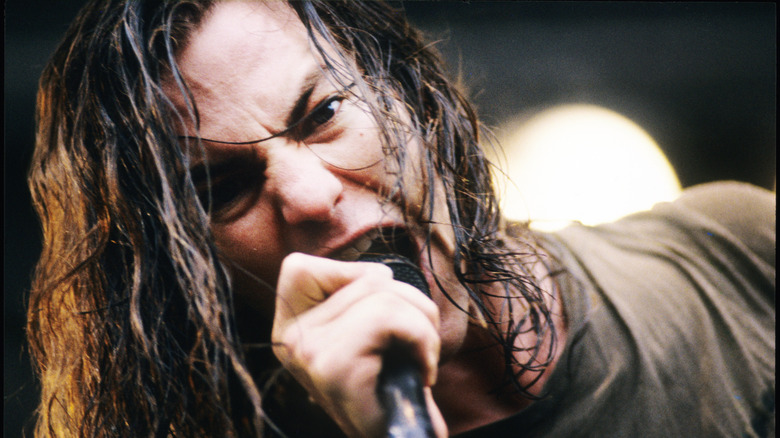
Though Pearl Jam's 1991 seether "Black" was never a single, it still reached No. 3 on the Billboard Mainstream Rock chart and became a signature song for the band, thanks to Eddie Vedder's vulnerable delivery and poetic descriptions of a relationship coming to a painful close. Vedder wrote the narrative to explore the emotional terrain of first-time romantic connections and having to release them when they no longer work, even when it presents agony. "And now my bitter hands cradle broken glass / Of what was everything," he sings. Clearly, a deep connection has come to a devastating end. The lasting impact of this breakup has scorched any imagined future, with Vedder proclaiming, "All the love gone bad, turned my world to black / Tattooed all I see, all that I am, all I'll be," his ravaged voice becoming a primal mumble.
Noise descends in the final passages as Vedder's voice becomes a roar, vacillating between well-wishes and despairing regret: "I know one day you'll have a beautiful life / I know you'll be a star / In somebody else's sky / Why, why, why can't it be in mine?" The emotion is raw and the vocals feel primal, leading into an anguished, melodic howl that seems to go on forever as the players pound on every string and key simultaneously. What started as a gentle recalling of sad memories becomes a cathartic cacophony as the breakdown ensues.
November Rain — Guns N' Roses
Unrequited love is a real bear to get over, a reality given a shimmering, piano-driven expression in 1992's "November Rain" from rockers Guns N' Roses. It's a surprising downshift for the highly controversial Axl Rose, but the unexpectedly affecting power ballad turned into a No. 3 hit and showed off the band's greater talents. Everything starts out stable enough, with Rose explaining quite philosophically, "I know it's hard to keep an open heart / When even friends seem out to harm you / But if you could heal a broken heart / Wouldn't time be out to charm you." The unusually sensitive reading from a band known for its hard-edged content is surprising. Orchestral string filigrees decorate the subdued verses, in which Rose compares both the good and bad things in life to a temporary storm: "Nothing lasts forever, even cold November rain."
Everything seems tidy and resolved until the dramatic coda arrives. The song's personality shifts into mania, with an ominous, Beatle-esque musical motif that turns the tenderness on its side. Slash's axe practically screams as Rose drops into a lower register and begins chanting, "Don't ya think that you need someone? / Everybody needs somebody / You're not the only one," again and again. It seems Rose's contemplative longing has shifted into sinister, droning obsession, causing chills for days, and without needing a real November rain to get the shivers going.
Hurt — Nine Inch Nails
Nine Inch Nails, Trent Reznor's groundbreaking industrial rock project, is renowned for its grinding noise and constrained chaos, even in the quieter moments. With 1994's "Hurt," Reznor conjured a deceptively serene-at-first breakdown of a song designed to haunt our heads. It seethes softly with conflict, portrayed by Reznor's crackling voice describing a drug-fueled emotional collapse. The lyrics sound like a therapy session or a page from a journal: "I hurt myself today / To see if I still feel / I focus on the pain / The only thing that's real / The needle tears a hole / The old familiar sting / Try to kill it all away / But I remember everything." The rawness is palpable, coming to a crescendo as Reznor's voice rises and leaves listeners hanging with almost two minutes of highly-charged electric dissonance and feedback.
A 2002 cover of "Hurt" recorded by country legend Johnny Cash in the year before his death became even better-known that the original, winning an MTV Video Music Award and prompting Reznor to declare that it felt like the song belonged to Cash now. But even the king of country music owes his acclaim for the reinterpretation to Nine Inch Nails setting the tone by creating such a massively personal heart wound of a song in the first place. Reznor may have gone on to become an Oscar-winning composer in the decades that followed, but his classic rock breakdown remains a stunning accomplishment.