

The Bee Gees' 5 Best Instrumental Breaks Prove They're More Than Their Harmonies
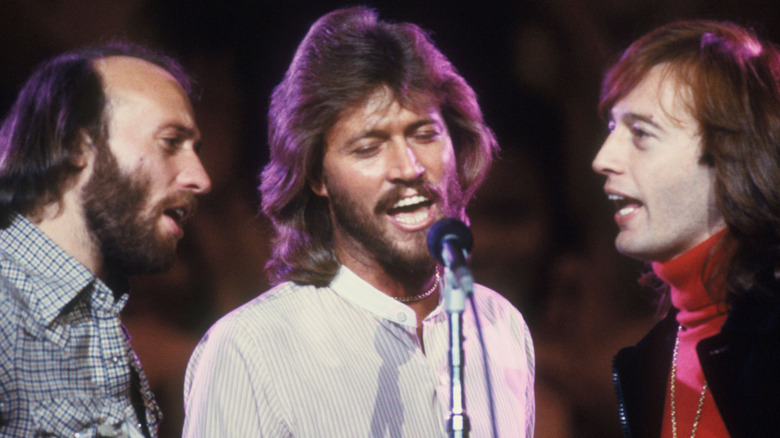
The Bee Gees have been long known for their beautiful three-part harmonies, with the three Gibb brothers honing them for much of their lives since they began singing together in childhood. That early interest in music had plenty to do with their father, Hugh Gibb Jr., who had his own band. But despite the Bee Gees being heavily associated with those intricate harmonies, they also have some stellar instrumental breaks in their songs, and we chose five of the best.
We selected these examples for the effect they have on the overall track and how they're used. That's because a good break isn't just slapped anywhere — it's placed strategically, so it pushes the cut forward and raises its overall quality. A solid instrumental interlude also lets listeners know that they've officially entered into another part of the tune, similar to the music changing in a film when the scene switches. The five that we chose clearly do all of those things. In fact, when thinking of any of these songs, the break is probably one of the first things that comes to mind.
You Should Be Dancing
A good instrumental break can do many things. It can be used to let the listener reflect on the words that came before it, to add some aural flavor to a track as a whole, and to bring some mellowness to a fast-paced, uptempo kind of song. However, the interlude in the Bee Gees' 1976 hit "You Should Be Dancing" takes an already high-energy cut and raises the intensity even more.
The break comes bursting in between the second chorus and third verse, with attention-grabbing horns and a throbbing bass. It plays right before a perfectly layered electric guitar enters in slightly below. In fact, the decision to use a rock-inspired electric guitar in a disco song is nothing short of inventive, and the entire solo adds some extra shine to an already bright-sounding tune. "You Should Be Dancing" — which is one of the five best Bee Gees songs that we chose for dancing — ended up going No. 1 on Billboard's Hot 100 and spent 20 weeks on the chart.
Jive Talkin'
The music break in the Bee Gees' 1975 tune "Jive Talkin'" is so infectious that the group uses it more than once in the cut — a pattern you'll notice in many of our song choices. The first comes in right before the second verse, as soon as the oldest Gibb brother, Barry, sings about a lover's lies always getting in the way. The second enters later after another chorus, allowing the perfect amount of time for the song's lyrics and meaning to settle in further.
The well-timed interludes are driven by the highly skilled synthesizer playing of Derek John Weaver, also known as Blue Weaver. During the second break, a catchy vocal melody even floats in and out of his unique sounds. The instrument was fairly new to the Bee Gees' music at the time, but they didn't let that unfamiliarity stand in the way of experimentation. Of course, synths would dominate much of popular music in the 1980s, so both Weaver and the Bee Gees were truly ahead of their time.
(Our Love) Don't Throw It All Away
There are times when an instrumental break fits the song's meaning and sentiment perfectly, which is the case with the Bee Gees' tender 1979 ballad, "(Our Love) Don't Throw It All Away." The track is about a man's last-ditch effort at convincing his woman to stay and fight through whatever relationship woes they're having. The lyrics definitely express a certain level of humility, as they capture a man who's broken and desperate. With that in mind, the right break needs to convey the same type of meekness — something the Bee Gees pull off in their ballad with ease.
The first break appears in the first half of the song, and the listener is treated to lush-sounding strings that rise and fall over a soft snare drum, which matches the cut's quiet feel. The second comes in later, around the 2:37 mark, before the Gibb brothers close everything out with their famous harmonies. The break is also in Andy Gibb's version of the song. He was the youngest of the Gibb brothers, and he died tragically in 1988 at just 30 years old.
Tragedy
The instrumental break in the Bee Gees' 1979 song "Tragedy," off their "Spirits Having Flown" album, lasts for nearly 30 seconds, and it's quite epic. It appears around the 1:36 mark, depending on the version, and it's a groove-heavy, head-nodding part of the track. The driving guitar riff compliments the other instruments instead of competing with them, in no small part thanks to the song's stellar mix.
The break later appears before the final chorus, and it includes an explosion sound that raises the intensity even more. Barry Gibb is the one who made the explosion, using only his mouth. In the end, "Tragedy" spent two weeks at No. 1 on Billboard's Hot 100 chart, and it's fair to say the instrumental break had something to do with its success. The song also helped "Spirits Having Flown" reach No. 1 on the Billboard 200 album chart, spending six weeks at the top spot. "Tragedy" even got a dance-pop makeover by British pop group Steps in 1998, becoming their first No. 1 single in the U.K.
Spirits (Having Flown)
The two breaks heard in the Bee Gees' 1979 gem "Spirits (Having Flown)" include a prominent flute played by late jazz musician Herbie Mann, as well as congas played by Daniel Ben Zebulon and Joe Lala, which gives the song a slight Caribbean feel. Blue Weaver also joined in on the fun, playing keyboards and the synthesizer. Speaking to music producer and journalist Richard Niles, he talked about how he usually constructed his melodies for the Bee Gees.
"Actually a lot of the stuff with the Bee Gees, I had to play while there weren't very many lyrics," Weaver told music producer and journalist Richard Niles. "So, I'd be building the song actually even before the lyric was there," he later added. So, it's safe to say that Weaver used the same approach for instrumental breaks. That would mean him and the Bee Gees were able to pin down the overall feel of the interlude, so Barry could tailor his words and vocal delivery to match.