

One Of Jazz's Most Enduring Crossovers Has No Known Author
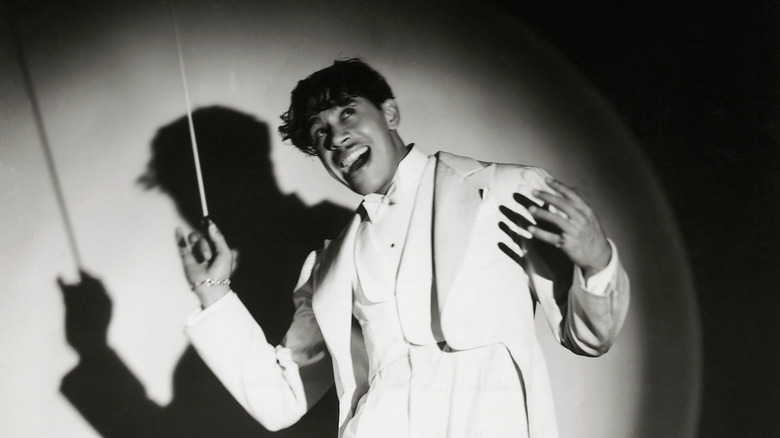
"St. James Infirmary Blues" is best remembered for the classic recordings by trumpeter Louis Armstrong in 1928 and legendary Cotton Club bandleader Cab Calloway, whose haunting, theatrical version featured in a famous sequence in the 1933 Betty Boop film, "Snow White." It has been recorded countless times since then, by artists working across a range of genres. But the truth is that despite its fame, the song's author remains shrouded in mystery, having been passed down the generations in distinct versions and under several different names long before it was ever written down as sheet music or recorded.
Music scholars have long been interested in uncovering the roots of this unique song, which is especially dark in its willingness to explore the theme of death. In its most famous version, the narrator heads to the titular infirmary, where he sees the body of his deceased lover. He then reflects on his own mortality, imagining his body well-dressed at his funeral. In the final lines of the song, it is revealed that the narrator is telling the story to drinking companions, and calls for another shot of booze.
The images in the song are vivid and seemingly easy to parse. But in fact, there is a lot more detail to explore in the song's themes, especially once you take a look at earlier versions of the song from which Armstrong's and Calloway's evolved.
'St. James Infirmary Blues' – A macabre masterpiece
The introduction of the narrator of "St. James Infirmary Blues" heading to see the remains of his lover makes for a shocking introduction to the song, while the turn towards the character's own funeral plans may come across as strangely abrupt. "She will search this wide world over / But she'll never find another sweet man like me," he sings in the second verse, making it clear that he is wrapped in thoughts of himself rather than the deceased lover. But the title of the song alone gives a big hint as to why this might be.
The song is often linked to in the traditional English 19th century song "An Unfortunate Rake," aka "The Unfortunate Lad," with which the later "St. James Infirmary Blues" shares many elements. Another traditional song, called "Those Gambler's Blues," is another strikingly similar precursor to "St. James Infirmary Blues," containing many of the same lyrics in a longer arrangement.
According to some scholars, "St. James Infirmary Blues" emerged from early traditional songs that lament death from sexually transmitted diseases, suggesting that the song may be the story of a woman who has died of syphilis. The narrator, then, is preoccupied with thoughts of his own death because, as the woman's lover, he realizes he may also already be infected with the fatal disease, although, with no explicit lyrical reference it is also possible to read the song as one of direct mourning.
False attributions and the ongoing popularity of 'St. James Infirmary Blues'
Despite its status as a traditional song by an unknown author that exists in the public domain, there has been some controversy over credits when it comes to recordings of "St. James Infirmary Blues." While many of its key elements appear as "Those Gambler's Blues" in poet Carl Sandburg's famous collection of traditional folk songs called "The American Songbag," which was published in 1927, "Gambler's Blues" had already been credited to Phil Baxter and Carl Moore in 1924. Other composers were also incorporating elements of the traditional song, such as the narrator's funeral imaginings, into their own work and crediting the whole composition as their own, muddying the picture.
A publisher named Irving Mills even gained ownership of the rights to the original despite it having no known author, leading in one case to legal action against a musician attempting to record it as a song in the public domain. Nevertheless, "St. James Infirmary Blues" has remained a much-performed and much-recorded track, with garage rockers the Animals recording it in 1968, and later, the White Stripes recorded a version with adapted lyrics on their debut album in 1999. Other adaptations ensured the classic song of love and death continued to evolve.