

5 British Rock Greats From The '60s And '70s That Never Made It Big In America
Ready to meet the best British bands of the classic rock era that you've never heard of before? Then we've got you covered. It might have seemed to American rock fans in the 1960s and 1970s that being British was all a band needed to make it on the Billboard charts. There had been British artists on the American charts before — Cliff Richard being a notable example from the late 1950s – but after the Beatles made a splash in America in 1964, the floodgates were open for countless British bands to arrive on American shores in what became dubbed the British Invasion.
But the truth is that for every Rolling Stones, Who, or Yardbirds, there were the Slades and Status Quos; great British bands that were beloved in their home country but failed to make it big on the other side of the Atlantic. We've selected five truly great British rock bands who enjoyed huge commercial success in the U.K. as well as critical acclaim from the music press, but didn't manage to sustain a career of note in the U.S. Sad for them, sure, but a great excuse for American rock fans to uncover some hidden gems.
Slade
One of the best-loved British rock bands of the 1970s, Slade enjoyed a flurry of hit singles, especially in the early part of the decade, with 17 straight Top 20 chart placements and six No. 1s. Their biggest songs include the irresistibly optimistic "Merry Xmas Everybody," a timeless Christmas No. 1 that has the same staying power in the U.K. as Mariah Carey's "All I Want for Christmas is You" does in the U.S.
Slade was fronted by the charismatic and gravel-voiced Noddy Holder, who typically performed with huge sideburns, platform boots, and, on occasion, a top hat decorated with mirrors. The band had a cartoonish quality that appealed to younger teens, while having a heavy glam sound that also endeared them to many serious rock fans. And Slade was far from a novelty band, with genuinely good songwriting, as evidenced by the catchy, stomping "Coz I Luv You" and the moving ballad "Everyday."
Surprisingly, however, Slade never caught on in the U.S., with even their finest, era-defining albums such as "Slade Alive!" failing to make much of an impact. Their only commercial traction arrived in 1983, when the American hard rock band Quiet Riot topped the charts with "C*m on Feel the Noize," a Slade track that had been a hit in the U.K. a decade earlier. Quiet Riot then tried to replicate their success with a second Slade cover, "Mama Weer All Crazee Now," though it was a comparative flop, and it did little to make Slade themselves popular among American rock fans.
Small Faces
Small Faces were a genre-bending British group that began as a mod and freakbeat combo in the mid-1960s, before embracing psychedelia and becoming more experimental and conceptual as the decade went on. They had a U.K. No. 1 single in 1966 with "All or Nothing," while their LP "Ogden's Nut Gone Flake" — named to sound like a brand of tobacco — spent six weeks atop the British album chart in 1968. By the time the band split the following year, they had had 12 singles in the charts, and a huge amount of critical respect and fan devotion.
Small Faces made a British icon of frontman and guitarist Steve Marriott. But the group proved to be short-lived, with internal tensions prompting Marriott to leave the band at the end of 1968. Marriott was apparently anxious about the prospect of trying to break America, where Small Faces had only enjoyed minimal chart presence outside a lone Top 20 single. The band continued without Marriott and changed their name to the Faces, which became a vehicle for the talents of one of the biggest British vocalists of the 1970s: Rod Stewart.
Marriott found his own fame in America around the same time as a member of hard rock outfit Humble Pie alongside Peter Frampton, but sadly his work with Small Faces — which also includes two albums after the band's brief reunion in the late 1970s — remains neglected by American listeners.
The Move
The Move were a genre-hopping Birmingham quintet who formed in 1965 and emerged on the British tour circuit in 1966. Initially, the Move treated their audiences to cover versions of songs by American bands such as the Byrds before developing their own material and becoming a U.K. chart success.
The band was built around the talents of Roy Wood, whose eccentric songwriting abilities later brought him lasting fame as a founding member of the Electric Light Orchestra alongside Move bandmate Jeff Lynne, before breaking off to form Wizzard. But it was with the Move that he first became a star in the U.K., penning the 1967 hit "Flowers in the Rain" and "I Can Hear the Grass Grow" among other tracks that placed the Move among the heaviest British psychedelic bands, while maintaining their commercial appeal. The band enjoyed nine singles in the British Top 20 throughout the late 1960s and early 1970s, releasing four albums, but despite a 1969 U.S. tour during which they supported an up-and-coming band called the Stooges, they failed to gain traction across the Atlantic.
The Pretty Things
London rockers the Pretty Things formed alongside the cream of British musicians who were inspired by blues and R&B in the early 1960s, such as the Rolling Stones, and quickly developed a reputation for riotous live shows that sent audiences into a frenzy. As well as fine musicianship, the band was captivating to audiences thanks to their rebellious, long-haired look, as well as the performances of frontman Phil May, whose harsh vocals prefigured later proto-punks like Iggy Pop.
Like the Stones and the Beatles, by the late 1960s the Pretty Things had embraced psychedelia and the growing importance of albums as pieces of coherent art. In 1968 they produced "S.F. Sorrow," their answer to "Sgt. Pepper's Lonely Hearts Club Band" that has been described by critics as the first rock opera. Despite its scope and vision, it baffled the Pretty Things' record label — which also refused to send the band to the U.S. during the British Invasion — and failed to be properly marketed, limiting the band's commercial prospects when they were at the peak of their creative ambitions. The album is arguably the place to start with the band for listeners today, but check out any of their live clips online for a sense of the atmosphere at their live shows.
Status Quo
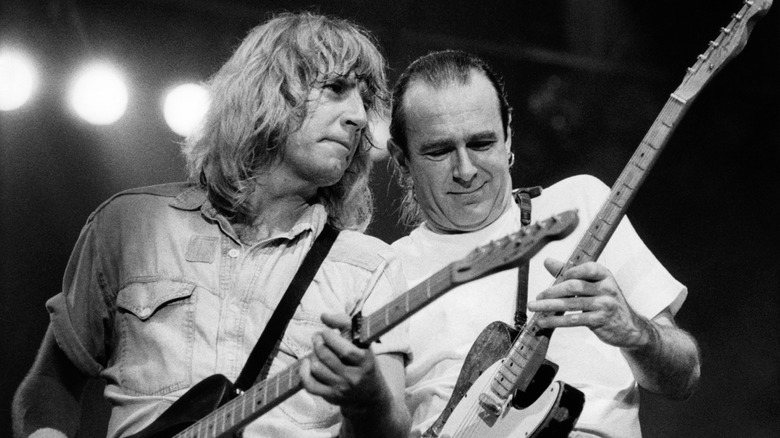
Status Quo is one of the longest-running prominent British rock bands to never make it in the United States, and their stats when it comes to the U.K. charts are staggering. Over the course of its existence, the band has had 57 singles in the U.K. Top 40, including 22 in the Top 10, and released 48 charting albums.
Founded by guitarist and vocalist Francis Rossi in 1962 while he was still in school, after cycling through several names until settling on Status Quo, the band first emerged during the psychedelic era and cut one of the movement's classic singles, "Pictures of Matchstick Men," in 1968. But it was in the 1970s that the band really distinguished themselves, with harder-rocking numbers that reached their high point with "Down Down" in 1974, a ridiculously catchy single that topped the charts — their only song to do so. Their signature songs also include their definitive cover version of Creedence Clearwater Revival legend John Fogerty's "Rockin' All Over the World," which was a hit in 1977.
Status Quo weathered the punk explosion of the late 1970s, the dawn of new wave and, later, grunge, sticking to their purist rock sound and maintaining a loyal following despite often being considered uncool by music fans in general. Not that the band, which has remained active in various degrees for six decades at this point, will care about that.