

5 Forgotten British Invasion Bands That Once Rivaled The Beatles In Popularity
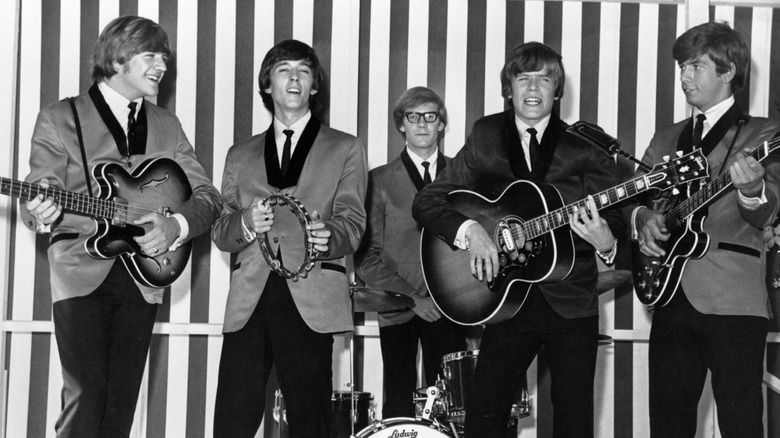
The British Invasion was a monumental era that brought to the U.S. some of the most enduring and beloved bands ever, particularly the Beatles, as well as a number of briefly but hugely popular bands who have been largely overlooked ever since. If the British Invasion, so called because of the sudden and overwhelming dominance of the hearts, minds, and wallets of young record-buyers in the mid-1960s of hook-boasting, guitar-wielding pop rock groups from England, had a winner, it was the Beatles. In the U.S., they're the best-selling group ever. Riding the wave of the Beatles' popularity and novelty were legends like the Rolling Stones and the Kinks, and a slew of relatively fleeting bands that physically and musically resembled the Fab Four.
Nevertheless, these bands notched numerous achievements and milestones of their own. Here are the stories of five British Invasion acts — the Dave Clark Five, Herman's Hermits, the Hollies, Gerry and the Pacemakers, and the Animals — who gave the Beatles some real competition in the '60s.
The Dave Clark Five
With Beatlemania strongly underway with massively viewed appearances on "The Ed Sullivan Show" in February 1964, American record labels and listeners looked around for other radio-friendly rock bands from England. One of the first acts to get that British boost: north London's the Dave Clark Five. One of the few successful eponymous rock bands who got their name from their drummer (its pleasantly voiced singer bore the unmemorable moniker of Mike Smith), the Dave Clark Five was climbing the Hot 100 by March 1964, peaking at No. 6 with "Glad All Over."
What followed were 16 more Top 40 hits in just three years' time. Highlights include the playful "Catch Us If You Can" and the cool "Over and Over," a No. 1 hit in late 1965. That year also saw the Dave Clark Five attempt movies, with "Having a Wild Weekend" hitting theaters. Ultimately, the band split up in 1970, the same year as the Beatles.
Herman's Hermits
Shortly after the Beatles achieved the unbelievable milestone of occupying the entire Top 5 of the Hot 100 in 1964, another British group came along to set records and rack up chart stats, too. After No. 1 hits by Freddie and the Dreamers and Wayne Fontana and the Mindbenders, Herman's Hermits followed those fellow Manchester bands with "Mrs. Brown You've Got a Lovely Daughter." It was also the third smash in less than six months for Herman's Hermits, following similarly jaunty, old-fashioned-sounding, and none-too-serious goofy pop-rockers "I'm Into Something Good" and "Can't You Hear My Heartbeat."
Herman's Hermits was mega-successful before any of its members turned 21, fronted by lead singer and leading teen idol of the era, Peter Noone. Altogether, Herman's Hermits recorded 18 Top 40 hits between 1964 and 1968, the peak of the British Invasion period and also the year the band starred in its own zany comedy film, "Mrs. Brown You've Got a Lovely Daughter." By that point, the Beatles had moved on to more mature and experimental fare, and Herman's Hermits faded away, continuing on as a band into the '70s even after Noone left for a solo career.
The Hollies
Rich and intricate harmonies, jangly guitars, and a working knowledge of pop song-craft and American R&B informed the music of early '60s band the Hollies, and they got caught up in the British Invasion, reaching the American charts in 1966 with the Top 10 hits "Bus Stop" and "Stop Stop Stop." Slowly incorporating other musical phenomena of the day like psychedelia and folk, the Manchester-based Hollies grew up and added more entries onto its list of 11 Top 40 hits, including "Carrie-Anne" and the poignant "He Ain't Heavy, He's My Brother."
Unlike most every other British Invasion group, the Hollies stayed famous and relevant into the 1970s, with its most significant hits arriving in that decade. In 1972, they hit No. 2 with the Creedence Clearwater Revival soundalike "Long Cool Woman (In a Black Dress)" and made No. 6 two years later with the gorgeous and immaculate ballad "The Air That I Breathe." The band even weathered the departure and return of frontman Allan Clarke and the exit of founding member Graham Nash, later of Crosby, Stills & Nash.
Gerry and the Pacemakers
Before several bands were lumped together and marketed as a collective "British Invasion," many of those constituent acts were associated with the early 1960s Liverpool scene, also known as Merseybeat, named for the local River Mersey. The Beatles were an internationally famous Merseybeat band, as were Gerry and the Pacemakers. The two bands shared a manager and champion in Brian Epstein, and the latter group, led by emotive crooner Gerry Marsden, repeatedly ran up the U.S. pop singles chart. Generally more somber, theatrical, and softer than its slightly edgy rock 'n' roll counterparts, Gerry and the Pacemakers graced the Top 40 seven times with turgid ballads like the brass-enhanced, hometown-referencing "Ferry Across the Mersey," inoffensive slow numbers like "Don't Let the Sun Catch You Crying," and the energetic, piano-propelled Beatles-esque "How Do You Do It."
The group's final hits arrived in 1966, and they went their separate ways that same year. To this day, however, Gerry and the Pacemakers' cover of the "Carousel" show tune "You'll Never Walk Alone" remains the official song of top-level soccer team Liverpool FC.
The Animals
With captivating and forceful singer Eric Burdon at the helm, the Animals didn't seem to specifically aim for the pop charts or go for wide appeal, but they wound up racking up plenty of smashes and winning lots of fans anyway. The Animals, whose music was as rowdy as the Beatles' was polished and tightly crafted, became mega-successful off their first single, a fiery, woozy, organ-drenched cover of the old folk song, "House of the Rising Sun," which went to No. 1 in 1964. That established this British Invasion band as one "comfortable" with R&B and instrumental experimentation, all the better to get across the big feelings lurking in their songs.
They reached the Top 40 with seven more singles in two years, including the raucous "Don't Let Me Be Misunderstood." Then, after rebranding as Eric Burdon and the Animals and embracing elements of the blues and psychedelic rock, they scored a few more hits, like "See See Rider" and "Monterey." By the dawn of the '70s, the Animals as they were had ended, as Burdon had moved on to head up the American band War.