

The 5 Best Duets In Pop History
A great duet is more than just two superstars collaborating on a song in order to sell to both of their audiences. The best duets occur when two artists come together to create something greater than themselves, to achieve a height only possible by the conjoining of their talents. A great duet occurs when the song and its performance embody an undeniable element of the human experience: the human condition is shared.
What all the songs on this list share are transcendent performances that speak to the most essential elements of our lives: love, pain, joy, desire, and the inveterate human propensity to defy the setting sun. Over half of the artists on this list are no longer alive, but their songs live on, memorialized in the annals of music history as chart-toppers, award winners, and cultural touchstones. Take a look at five of the best duets in pop music history.
Ain't No Mountain High Enough — Marvin Gaye and Tammi Terrell
This song is so good it became a hit twice, first as a duet by Marvin Gaye and Tammi Terrell in 1967 and again with Diana Ross in 1970. "Ain't No Mountain High Enough" is a product of the Motown machine, which at the time rivalled even the Brill Building at churning out hits. The song was written by Nickolas Ashford and Valerie Simpson, a husband-and-wife songwriting duo who penned several hits such as "Let's Go Get Stoned," recorded by Ray Charles, and "Ain't Nothing Like the Real Thing," also recorded by Gaye and Terrell.
Originally, the song almost landed with Dusty Springfield. According to an interview with the Chicago Tribune, Simpson said that they were meant to offer it to Springfield, but held onto it hoping it would be their ticket into Motown Records. "Dusty Springfield had just come to town and wanted to meet with us for material," Simpson said. "We played that song for her but wouldn't give it to her ... We felt like that could be our entrée to Motown. Nick [Ashford] called it the 'golden egg.'"
The song was a hit, charting at No. 19 on the Billboard Hot 100, and No. 3 on the Billboard R&B chart. In Billboard's review at the time they said, "Chalk up another pulsating fast smash for Gaye with his new partner Tammi Terrell. The electricity of the duo combined with the blockbuster rhythm material grooves all the way." In 1999 the song was inducted in the Grammy Hall Of Fame as a "recording of lasting quality or historical significance."
Islands in the Stream — Kenny Rogers and Dolly Parton
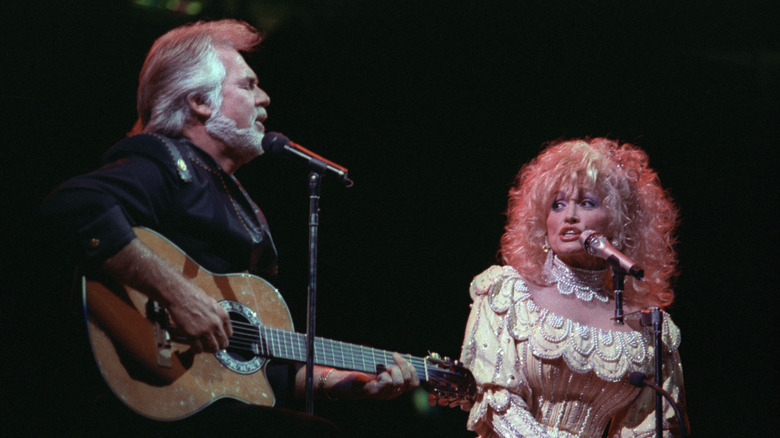
It's not hard to argue that this is the greatest country duet of all time, but the song makes this list for its success crossing genres. The tune was written by the disco legends, the Bee Gees, as an R&B song meant for Diana Ross. They eventually offered the track to Kenny Rogers who had his own issues with it, so he knocked on Dolly Parton's door who happened to be recording at the same studio at the time.
There's a magical chemistry going on between Rogers and Parton, whether you're listening to their voices or watching them perform the song live. Although the song can be easily interpreted as a romantic love song due to its lyrics, the joy and kinship imbued in their performances demonstrates that sometimes friendship can transcend romance and be its own kind of unique, special love.
That kind of special love was obviously relatable, because the song immediately went No. 1 on the Billboard Hot 100 Chart, and the Country and Adult Contemporary Charts. It has since gone on to go triple platinum in the U.S., and been the endless subject of tributes, covers, and even spoofs , making it one of the defining duets of the 1980s.
Don't Let the Sun Go Down on Me — Elton John & George Michael
The sun could not go down on this single originally recorded in 1974 by Elton John. Upon initial release it reached No. 2 on the U.S. Billboard Chart, was certified Gold by the RIAA, and was nominated for two Grammy awards. Eleven years later it made a splash when John brought out George Michael for a duet performance of the song at Live Aid 1985. The ballad became a part of Michael's touring repertoire and in 1991, Michael invited John to perform it with him at Wembley arena where it was recorded and later released as a single that went No. 1 on the charts in the U.S. and U.K., was nominated for a Grammy for Best Pop Vocal Performance by a Duo, and was also certified Gold.
This is one of those moments that demonstrates how sometimes an already incredible song can be even better in the hands of a new artist. "I Will Always Love You" by Dolly Parton blossomed from a beautiful country ballad into a career-defining performance from Whitney Houston, no one even remembers Bob Dylan's "All Along Along the Watchtower" after Jimi Hendrix remade it in his own image, and the same can be said about including Michael on "Don't Let the Sun Go Down." John already has a powerful, velvety voice, but Michael's ferocious charisma, soaring leads, and one-of-a-kind timbre not only match John's vocal prowess, but elevates it and takes the song to a higher emotional peak.
Fire And Desire — Rick James and Teena Marie
Rick James was a habitual line stepper with a complicated life story, but in the 1980s he was delivering some of the smoothest, funkiest, and most passionate R&B of the era. His creative and commercial peak was "Street Songs" which featured some of his biggest hits like, "Give It to Me Baby" and "Super Freak," but also one of the greatest duets ever put to tape: "Fire and Desire." The song is performed by James and the soul and R&B singer, Teena Marie, whose small stature betrays her gargantuan voice.
The track opens with a lush drum intro, shimmering chimes, and lusty synth pads before James enters the track with an intimate soliloquy. The charm and allure in his voice is charming and seductive, but not before he erupts into a deep throated wail of forlorn lust. His plea for intimacy is then answered by Marie's jaw-dropping entrance; like a singing siren she shrieks to the top of her register and back to the very bottom before the two voices intertwine for the final chorus.
The album peaked at No. 3 on the Billboard 200, spent a whopping 20 weeks as No. 1 on the Top R&B/Hip-Hop Chart, and was certified platinum by the RIAA. "Fire and Desire" was never released as a single, but it retains a spot of reverence for many of James' fans. Ice Cube called it "... one of the most perfectly produced songs ever made."
Under Pressure — David Bowie and Queen
You'd be hard pressed to find a song that suits its title as well as Queen and David Bowie's 1981 hit, "Under Pressure." Built upon John Deacon's instantly recognizable bass line, the gradual addition of instruments, and the tension-building back and forth of Bowie and Freddie Mercury's vocals, the song is boiling in a pressure cooker until it explodes in an electrifying refrain, begging "can't we give love one more chance?" before fading away to the echo of finger snaps.
Like many of the best duets in classic rock history, "Under Pressure" was the result of musical serendipity. In 1981, Queen was working on their album "Hot Space" at Mountain Studios in Montreux, Switzerland. Bowie lived near the studio where he had recorded songs for his 1979 album, "Lodger," and Queen invited him to work on some sessions for their song "Cool Cat." Although Bowie's vocals never made it on the final track, they all continued to play and write until they eventually put together what would become "Under Pressure."
The song went No. 1 across the world, particularly in Europe. It has since gone 4x platinum in the U.K. and the U.S. Unfortunately, Bowie and Mercury never performed the song live together. Only Queen incorporated the song into their live shows, and Bowie never performed it live until the 1992 Freddie Mercury Tribute Concert where he sang it with Annie Lennox from the Eurythmics, filling in after Mercury's death. However, following that performance, Under Pressure became a recurring staple of Bowie's setlist throughout the rest of his career.