

The 5 Best Talking Heads Songs That Aren't Once In A Lifetime
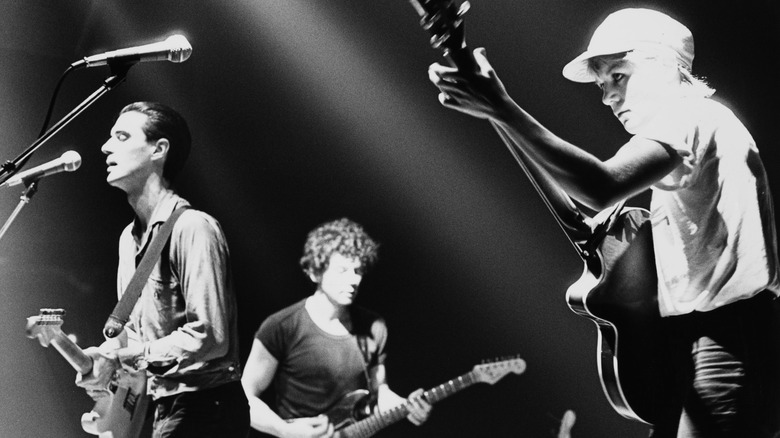
Talking Heads is now considered one of the definitive new wave bands, which, in the late 1970s and 1980s, put out some of the most skewed, daring, and forward-thinking pop music while maintaining a high degree of listenability that made them a regular fixture on the charts. For many music fans, 1980's "Once in a Lifetime" is the band's defining song, an angular but catchy meditation on middle-class suburbia set to polyrhythms by producer Brian Eno. It wasn't a chart smash, but it was buoyed throughout the 1980s MTV era by its famous music video featuring frontman David Byrne's now-iconic dance moves.
But Talking Heads were no commercial lightweights, with several of the singles they released over more than a decade working together, both performing well on the charts and receiving critical acclaim. Here are five classic Talking Heads songs that aren't "Once in a Lifetime," but are up there with the best songs the band produced. We have stuck with singles because attempting to explore the deep cuts of the band's eight excellent studio albums could fill a book — but there is plenty here to add to your playlists if you don't have them saved already.
This Must Be the Place (Naive Melody)
While "Once in a Lifetime" may be Talking Heads' signature song, in the 21st century, another of their singles has emerged as a more popular track among the streaming generation: "This Must Be the Place (Naive Melody)." The 1983 track was the second single from their album "Speaking in Tongues" and has been noted since its release as a very different beast from much of the Talking Heads discography up to that point.
Talking Heads rose to prominence in the late '70s musical landscape that had been utterly transformed by the arrival of punk. Devotional love songs came across as cheesy to many listeners, and indeed David Byrne's lyricism typically went in other, more intellectual directions. However, for "This Must Be the Place," Byrne, who was in a new relationship, found himself in the mood to revert to pop music's most classic mode, writing, for once, a love song — its simplicity reflected in the track's intentionally "naive" instrumentation. "I tried to write one that wasn't corny, that didn't sound stupid or lame the way many do. I think I succeeded; I was pretty happy with that," he said (via Music Radar). And as its huge listenership today makes clear, there's always an audience for a well-made love song.
Burning Down the House
1983's "Burning Down the House" was Talking Heads' highest-charting single, peaking at No. 9 and spending 22 weeks on the chart. The funk-infused dancefloor-filler was inspired by drummer Chris Frantz and bassist Tina Weymouth's attendance at a Parliament/Funkadelic concert at Madison Square Garden, during which the fans of the funk institution chanted the phrase "burn down the house."
Talking Heads had long taken inspiration from funk groups, and the phrase proved to be an effective prompt for David Byrne, who delivers one of his most famous sets of lyrics and vocal performances. To Byrne, however, the song isn't about literal fires. Instead, he explained: "The title phrase was a metaphor for destroying something safe that entrapped you. I envisioned the song as an expression of liberation, to break free from whatever was holding you back. As for the rest of the lyrics, there are no hidden meanings. There's no logical, linear connection. They aren't telling a story or signifying anything. I simply combined aphorisms and non sequiturs that had an emotional connection" (via Inside Hook).
Featuring exceptional percussion and infectious basslines, it remains a staple at indie discos and party playlists, and lives up to its reputation as one of the catchiest of Talking Heads' songs.
Life During Wartime
Apocalyptic visions are rarely as danceable as "Life During Wartime," Talking Heads' 1979 classic that cemented David Byrne's reputation as one of new wave's most thought-provoking lyricists. Featuring the famous chorus, "This ain't no party / This ain't no disco / I ain't got time for that now," Byrne paints an impressionistic future world in which food is scarce, there is no entertainment, weapons are being transported, and people hide from the outside world.
Though the synths in "Life During Wartime" are melodic and catchy, matching the rhythm of Byrne's vocals, they have a staccato, machine-gun effect, and the frantic rhythm section creates the sense of the world the narrator inhabits being grindingly chaotic. Nevertheless, it makes you want to move your feet, raising questions about the possibility of pleasure for those living in tumultuous times. The track peaked at No. 80 and remained a mainstay of the band's live shows. An undoubted classic of Talking Heads' early period.
Psycho Killer
Far and away the most-played Talking Heads song of the streaming age, "Psycho Killer" is the band's juddering, stuttering 1977 breakthrough hit. For many listeners at the time, "Psycho Killer" seemed to have been inspired by the grisly story of David Berkowitz, aka the Son of Sam, a New York serial killer who terrorized the city and was captured around the time that Talking Heads were coming to prominence.
The band, however, has claimed that "Psycho Killer" emerging around the same time as Berkowitz is coincidental, and the song itself appears to back this up, with no narrative link apart from the title refrain. In fact, the song seems to be focused on the subject of communication, with David Byrne perhaps being inspired by his own Asperger's Syndrome: "I couldn't talk to people face to face, so I got on stage and started screaming and squealing and twitching," he said (via the Financial Times). The figure of the psycho killer could be read as an expression of Byrne's sense of outsiderness brought on by his condition.
Characterized by funky guitar and bass lines and the soaring crescendos following the song's famous bridge sung in French, the song was an unusually arty breakthrough that announced Talking Heads as a chart-friendly act that nevertheless sought to do things differently. It peaked at No. 92, but has eclipsed its chart position over the years.
Road to Nowhere
Talking Heads' gospel-infused 1985 single "Road to Nowhere" wasn't a pop hit in the U.S. on its release — though it did peak at No. 25 on the Mainstream Rock chart and was a major hit in Europe, hitting No. 6 in the U.K. The track is an intentionally light-hearted look at the human condition, the inevitability of aging, death, and disaster, but with a tone that suggests David Byrne is feeling philosophical about all of these things.
The contrast between the instrumental and the subject matter reveals the song's central thesis: that the future is, ultimately, decided, and humanity would do well to come to terms with that fact. "Come along and take that ride / And it's alright, baby, it's alright," Byrne implores us. The song's two-chord structure is as uncomplicated as the message it conveys, reminding us that for all their experimentation, Talking Heads were a band whose best ideas were bold rather than complex. A late gem in their discography.