

The 5 Best Journey Songs That Aren't Don't Stop Believin'
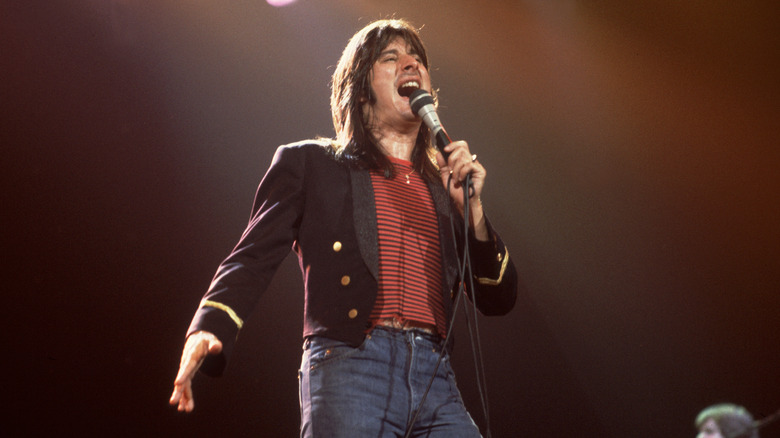
Let's get this straight: There is much, much more to Journey than their perennial singalong favorite, "Don't Stop Believin'." Yes, the song has often been called one of the best and biggest rock songs of all time, with an 18x platinum certification to prove it, and remains a ubiquitous fixture at karaoke and public events. It's simply a song everyone will recognize within its opening lines. But Journey is far, far from a one-hit wonder and, in fact, has several singles that charted even higher than "Don't Stop Believin'" did in its time. More importantly, the band has crafted songs with entirely different feelings than "Don't Stop Believin'" but every bit as much craftsmanship.
We've chosen here five Journey songs other than "Don't Stop Believin'" that showcase the band's range, meaning they vary between soft rock, progressive, and hard rock, as well as doing what Journey does best: soaring hooks, screaming guitar, airy synths, and earworm choruses. Some, like "Open Arms" and "Lights," were hit singles, while others, like "Look to the Future" and "Escape," are gems that are slightly more hidden but no less pristine. Here are five of the best Journey songs that aren't "Don't Stop Believin'."
Look Into the Future
We'll start with a song that more casual Journey fans are likely to have missed, mainly because it comes from their early period, when the band was more experimental and less radio-friendly. The title track from the band's second album, "Look Into the Future," is representative of the band's early style, which incorporated more progressive and jazz elements and, as such, wasn't afraid to let songs develop into sprawling, extended epics — hence the song's eight-minute-plus runtime. It's also from the period before Steve Perry joined the band, so the vocals come courtesy of Gregg Rolie, who fans will also know from his time in Santana, providing vocals on "Black Magic Woman" and other hits. Though a Perry-less, jazzy Journey might sound strange, songs like "Look Into the Future" show off how exceptional the band was, even in that odd, early iteration.
If there were only one takeaway from "Look Into the Future," it would be how impressive guitarist Neal Schon was, years before his work on Journey's commercial hits made him a legend. Alongside some solid bluesy vocals and fun keyboards from Rolie, Schon practically is "Look Into the Future." While Rolie wails away, Schon's guitar work ranges from soft and beautiful balladry to screaming solos to inventive, angular riffs and back and forth between them all. By the end of the song, Journey have taken listeners on a fittingly futuristic odyssey, cruising through more varied sonic landscapes than those most familiar with "Don't Stop Believin" would guess possible.
Separate Ways (Worlds Apart)
The secret superpower of Journey's "Separate Ways (Worlds Apart)" is that it packages a genuinely pounding hard rock song in an outer shell digestible to the band's wider, more soft-rock-leaning audience. Despite Schon's gritty, growling power chords, shredding solo, and the tense synth line that seems to presage danger throughout, the song has been described as a ballad, underscoring the band's unique talent for blending musical and emotional tones into something coherent and entirely their own. According to Schon, however, the song's core is neither hard nor soft rock — it's more like rhythm and blues.
Speaking with Guitar World, Schon revealed that "A big part of Journey's influence comes from Motown mixed with R&B and blues, and that's pretty much where 'Separate Ways' is coming from." Whatever the genres' influences were, they are certainly hidden in the final recording, beneath all the synth, distorted guitar, and Perry's uber-high belting, but that again goes to show the deep reservoir of musicology the band draws from and their singular results. No matter the genre, the song has always been a fan favorite. In the same interview, Schon explained that "We've opened with it, we've closed with it, and we've stuck it in the center of the set. It doesn't matter where we put this song because it has always had a strong effect on the audience, all the way back to the first time we played it."
Lights
In some ways, "Lights" is a strange exploration for Journey, and the fact that it still slowly became a sleeper hit for the band says a lot about their versatility. Across the band's many hits, "Lights" charted among the worst, only reaching No. 68 on the Billboard Hot 100. Nonetheless, it became a staple for the band over the years, receiving consistent play on the radio and in concert. It also gradually became more and more celebrated in the San Francisco Bay, the area it is (sort of) about, and as one of the band's first singles to feature Perry, has also come to be hailed as a signifier of the band's golden age.
We did say the song is only sort of about San Francisco, and that's because Perry originally wrote it with Los Angeles in mind. As he revealed to Ultimate Classic Rock, "It was written about Los Angeles. It was, 'When the lights go down in the city / And the sun shines on L.A.' I didn't like the way it sounded at the time. I love San Francisco, and I love the Bay and the whole thing, and the words 'the bay' fit in so nice." In that way, "Lights" is an ode to two cities at once, which is fitting for a band initially formed as a supergroup, whose members came from very different bands and backgrounds. The unusual Hendrix-like guitar parts further add to the song's piecemeal nature, a style that Journey would eventually come to perfect.
Escape
There's almost no avoiding Journey's definitive 1981 album "Escape," which topped the Billboard 200, spent about three years on the chart, and produced major singles including "Don't Stop Believin,'" "Who's Crying Now," and "Open Arms." Yet it's precisely because of the massive success of those singles that other tracks on the album sit in relative obscurity, and one of the best among them is the title track "Escape." The band's choice to name the song after the album and to open side two with it suggests they had faith in the song, and there's little wonder why. The song has an anthemic, shout-along chorus, Van Halen-esque guitar work, and a number of surprising and interesting section changes throughout.
From its first moments, "Escape" has a driving energy that never lets up. Schon's guitar is full of swift riffs, showy harmonics, and one of the most exemplary arena rock solos you'll ever hear. The bass has moments of fury, and the synths have dramatic crescendos of their own, but it's Perry and his timeless voice that bring "Escape" to its full potential. His vocals are as elevated (in both senses of the word) as you'd expect and we defy anyone not to sing along as he belts the repeated "I'm on my way" of the choruses. "Escape" is the type of song that could absolutely have been a hit single were it not for the stiff competition from the other songs on its own album.
Open Arms
For all of Journey's versatility, there is one style they continually return to because it's simply what they do best: huge, singable, arena-worthy ballads. Supporting that assertion is "Open Arms," an almost peerless ballad that is emblematic of the band's best year. For all the cultural weight that "Don't Stop Believin'" has accrued, it only managed to hit No. 9 on the Billboard Hot 100, while "Open Arms" hit No. 2 — the band's highest-charting single ever. In the years since, "Open Arms" has come to be called one of the greatest ballads and love songs ever written, with countless covers and appearances in other media. For all its massive impact, however, "Open Arms" remains at its core a delicate, intimate love song about naked vulnerability.
The chorus begins "So now, I come to you with open arms / Nothing to hide, believe what I say," a transparently honest plea, and it's one the song doesn't renege on. There's no twist to "Open Arms." There isn't a betrayal or a secret; the couple simply drifted apart. It is honest and loving, which is a refreshing change of pace from most pop songs. Even the single moment of tension in which Perry could have zigged or zagged, "But now that you've come back, turned night into day," ends with a frank "I need you to stay." That sincerity is charming, and it adds to the song's already considerable appeal. Overall, "Open Arms" is among Journey's best songs, despite having little in common with "Don't Stop Believin.'"