

The 5 Best One-Album Supergroups Of All Time
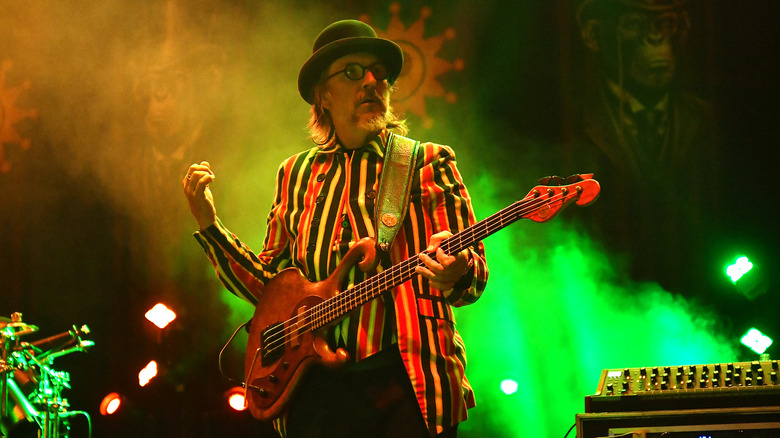
They say lightning never strikes the same place twice, and while that's not actually true, it definitely describes the bands we're looking at today. As we've discussed here on Grunge before, the best supergroups of all time are the ones that manage to find a sense of internal cohesion rather than just serving as a dumping ground for the best of the best to run off their lead licks and various unused riffs. When that happens, the results are truly unique, and all the more so for supergroups that came together only once in the recording studio.
So with that in mind, we wanted to take a look at the supergroups that came together only once and for something that stands out from their standard fare. Whether it's an all-star cast of the early '80s heavy metal underground or the British electric blues behemoth that started the supergroup phenomenon, these are the bands that had just one LP to their credit and made it count.
Gogmagog — I Will Be There
Gogmagog, whose lone release was the 1985 EP "I Will Be There," was certainly a supergroup, but producer Jonathan King had even greater aspirations with grand, theatrical visions for the project. Originally intended to feature Rainbow drummer Cozy Powell and Who bassist John Entwistle, the project eventually became a who's who of the New Wave of British Heavy Metal movement. Vocalist Paul Di'Anno and drummer Clive Burr, both formerly of Iron Maiden, are joined by former Def Leppard guitarist Pete Willis and ex-Whitesnake bassist Neil Murray. Rounding out the lineup was guitarist Janick Gers, who had recently left the band White Spirit, and who would go on to massive success as a member of Iron Maiden as well as Bruce Dickinson's solo band.
The short EP showcases a decidedly pop sensibility beneath the hard-rock accouterments, but the group remains engaged throughout. The project fell apart even before the EP was released, but the music therein is notable as it's one of the few instances of leading lights from the New Wave of British Heavy Metal getting to have the kind of all-star team interplay more commonly afforded to jam bands, jazz ensembles, and other genres where such experimentation is the norm. While Iron Maiden was on the path to becoming one of the richest metal bands in the world, their alumni and colleagues were cooking up a unique foray into heavy metal art-pop, and the results deserve to be remembered.
Blind Faith — Blind Faith
Blind Faith looms large over the very idea of the supergroup, having been one of the first rock bands to officially explore it. The ensemble of Cream's Eric Clapton and Ginger Baker (guitarist and drummer, respectively) alongside Traffic/Spencer Davis Group keyboardist Steve Winwood and Family bassist Ric Grech meshes together with a natural, fluid familiarity on the group's self-titled LP.
Blind Faith emerged as the collaborative vision of Clapton and Winwood following the disillusionment of Cream and Traffic. The music blends electric blues, jazz, and jam band elements and primarily serves as a window into the more mature chemistry that might have emerged between Clapton and Baker had Cream stayed together.
Despite tremendous public interest and massive media hype, Eric Clapton's supergroup vanished in a flash. The group played its first show to 100,000 attendees at London's Hyde Park, followed by additional dates in Europe before taking the stage at New York City's Madison Square Garden. Blind Faith opened to the kind of gigs most bands only dream of getting, but Clapton and company never felt like they were truly gelling together onstage. Thus, Blind Faith folded less than a year after its meteoric launch. The album that remains stands as a landmark, first-of-its-kind blueprint for future supergroups to follow.
Oysterhead — The Grand Pecking Order
Oysterhead and their lone album, 2001's "The Grand Pecking Order," bring together three leading lights of three seemingly divergent musical traditions. There's Trey Anastasio, guitarist and vocalist for the jam band behemoth that is Phish; Les Claypool, whose thundering slap bass and eccentric hillbilly vocals define Primus; and Stewart Copeland, the clean-cut but no less technically dazzling drummer for new wave pop rockers The Police. On paper, it shouldn't work, but on the recording, it pays off time and time again.
Initially planned as a one-time concert at the New Orleans Jazz Festival, the resulting jam proved so satisfying that Anastasio invited Claypool and Copeland out to The Barn, his legendary private studio, to track what would become the trio's only LP. The result brings together the three musicians' disparate worlds: Anastasio burns through the electrified bluegrass phrasing that makes Phish so endlessly listenable, Claypool tempers his white trash mad hatter routine for a more relaxed delivery, and Copeland kicks out laid-back but no less frenetic funk grooves with an afterthought ease that suggests he was balancing his checkbook in his head as he went. It's a masterclass in the cohesion that can happen when three players who respect one another just throw caution to the wind and let whatever happens happen.
Following a successful tour and promotional cycle, the group disbanded. They reunited for a couple of shows in the 2020s, but other than that, "The Grand Pecking Order" has been their one endlessly surrealistic creative statement.
Mad Season — Above
Mad Season stands alongside Temple of the Dog, another of rock's greatest supergroups, as a legendary pairing of talent from the Seattle grunge scene's leading bands — in this case, for 1995's "Above." Like Temple of the Dog, it affords an ensemble of normally dour, morbidly aggressive grunge rockers the opportunity to explore a more relaxed and reflective environment free of the moribund angst and belligerent riffage that defined the genre. Alice in Chains vocalist Layne Staley, Screaming Trees drummer Barrett Martin, Pearl Jam guitarist Mike McCready, and accomplished hired-gun bassist John Baker Saunders explore largely sedate, reflective, and even uplifting sonic avenues throughout the LP.
The most arresting facet of the material on "Above" is the stylistic range it affords to Staley in stark contrast to his primary band. Tracks like "I Don't Know Anything" have that signature Alice in Chains doom and gloom aura, but by and large, the tracks on offer sit comfortably inside rootsy blues and tastefully distorted folk rock. The shift in dynamic allows Staley to explore vocal techniques more reminiscent of Jim Morrison or Billy Squier than his usual grunge wail.
A planned follow-up release never materialized, and the future of the band was sealed when both Staley and Saunders passed unexpectedly. As it stands, the lone Mad Season album is a gently sculpted foray into previously untapped sonic realms for one of rock's most distinctive voices.
Colonel Claypool's Bucket of Bernie Brains — The Big Eyeball in the Sky
The convoluted name of Colonel Claypool's Bucket of Bernie Brains is a combination of the names of bassist/vocalist Les Claypool and drummer Bryan "Brain" Mantia of Primus fame; masked marvel guitarist Buckethead; and Parliament-Funkadelic keyboardist Bernie Worrell (apparently "Bernie" is an adjective?). Founded initially as a last-minute set-filler when Bill Laswell's Praxis (which featured Buckethead and Brain) was unable to perform at an outdoor festival, the group soon felt compelled to release a studio album in the form of 2004's "The Big Eyeball in the Sky."
What makes the group so captivating is that they manage to sound tight and integrated even as they appear to be actively working against any sort of logical cohesion. Each player sounds fully absorbed in their own sonic headspace, with Claypool throwing down his signature bass histrionics, Worrell covering a diverse array of jazz-fusion keyboard comping and prog-rock synth solos, Buckethead fluttering in and out of it all with dizzying leads, and Brain somehow holding it all together. The result comes off like what it would sound like if avant-garde surrealists like the Residents or Renaldo & the Loaf could kick a dope groove.
Although well-received, the album proved to be a one-off. As it stands, what began as a last-minute placeholder now stands as a fascinating meeting of some very strange minds.