

5 Classic Albums That Define Funk
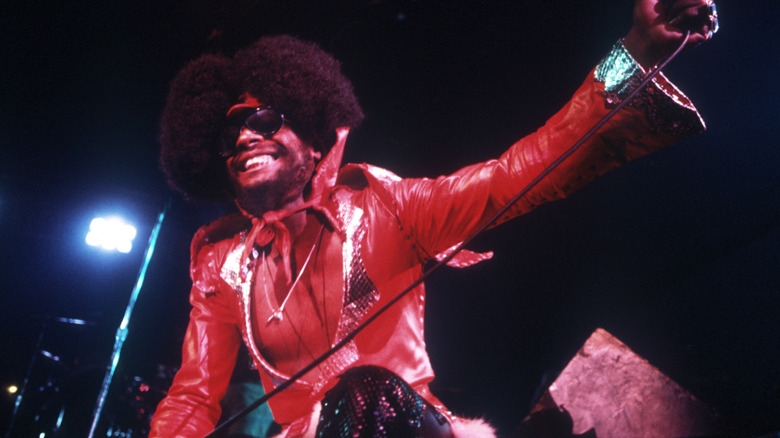
If you feel it, you know it, and you certainly can't fake it. It's funk, that infectious groove that blends elements of soul, jazz, gospel, R&B, and rock into a sound that gets you up out of your seat and moving on your feet. Emerging in the late 1960s, funk rose to stardom in the following decade before becoming neon-electrified in the 1980s. Thanks to pioneers like an unrepentant queen, a "prince" from Minneapolis, and a funky collective led by a star child, funk has given music fans some timeless albums that continue to influence the genre to this day.
Whittling down this genre to just five albums would be as foolish as trying to write a funk song whose rhythm doesn't start "on the one." There are so many acts of the '60s, '70s, and '80s with worthy albums. So, before you flip the funk out if your faves aren't here, the following list of albums is part of the genre's bedrock, but they are by no means its pinnacle. In fact, funk has never really left the conversation. While it might not always be in the spotlight, every once in a while, a song comes around to remind us that we're one nation, under a groove — and we have these albums to thank for that.
There's A Riot Going On — Sly and the Family Stone
In the wake of the turbulent social rights movement of the 1960s, Sly and the Family Stone released an album with a message. "There's A Riot Goin' On" is notably darker and less optimistic than their four prior LPs, and a distinct departure for the group that gave us "Everyday People," "Dance to the Music," and "Thank You (Falettinme Be Mice Elf Agin)."
"One child grows up to be / Somebody that just loves to learn / And another child grows up to be / Somebody you'd just love to burn," sings Stone on "Family Affair," the album's first single (and No. 1 hit on the Billboard Hot 100). Rolling Stone described the album "implosive, numbing, darkly self-referential" but "fiercely compelling in its anguish over the unfulfilled promises of civil rights and hippie counterculture." The album also showed that funk could be political and revolutionary. It wasn't always about the party.
When celebrating "There's A Riot Going On" turning 50, Nile Rodgers told The Guardian that the album's message to young Black America was "one of positivity. A lot of the problems that we were facing — and unfortunately continue to face — we were starting to talk about and deal with directly in our pop music. Black artists traditionally didn't have the freedom to do that, unlike white artists, but now Sly was at the vanguard of that."
They Say I'm Different — Betty Davis
While many artists have been called "ahead of their time," Betty Davis was truly a pioneer. With sexually provocative lyrics and a stage presence to match, Betty (who spent a turbulent year married to Miles Davis) was an unrepentant sexual icon credited with blazing a trail that many other boundary-pushing artists followed. "I wrote about love, really, and all the levels of love," she told The New York Times in 2018. "When I was writing about [sexuality], nobody was writing about it. But now everybody's writing about it. It's like a cliché."
Betty released a self-titled debut album in 1973, but her sophomore release, 1974's "They Say I'm Different," is arguably her best. With songs like "He Was a Big Freak," "Git In There," and the title track, Betty Davis crafted an experience that was funky, sensual, raunchy, and undeniably powerful. It was funk from the female perspective, a rarity in those days. "I used to make the guys uptight sometimes," she told The New York Times. "The women were very receptive with me."
While nowhere as commercially successful as her peers, "They Say I'm Different" is a retroactively radical album, one that feels more at home today than it did when it first came out. The echoes of Ms. Davis's work can be heard in modern R&B and pop.
Mothership Connection — Parliament
Theoretically, we could have chosen Funkadelic's "Maggot Brain" (the album where George Clinton made an odd request to guitarist Eddie Hazel). We'll go with "Mothership Connection" by their sister band, Parliament. Though both bands shared members and had Clinton at the helm, Funkadelic ironically leaned more towards funk's psychedelic rock aspects.
Parliament took funk to a cosmic level on 1975's "Mothership Connection," an album that changed the band's image and artistic direction. "My dream, up until then, had always been to be able to do a funk opera," Clinton told Splice. "So, I said, 'Where's the next place you don't see [Black people] at?' And that was basically outer space. ... [S]o, the 'Mothership Connection' was that funk opera — and while making it, we weren't tied down to this planet for a minute."
While other funk bands were more grounded in their approach, Parliament went far out on "Mothership Connection." You could probably credit this album for popularizing all the funk band stereotypes: the outlandish costumes and slightly absurd lyrics. You can also credit this album for being the soundtrack to thousands of parties. It's a big bang of funk, with Clinton's larger-than-life personality guiding a group of phenomenal players, including two former members of James Brown's band (Maceo Parker and Fred Wesley), Bootsy Collins, Bernie Worrell, and Cordell Mosson.
The Payback — James Brown
Both funk music and "blaxploitation" surged in the '70s. So it's no surprise that the stylistic cinematic subgenre, with films like "Sweet Sweetback's Baad Asssss Song," "Cleopatra Jones," and "Dolemite," would make use of this new sound for its soundtrack. It's also why Curtis Mayfield's soundtrack to 1972's "Super Fly" and Issac Hayes' work on 1971's "Shaft" are considered pillars of the funk genre, and not just incredible soundscapes to radical films. James Brown had already contributed two soundtracks — 1972's "Black Ceaser" and 1973's "Slaughter's Big Rip Off" — and almost pulled off the hat trick with 1973's "Hell Up in Harlem."
However, the film's producers rejected it, calling it "the same old James Brown stuff" (per uDiscover). Brown claimed the film's director, Larry Cohen, told him that the music "wasn't funky enough," though they later denied that. At the time, Brown was nearly 20 years and over 40 albums into his career. It seems that the film's producers thought "The Godfather of Soul" and one of funk's progenitors had fallen behind those he influenced.
So, Brown decided to enact some revenge: he repurposed the soundtrack into a 1973 double album titled "The Payback," an album that some consider to be Brown's best, most complete album. Tightened, focused, and funky, the album revitalized Brown's reputation, giving him an incredible shot of funk gold in the back half of his career.
1999 — Prince
Funk didn't fade away when the calendar rolled over into the 1980s. Quite the opposite — Prince brought the sound into the mainstream, making its grooves and rhythms part of the larger pop pantheon. With "1999," released in October 1982, Prince took the groove of his funk forefathers, the sexuality of the underground, and merged them together into a package that could be played on the radio. "There was no way the pop audience could resist '1999,'" wrote Rolling Stone's Rob Sheffield. "Prince ended up becoming a big-time star with his artiest, most extreme, most demanding music."
The title track is a perfect example: with a signature synth line, a dark subject matter, and an undeniable groove, "1999" and its corresponding album brought funk into the new decade in a way no one expected. The album produced a handful of Top 10 Billboard 100 hits ("Little Red Corvette," "Delirious") while the album went to No. 7 on the albums chart. Prince had arrived.
Prince would exceed this success two years later with the earthshaking "Purple Rain," but "1999" marks the evolution of funk. It is also highly influential, showcasing the "Minneapolis Sound," that blend of rock guitar solos, funky basslines, and new wave synths. Prince popularized the sonic movement and cultivated it with protégé projects like Morris Day and the Time, Jill Jones, and Sheila E.